Flower Tattoo Designs: Meanings, Indian Flowers and What Ages Well
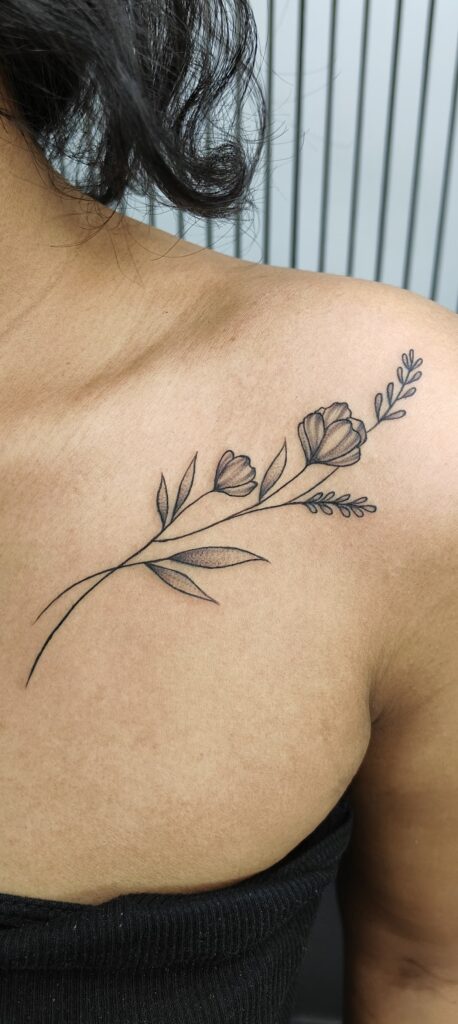
Flowers are the most tattooed subject in the world, and almost everyone picks one for how it looks rather than what it says. That is fine — but it means a lot of people are wearing a meaning they never chose.
There is also a gap worth pointing out. Nearly every flower tattoo guide you will read is written for a Western audience: roses, peonies, sunflowers, forget-me-nots. Very few mention the flowers that actually mean something in an Indian home — marigold, jasmine, lotus, hibiscus, parijat. Those carry as much meaning as any rose, and they look wonderful on skin.
If you are looking at flower tattoo designs, this covers what each bloom means, which ones suit Indian skin and Indian lives, and what actually survives on skin. We are Vulture Tattoos, an appointment-only studio in Sector 47, Gurgaon.
Indian flowers — the ones nobody writes about
- Marigold (genda). The flower of every Indian festival, wedding and temple. It means auspiciousness, celebration and devotion. Visually it is superb for tattooing — dense layered petals give an artist real texture to work with, and its orange holds beautifully on Indian skin.
- Jasmine (mogra / chameli). Purity, simplicity and love. It carries a strong association with mothers and grandmothers for a lot of people — the smell of a gajra. Small, delicate, and it suits fine-line work.
- Lotus (kamal). Rising clean from muddy water. Spiritual growth, rebirth and purity, and it appears in both Hindu and Buddhist tradition. Our lotus tattoo guide covers it in full, because it deserves its own page.
- Hibiscus (gudhal). Offered to Kali and Ganesha. Bold, large-petalled and striking in colour.
- Parijat (night-flowering jasmine). Deeply loved in Bengali and Odia tradition, associated with Krishna. Small white flowers with orange stems — beautiful and almost never tattooed.
- Champa (frangipani). Temple flower, associated with devotion and with South and Southeast Asian tradition.
- Sunflower. Not native, but hugely popular here. Loyalty, positivity, turning towards the light.
The classics, and what they actually mean
- Rose. Love, but the colour changes it — red for passion, white for remembrance, black for grief or endings. Our rose tattoo guide covers the most requested flower in detail.
- Peony. Prosperity, honour and boldness. Enormous in Japanese work — see our Japanese tattoo guide.
- Cherry blossom (sakura). Beauty precisely because it does not last. The falling petals are the meaning.
- Chrysanthemum. Longevity and, in Japan, imperial associations.
- Lily. Purity and renewal; also a traditional funeral flower, which some people choose deliberately for a memorial.
- Orchid. Rare beauty, refinement, strength.
- Daisy. Innocence and new beginnings. Simple shapes that hold up very well.
- Poppy. Remembrance and rest.
- Tulip. Declaration of love; a gentler alternative to a rose.
- Birth-month flowers. A personal way to represent people without using names — increasingly requested for family pieces.
Styles, and which suits you
- Fine-line botanical. Delicate outlines, minimal shading. The most requested style right now. Beautiful, and it needs honest sizing — see our fine line tattoo guide.
- Black and grey realism. Full tonal shading, petal by petal. Ages very well and holds contrast on every Indian skin tone — see our black and grey guide.
- Colour realism. The full palette. Stunning, with a caveat covered below.
- Watercolour. Soft washes and bleeding colour — see our watercolour tattoo guide.
- Neo-traditional. Bold outlines with rich colour. One of the best-ageing styles there is.
- Dotwork and ornamental. Flowers built into mandala geometry — see our mandala guide.
- Silhouette. Solid black flower shapes. Simple and extremely durable.
Colour on Indian skin — the honest bit
Flowers are the design people most often want in colour, so this matters.
Deep, saturated colours read beautifully on medium and deeper Indian skin — deep reds, oranges, emerald greens, rich purples, strong yellows. Marigold orange and hibiscus red are genuinely well suited.
What struggles is the opposite end: pale pastels, soft pinks, light lilacs and anything washed-out. There is simply less contrast between a pale pigment and the skin beneath it, so those tones read faint once healed and fade first. A great deal of the floral tattoo inspiration online is photographed on very fair skin, where pastels behave completely differently.
This is not a limitation — it is a palette choice. A marigold in deep saturated orange looks better on Indian skin than a pastel peony ever will. Our colour tattoo guide covers this properly.
What makes a floral tattoo last
Flowers have a specific weakness: petals overlap, and the narrow gaps between overlapping petals are the first thing to close as ink settles over the years. Once two petals merge, the flower stops reading as separate petals and becomes a shape.
- Generous gaps between petals. The single biggest factor. This is what your artist means when they say a design needs to be bigger.
- Fewer petals, drawn better. A flower with eight well-spaced petals outlives one with twenty crammed together.
- Some dark value somewhere. Pure hairline outline with no solid areas has nothing holding it together long term.
- Honest size. A detailed rose at 3 cm loses its structure within a decade.
- Stems and leaves help. They give the composition structure and let the flower breathe rather than filling every millimetre.
Where flowers sit best
- Inner or outer forearm. The best all-round placement. Flat, low friction, ages well.
- Upper arm and shoulder. Comfortable, easy to cover, good curve for a spray.
- Collarbone. Elegant for a trailing spray — see our collarbone guide.
- Spine. A vertical vine down the back — see our spine tattoo guide.
- Thigh. Roomy, comfortable, easy to keep out of the sun. Ideal for large detailed work.
- Ribs. A trailing botanical suits the vertical space — see our rib tattoo guide.
- Ankle and wrist. Popular, but the highest friction and sun. Keep these simple.
Does it hurt?
The same as any tattoo of that size in that place — the subject changes nothing. Outer forearm, upper arm and thigh are the most comfortable. Ribs, collarbone, ankle, spine and sternum are sharper.
A single small flower is a short session. A large colour piece or a floral sleeve takes hours and may be split across sittings. Our tattoo pain chart covers every placement.
Want to talk it through? Call or WhatsApp us on +91 96676 14250 or message us on WhatsApp.
Healing and aftercare in Gurgaon
- Keep the wrap on as long as your artist says, then wash gently with lukewarm water and mild fragrance-free soap.
- Pat dry, do not rub. Rubbing fresh colour work pulls pigment straight out.
- Thin layer of balm. Thin is the word.
- Do not pick or scratch. A lost patch inside a petal needs a touch-up.
- No swimming, sauna, gym sweat or soaking for two to three weeks.
- Keep it moisturised well past the peeling stage.
If your flower is in colour, sun protection is not optional here. UV breaks down coloured pigment faster than black, and reds, oranges and yellows go first — exactly the colours a marigold or hibiscus depends on. Use SPF 30 or higher once healed. Our full aftercare guide for Gurgaon covers each stage.
Why the artist matters
Flowers look forgiving and are not. A petal is a curved shape with a specific relationship to every petal around it, and if those relationships are slightly wrong the flower looks like a generic bloom rather than a rose, a marigold or a lotus.
The other skill is knowing what to leave out. A good artist simplifies a reference deliberately at the drawing stage so it survives, rather than copying every petal and letting time remove them unevenly.
Ronny specialises in fine-line, botanical, script and geometric work — botanical is literally his listed speciality. Ajay handles realism, devotional, portrait and cover-up work, which covers shaded and colour-realism florals. Our page on the tattoo artists in Gurgaon introduces both.
Every tattoo is done with single-use sterile needles opened in front of you, in an appointment-only studio. That is part of why our clients have left more than 270 five-star Google reviews.
Why book in Sector 47
Vulture Tattoos is at Shop F-04, Spaze Boulevard, Malibu Towne, Sector 47, Gurugram. Easy to reach from across Gurgaon, DLF, Sohna Road, Golf Course Road and South Delhi.
Book your floral tattoo: call or WhatsApp +91 96676 14250. See our work on Instagram at @vulture_tattooz, or reach us through our contact page.
Frequently Asked Questions
Which Indian flowers work well as tattoos?
Marigold, jasmine, lotus, hibiscus, parijat and champa all work beautifully and carry real meaning here. Marigold is particularly good for tattooing — dense layered petals give an artist texture to work with, and its deep orange holds well on Indian skin. These are rarely covered in Western tattoo guides, which is a shame.
What does each flower mean?
Marigold is auspiciousness and celebration; jasmine is purity and simplicity; lotus is spiritual growth and rebirth; rose is love, with the colour changing the meaning; peony is prosperity; cherry blossom is beauty because it ends; lily is purity and remembrance; sunflower is loyalty and positivity. Birth-month flowers are a lovely way to represent people without names.
Which colours work best on Indian skin?
Deep saturated shades — rich reds, oranges, emerald greens, purples and strong yellows. Marigold orange and hibiscus red are genuinely well suited. Pale pastels, soft pinks and light lilacs struggle, because there is less contrast against the skin, so they read faint once healed and fade first.
How big does a flower tattoo need to be?
Bigger than most people first want, because petals overlap and the narrow gaps between them close first as ink settles. Once two petals merge, the flower stops reading as petals. Fewer petals with generous spacing outlasts many petals crammed together — which is why an artist asking for another centimetre is protecting the tattoo.
Fine-line or bold for a floral tattoo?
Fine-line looks beautiful fresh, but pure hairline work with no solid areas has nothing holding it together over decades. The versions that age best keep some dark value somewhere — a heavier outline on the main bloom, a solid leaf, or dotwork shading. A slightly bolder floral still reads clearly in twenty years.
Which flower is best for a first tattoo?
A single simple bloom with clean shapes and space around it — a daisy, a small lotus, a single rose, or a jasmine sprig. Put it on the inner or outer forearm, keep it modest in size, and it will be a short comfortable session. Our first tattoo guide walks through the whole day.
Can I combine several flowers in one tattoo?
Yes, and family pieces using birth-month flowers are increasingly popular. The one rule is space — three flowers crammed into a small area will merge into a shape within a decade. Either go larger, or pick two and give them room. We will tell you honestly at the design stage which your placement allows.
How do I book and how much will it cost?
Booking is by appointment. Call or WhatsApp +91 96676 14250 to arrange a consultation. We discuss the flowers, style, colour, size and placement, and give you a clear written quote once the details are settled. Pricing depends on size, detail and time, so we quote in person rather than online.