Black and Grey Tattoo in Gurgaon: Why It Ages Best on Indian Skin
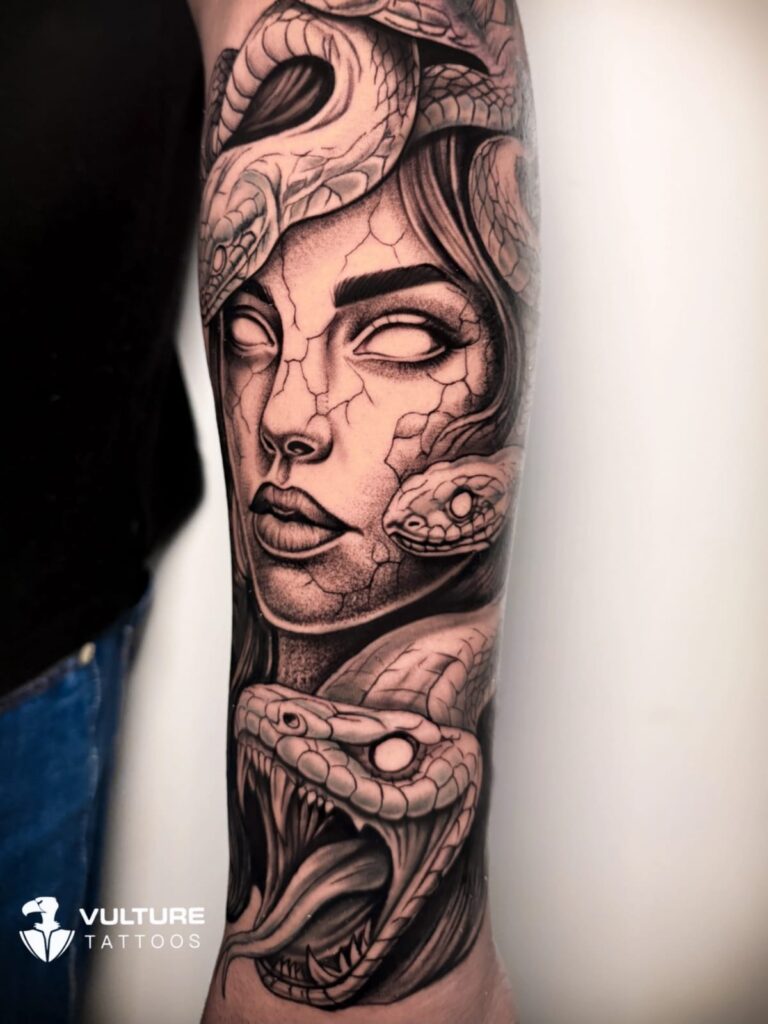
Ask most people what black and grey means and they will tell you it is a tattoo without colour. That is true in the same way that a black-and-white photograph is a photograph without colour — technically correct, and it completely misses what the thing actually is.
Black and grey is a style built entirely on contrast. There is no colour to carry the image, so every bit of depth, every curve, every sense of light falling across a surface has to come from how dark one area is next to another. Get that right and it looks like the tattoo has weight and dimension. Get it wrong and it looks flat and grey — literally. If you are considering a black and grey tattoo in gurgaon, this guide covers how the style actually works, why it holds up better than anything else on Indian skin in this climate, and what separates work that still looks sharp in twenty years from work that goes soft in five. We are Vulture Tattoos, an appointment-only studio in Sector 47.
What black and grey actually is
The greys are not a separate ink. They are black ink diluted — traditionally with distilled water, in a series of progressively lighter washes. An artist builds a set of tones from solid black through to the faintest wash, then uses that range the way a pencil artist uses pressure.
That is the whole craft. Where you place the darkest black and where you leave skin untouched is what creates the illusion of a jaw, a petal, a fold of cloth, or light hitting water. Skin itself becomes the lightest value in the piece, which is why good black and grey uses negative space so deliberately.
There are two broad approaches:
- Greywash. Smooth, blended, photographic. Soft transitions between tones, minimal or no outline. This is what most realism uses.
- Black and grey with structure. Bold outline, then shading inside it. More graphic, more durable, and easier to read from a distance.
Neither is better. They age differently and they suit different subjects, and choosing between them is one of the first real decisions at your consultation.
The sub-styles worth knowing
“Black and grey” covers a wide family, and knowing roughly where your idea sits helps enormously.
- Black and grey realism. Portraits, animals, religious figures, hands, eyes, cloth. The most demanding work in the style and the reason many people come to it. Needs size and needs a specialist.
- Blackwork. Heavy solid black shapes, high contrast, often graphic or ornamental. Extremely durable because there is so much pigment holding the design.
- Dotwork and stippling. Tone built from thousands of individual dots rather than smooth shading. Slow, meditative, beautiful on geometric and ornamental work — see our mandala tattoo guide for where this fits.
- Sketch style. Deliberately loose, unfinished-looking linework that mimics a pencil sketch, sometimes with construction lines left visible.
- Chicano. Fine single-needle greywash, script, roses, religious imagery, clocks. Delicate and distinctive.
- Single needle / micro-realism. Very fine detail at small scale. Stunning fresh, and the least durable option in the family — worth understanding the trade-off before choosing it.
- Blackout. Large areas filled solid black, sometimes with negative-space designs inside. A serious commitment and effectively permanent.
Why black and grey suits Indian skin so well
This is the part that genuinely matters here and that almost nobody explains properly.
Colour tattooing on medium and deeper skin has a real constraint: your skin has its own undertone that sits over every pigment. Pale colours have less contrast against deeper skin, so they read faint or muddy once healed. That is not a flaw in the skin, it is simple optics, and it is why a good artist plans a colour palette around the person in front of them.
Black and grey has none of that problem. Black pigment reads as black on every skin tone on earth. The greys are just less of the same pigment. The style’s entire language is contrast, and contrast is available to everyone.
- Nothing gets lost. There is no pigment that “does not show up” on your skin.
- Depth comes from tone, not hue. So the effect you see in the reference is the effect you get.
- The lightest values are your own skin. Which means the piece is designed around your skin instead of fighting it.
One honest technical note: on deeper skin tones the artist works with a slightly compressed tonal range at the light end, because very pale washes have less contrast against the skin to work with. A skilled artist plans for that by pushing the darks harder and using cleaner negative space, so the piece reads with more punch rather than less. An unskilled one just shades lighter and lighter until the top end disappears. This is exactly the sort of thing that gets decided in person, on your actual skin, in real light.
If you want to compare the two routes properly, our page on colour tattoos in Gurgaon covers how pigment behaves on Indian skin in detail.
Why it is the most durable style there is
If you asked a room of tattoo artists which style holds up best over thirty years, most would say black and grey without hesitating.
- Black pigment is the most stable. It is dense, it resists UV better than coloured pigments, and it does not shift hue as it ages the way some colours do.
- There is no colour to fade unevenly. On a colour piece, pale yellows and pastels go first, which unbalances the whole design. In black and grey, everything softens together and the composition stays intact.
- Contrast survives. As long as the darks were laid solid, the piece keeps reading even after decades of gentle softening.
But durability is not automatic, and this is the honest bit. The two things that ruin black and grey over time are insufficient contrast and too much detail at too small a size. A piece shaded entirely in mid-greys with no true blacks looks soft on day one and washed out in five years. A micro-realism portrait the size of a matchbox will lose its finest detail as pigment settles, because those details were smaller than the skin’s own margin for spread.
When we tell you a design needs to be bigger, or that it needs stronger darks than the reference photo has, we are not padding the job. We are protecting the tattoo.
Cover-ups — the black and grey workhorse
Black and grey is the most reliable tool for reworking an old tattoo, because dense dark value can carry a new design over existing ink in a way pale colour never can. Blackwork elements and strong greywash shading can absorb an old outline into a new composition entirely.
Ajay handles our realism, devotional, portrait and cover-up work, so black and grey rework is squarely his territory. If you have something you want to change, our tattoo cover-up in Gurgaon page goes into what is and is not possible with different kinds of existing work.
Best placements
Black and grey is more placement-forgiving than colour, because it is less vulnerable to sun. Still, some spots serve it better than others.
- Forearm and inner forearm. Flat, visible, and gives realism the room it needs. One of the best canvases in the style.
- Upper arm and shoulder. Naturally protected, easy to keep covered, good curve for flowing compositions.
- Upper back and shoulder blade. A large flat canvas with minimal friction, ideal for big detailed work.
- Chest. Excellent for symmetrical or portrait work, with plenty of surface for tonal range.
- Thigh and calf. Comfortable to sit through and easy to protect from sun.
- Ribcage. Dramatic, though tender, and skin movement means composition needs care.
Placements we would gently steer you away from for fine greywash: hands, fingers and feet. Constant friction and washing blur delicate shading fastest there. Bold blackwork can survive those spots far better than soft greywash can, so if your heart is set on a hand piece, the style choice within black and grey matters enormously.
Does it hurt?
The same as any tattoo of the same size in the same place. Style does not change pain — placement and duration do.
Fleshier areas like the outer thigh, upper arm and calf are the most comfortable. Ribs, sternum, spine, ankles and the tops of the feet are sharper. What is specific to black and grey is that large shaded areas mean more passes over the same skin, so a heavily shaded piece can feel like a longer, warmer session than a line piece of the same size. It is a dull persistent heat rather than a sharp sting, and most people find it very manageable once they settle in. We pace the work and take breaks.
Ready to talk through your idea? Call or WhatsApp us on +91 96676 14250 or message us on WhatsApp and we will help you plan a piece built to last.
Healing and aftercare, with a Gurgaon twist
Black and grey is more forgiving than colour in healing, but the rules are the same and a bad heal still costs you contrast.
- Keep the initial wrap on for as long as your artist advises, then wash gently with lukewarm water and a mild fragrance-free soap.
- Pat dry, never rub. Rubbing a fresh shaded area can lift pigment.
- Apply a thin layer of the recommended balm. Thin is the word. Over-applying softens scabs and pulls ink out with them.
- Do not pick or scratch. Heavily shaded areas scab more than linework, and a picked scab leaves a light patch right where you needed depth.
- No swimming, saunas, gym sweat or soaking for the first two to three weeks.
- Keep it moisturised well past the peeling stage, with a plain unscented moisturiser.
Now the local part. Black and grey handles Gurgaon’s sun better than colour does, but “better” is not “immune”. UV still breaks black pigment down over years, and the first thing to go is the subtlety in the light greys — exactly the part that gives a piece its depth. Once healed, use SPF 30 minimum, 50 is better, every time it is exposed, and cover it on long outdoor days. Dry skin also makes black and grey look dull even when the ink underneath is perfectly fine, so daily moisturiser genuinely changes how your tattoo looks. Our full tattoo aftercare guide for Gurgaon covers every stage.
Why the artist matters most
In colour work, a strong palette can carry a mediocre composition. In black and grey there is nothing to hide behind. Every value decision is visible, and the difference between a piece that looks three-dimensional and one that looks like a grey smudge is entirely in how the artist handled contrast.
A skilled black and grey artist knows how to keep the darks genuinely dark rather than settling for a safe mid-grey, how to lay smooth transitions without patchiness, how to use your skin as the highlight instead of trying to paint one in, and how much detail will actually survive at the size you have chosen. An inexperienced one gives you a flat, muddy piece that reads as “grey” instead of “black and grey”.
Ajay is our realism, devotional, portrait and cover-up specialist, which makes black and grey realism his core work. Ronny specialises in fine-line, botanical, script and geometric work, which covers the dotwork, blackwork and ornamental side of the style. If you want to see how their tonal work reads healed rather than fresh, our page on the tattoo artists in Gurgaon introduces both of them, and our realism tattoo guide explains how to judge realism work properly.
Every tattoo is done with single-use sterile needles opened in front of you, in an appointment-only studio, which is part of why our clients have left more than 270 five-star Google reviews.
Custom design, made for your skin
- Consultation. You bring the idea and any references. We talk subject, size, placement and which approach within black and grey suits it, and we look at your actual skin in real light.
- Design. We build the piece around where the darks need to sit and where your skin will do the work as highlight, and size it so the detail survives. You see it before any needle touches you.
- A written quote at consultation. Once design and size are settled, you get a clear written quote. No surprises. Our tattoo cost guide for Gurgaon explains what shapes the number.
- The session. Sterile, paced, and split across sittings if the piece needs it.
- Aftercare and touch-ups. A clear plan, and we are on WhatsApp while it heals.
The local angle: why book in Sector 47
Vulture Tattoos sits at Shop F-04, Spaze Boulevard, Malibu Towne, Sector 47, Gurugram, easy to reach from across Gurgaon, DLF, Sohna Road, Golf Course Road and South Delhi. Being local matters for tonal work because contrast is the thing that occasionally wants refreshing years down the line, and having the artist who built the piece do that refresh keeps the values consistent instead of guessed at.
Appointment-only means the studio stays calm and quiet during the long, focused sittings that shaded work needs, and that your design gets proper planning time rather than being fitted around walk-in traffic.
Book your black and grey tattoo: call or WhatsApp +91 96676 14250 to start with a consultation. Bring the idea, we will handle the rest.
See our work and get in touch
Tonal work has to be seen to be judged, and ideally seen healed rather than fresh, so browse our recent pieces on Instagram at @vulture_tattooz, read more about the studio at Vulture Tattoos, or reach out through our contact page. When you are ready, call or WhatsApp us on +91 96676 14250 and we will help you plan a black and grey tattoo in gurgaon that still has depth in twenty years.
Frequently Asked Questions
Does black and grey last longer than colour?
Generally yes. Black pigment is denser and more UV-resistant than coloured pigment, and because there is no colour to fade unevenly, the whole piece softens together instead of losing its balance. That said, durability comes from strong contrast and honest sizing, not from the absence of colour alone. A piece shaded entirely in mid-greys with no true blacks will look washed out regardless of style.
Is black and grey better for Indian and darker skin tones?
It is the easiest style to get right on any skin tone, yes. Black reads as black on every skin, so nothing gets lost the way pale colours can on medium and deeper skin. The one adjustment a good artist makes is pushing the darks harder and using cleaner negative space, because the very lightest washes have less contrast to work with. Done that way, it reads with more punch, not less.
What is greywash?
Greywash is black ink diluted into a series of progressively lighter tones — the artist’s equivalent of a pencil’s pressure range. Those washes are what create smooth shading, depth and the illusion of light. There is no separate grey ink; every tone in the tattoo is the same black pigment at a different dilution, with your own skin acting as the lightest value.
Can black and grey cover an old tattoo?
It is the most reliable cover-up approach available, because dense dark value can carry a new design over existing ink in a way pale colour cannot. Blackwork elements and strong greywash can absorb an old outline into a new composition entirely. Very dark, heavily saturated originals are harder and sometimes want a few laser sessions first. Bring it in and Ajay will tell you honestly what is possible.
Does a black and grey tattoo hurt more?
No more than any tattoo of the same size in the same place. What is specific to the style is that large shaded areas mean more passes over the same skin, so a heavily shaded piece can feel like a longer, warmer session than a line piece. It is a dull persistent heat rather than a sharp sting, and we pace the session and take breaks.
How small can a black and grey realism piece be?
Smaller than you think, but not as small as you want. Fine detail at very small scale is the main reason black and grey work ages badly — those details are smaller than the skin’s natural margin for pigment spread, so they close up over the years. We will always tell you the honest minimum size for the level of detail in your reference, and we would rather have that conversation at the consultation than at a touch-up appointment.
Will my black and grey tattoo turn blue or green?
Modern quality black inks do not. That greenish-blue tint you see on very old tattoos came from older pigment formulations that shifted as they broke down. We use quality inks chosen for stability and longevity, and a well-laid black stays black. Fading, when it happens, shows as softening contrast rather than a colour shift.
How do I book and how much will it cost?
Booking is by appointment. Call or WhatsApp us on +91 96676 14250 to arrange a consultation, where we discuss the design, placement and size, and give you a clear written quote once the details are settled. Pricing depends on size, detail and time, so we quote in person rather than online.