Japanese Tattoo in Gurgaon: Irezumi Motifs, Meaning, Sleeves & Sessions
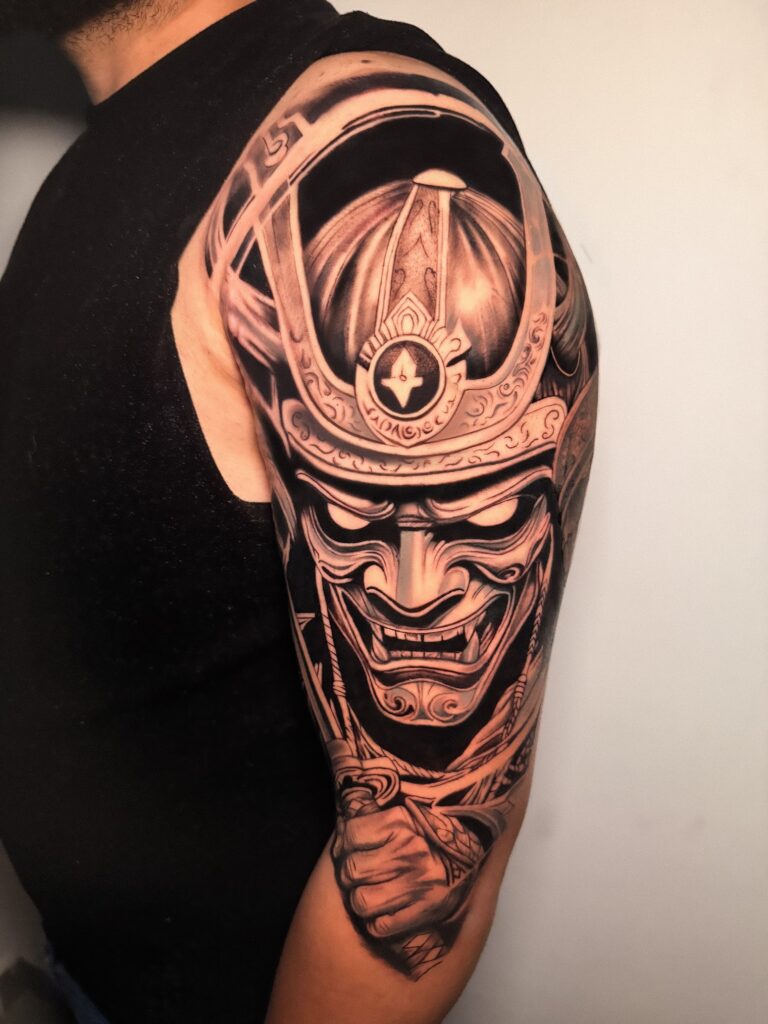
Japanese tattooing is the only major style with a rulebook. Not a strict one, not a rulebook anybody enforces, but a few hundred years of accumulated logic about which creatures go with which flowers, which direction water flows, and why a dragon sits the way it does on a shoulder. Learn a little of it and a Japanese piece stops looking like a collection of cool images and starts looking like one thing.
That is also why it is the style people most often get wrong. A koi from one reference, a hannya mask from another, cherry blossom because it looked nice, all crammed onto a forearm with no background — technically a tattoo, but it will never settle into anything. If you are looking for a japanese tattoo in gurgaon, this guide covers what the style actually asks of you, what the motifs mean, and how a piece is planned so it holds together for the rest of your life. We are Vulture Tattoos, an appointment-only studio in Sector 47.
What irezumi actually is
Irezumi is the traditional Japanese tattooing style that took its modern form in the Edo period, heavily influenced by ukiyo-e woodblock prints. What separates it from almost every other style is that it is compositional. The subject is never alone. It sits inside a designed environment of water, wind, clouds or smoke that fills the space around it and ties the whole piece to the shape of the body.
That background is not decoration. It is the thing that makes the style work. It creates flow, it gives the piece a direction, it lets a design wrap a limb without looking pasted on, and it is the reason a well-built Japanese sleeve still looks intentional from across a room after thirty years.
The technical hallmarks follow from that: bold, confident outlines, solid saturated colour or deep black and grey, and large scale. All three are also why the style ages better than nearly anything else. Heavy outlines contain the colour as pigment spreads over decades, and large scale means detail has room to survive.
The motifs, and what they actually mean
These are not interchangeable. Choosing motifs that belong together is most of what makes a piece read as authentic rather than assembled.
- Koi. Perseverance and determination, from the legend of the carp that swam up a waterfall and became a dragon. Direction matters in the traditional reading — a koi swimming upstream is still striving, downstream has arrived. Almost always paired with water and often with lotus or maple.
- Dragon (ryu). Wisdom, strength and protection. The Japanese dragon is a benevolent water deity, not the hoarding western beast. Usually paired with clouds, wind bars or waves, and it suits a full sleeve or back piece where it can properly coil.
- Tiger (tora). Courage and protection against bad luck and disease. Traditionally the counterpart to the dragon, often shown with bamboo or wind.
- Phoenix (ho-o). Rebirth, triumph, rising after loss. Fire and flowing feathers give it enormous movement, ideal for a back or a full sleeve.
- Hannya mask. From Noh theatre — a woman consumed by jealousy and grief, transformed into a demon. Its meaning is far sadder than most people realise, and it is often used as a protective symbol. Worth knowing before you wear it.
- Oni. Demons and ogres. Guardians and punishers of the wicked as often as villains.
- Samurai. Honour, discipline, loyalty, the code. Suits large panels where armour detail has space.
- Cherry blossom (sakura). The beauty of things because they end. Falling petals are the whole point — the impermanence is the meaning.
- Chrysanthemum (kiku). Longevity, and imperial associations. A perfect filler flower that carries real weight.
- Peony (botan). Wealth, prosperity, boldness. Often paired with the lion-dog, and one of the great background flowers.
- Waves, wind bars and clouds. The connective tissue. These are what carry the eye around the arm and make the composition breathe.
Some pairings are traditional and read correctly: dragon with clouds, koi with water and maple leaves, tiger with bamboo, phoenix with fire, samurai with wind bars. Some combinations simply do not sit together, and a good artist will say so at the consultation rather than after the outline is in.
Traditional versus neo-Japanese
You do not have to be a purist, and most of what we do sits somewhere in the middle. It helps to know where you want to land.
Traditional irezumi follows the conventional palette, the conventional motif pairings and the conventional background rules. Restrained, timeless, and it looks correct to anyone who knows the style.
Neo-Japanese keeps the composition, the bold outlines and the flow, but takes liberties — a wider colour range, more realistic rendering inside the shapes, occasional modern subjects. Still holds together, still ages well, because the underlying structure is intact.
What does not work is taking Japanese subjects and dropping the structure — no background, no flow, arbitrary scale. That is the version that looks unfinished forever.
It is a project, not an appointment
This is the honest part, and it is the thing to be clearest about before you start.
A Japanese sleeve or back piece is many sessions over many months, sometimes over a year or more. That is not a studio stretching the work out. It is physically how large-scale tattooing happens: your body will not take twelve hours in a row, ink will not settle properly if it is rushed, and each area needs to heal before the next stage is built on it.
- Plan the whole composition first, even if you build it slowly. Japanese work fails when it is added to piecemeal without a map. The background has to be planned from day one, or it will never connect.
- Outline first, then colour and background. The structure goes down early and the piece fills in over subsequent sessions.
- Expect an in-between stage where it looks half-finished. It will, because it is. This is normal and temporary.
- Book with continuity in mind. The same artist finishing what they started matters enormously in this style, because line weight and background rhythm have to stay consistent.
If you want to understand how multi-session work is quoted before you commit, our guide to tattoo cost in Gurgaon explains how size, detail and time come together. And if you are thinking specifically about arm coverage, our sleeve tattoo in Gurgaon page covers quarter, half and full sleeve planning in detail.
Where Japanese work sits best
This style wants space. It rewards big canvases and struggles on small ones.
- Full sleeve. The classic. The arm’s shape suits a coiling dragon or a rising koi, and the background can wrap naturally.
- Back piece. The largest single canvas on the body and the traditional home of the most ambitious work. A phoenix or dragon across the full back is the style at its best. Our back tattoo in Gurgaon page covers session planning for pieces this size.
- Chest panels. Traditionally worked as symmetrical panels, often as part of a larger body suit.
- Thigh and calf. Excellent large canvases, comfortable to sit through, and easy to keep out of the sun.
- Half sleeve (shoulder to elbow). The most practical starting point. Big enough for a proper composition, and it can be extended later if the plan allows for it.
Placements we would steer you away from: small isolated spots. A four-inch dragon on a forearm with no background is not a Japanese tattoo, it is a picture of a dragon. If the space available is small, we would rather build you something in a style that suits small scale than shrink irezumi past the point where it works.
Colour, black and grey, and Indian skin tones
Both routes are traditional. Colour irezumi uses deep reds, strong blues, greens and golds. Black and grey — sometimes called sumi style — uses the same composition with tonal shading instead.
On Indian and South Asian skin, both work well, but the palette needs choosing deliberately. Deep, saturated colours — strong blues, emerald greens, deep reds, rich purples and warm oranges — hold their contrast beautifully on medium and deeper skin tones. Pale pastels and very light washes are the ones that read faint once healed, and they are not part of the traditional Japanese palette anyway, which is one reason this style suits Indian skin so naturally.
Black and grey Japanese work is worth serious consideration here. It has enormous depth, it holds contrast on every skin tone, and it is the most durable option in strong sun. Our page on colour tattoos in Gurgaon goes deeper into how pigment behaves on Indian skin.
Does it hurt?
The style itself does not change the pain — placement and duration do. Fleshier areas like the outer thigh, upper arm and calf are the most comfortable. Ribs, sternum, inner bicep, the back of the knee and the areas over bone are sharper.
What is genuinely different about Japanese work is session length. Filling large areas of solid colour or dense black means long sittings, often four to six hours, and hours four through six feel different from hour one. That is not something to be scared of, it is something to plan for: eat properly beforehand, stay hydrated, and take the breaks when they are offered. We pace long sessions deliberately and we would rather split a stage across two sittings than push you past the point where you stop being able to sit still.
Ready to talk through your idea? Call or WhatsApp us on +91 96676 14250 or message us on WhatsApp and we will map out the whole project with you.
Healing and aftercare, with a Gurgaon twist
Large pieces heal in stages, which means you will be managing a healing tattoo repeatedly over months rather than once.
- Keep the initial wrap on for as long as your artist advises, then wash gently with lukewarm water and a mild fragrance-free soap.
- Pat dry, never rub. Rubbing a large freshly-packed area can pull pigment.
- Apply a thin layer of the recommended balm. Large areas tempt people to over-apply. Thin is still the word.
- Do not pick or scratch. Dense colour and solid black scab more than linework, and a picked scab leaves a patch that needs correcting.
- No swimming, saunas, gym sweat or soaking for the first two to three weeks after each session.
- Keep it moisturised well past the peeling stage.
The Gurgaon part matters more here than on a small piece. Sun protection is not optional on large colour work. UV is what breaks pigment down, and you now have a lot of pigment to protect. Once healed, use SPF 30 minimum — 50 is better — every time it is exposed, and cover it on long outdoor days. During the healing window, dust and sweat are the other local hazard, so keep a fresh session covered on the commute. Our full tattoo aftercare guide for Gurgaon walks through every stage.
Two honest things most studios will not tell you
First, this style is very hard to cover later. Bold outlines and dense saturated colour are exactly what makes Japanese work last, and exactly what makes it difficult to hide if you change your mind. A cover-up over solid black is limited to going darker and bigger. That is not a reason to avoid the style — it is a reason to be certain about the design before the outline goes in, which is why we spend so long at the drawing stage.
Second, the style carries history. In Japan itself, tattoos still carry a social stigma linked to organised crime, and many onsen, gyms and pools there refuse entry to visibly tattooed people. That has nothing to do with your right to wear the art, but it is worth knowing if you travel. It is also worth understanding what your motifs mean rather than picking them by appearance — a hannya mask is a story about grief, not just a striking face. Wearing the style with some knowledge of it is the difference between homage and costume.
Why the artist and the plan matter most
In Japanese work, the composition is the skill. Anyone can draw a koi. Very few people can place that koi on a specific arm so the water flows correctly around the elbow, the negative space sits where it should, and the whole thing still reads as one design when the arm is at rest and when it is raised.
Ajay handles our realism, devotional, portrait and cover-up work, which puts the rendering, shading and colour depth of large Japanese pieces in his hands. Ronny specialises in fine-line, botanical, script and geometric work, which covers the linework discipline and the background rhythm the style depends on. Large projects are planned together. Our page on the tattoo artists in Gurgaon introduces both properly.
Ink quality matters especially here, because you are committing to a lot of pigment over a lot of hours. We use quality inks chosen for saturation and longevity — on a piece this size, cheap ink is not a saving, it is a decade of regret.
Every tattoo is done with single-use sterile needles opened in front of you, in an appointment-only studio, which is part of why our clients have left more than 270 five-star Google reviews.
How a Japanese project comes together with us
- Consultation. You bring the subject, the reason and any references. We talk motifs, meaning, scale and how far you eventually want the piece to go, and we look at the actual body it will live on.
- The full composition. We design the whole piece before the first session — subject, background, flow, and how it wraps — even if you plan to build it over a year. You see the map before anything starts.
- A written quote at consultation. Once design and size are settled, you get a clear written quote and a realistic session plan. No surprises.
- Outline session. The structure goes down first and sets everything that follows.
- Colour and background sessions. Spaced to let each stage heal properly. This is where the piece comes alive.
- Aftercare and touch-ups. A clear plan after every sitting, and we are on WhatsApp throughout the project.
The local angle: why book in Sector 47
Vulture Tattoos sits at Shop F-04, Spaze Boulevard, Malibu Towne, Sector 47, Gurugram, easy to reach from across Gurgaon, DLF, Sohna Road, Golf Course Road and South Delhi. For a project that runs across months, being local stops mattering as a convenience and starts mattering as a requirement. You will be coming back repeatedly, and consistency of hand across those sessions is what makes the difference between a sleeve and a collection of tattoos on the same arm.
Appointment-only also means long sessions happen in a calm, quiet, private studio rather than around walk-in traffic — which matters a great deal when you are sitting for five hours.
Start your Japanese piece: call or WhatsApp +91 96676 14250 to book a consultation. Bring the idea, we will map the whole project.
See our work and get in touch
Composition is impossible to judge from a description, so browse our recent pieces on Instagram at @vulture_tattooz, read more about the studio at Vulture Tattoos, or reach out through our contact page. When you are ready, call or WhatsApp us on +91 96676 14250 and we will help you plan a japanese tattoo in gurgaon built to last a lifetime.
Frequently Asked Questions
How long does a Japanese sleeve take?
Multiple sessions across many months, and often longer than a year for a full sleeve with dense background. The outline goes down first, then colour and background are built in stages with proper healing time between them. We map the realistic session count at the consultation so you know what you are committing to before the first needle, rather than finding out halfway.
Can I start small and extend it into a sleeve later?
Yes, but the whole composition has to be designed first. Japanese work depends on background flow, and background cannot be added convincingly around pieces that were never planned to connect. Starting with a half sleeve designed as part of a full sleeve works beautifully. Starting with three unrelated tattoos and hoping to join them later rarely does.
Does a Japanese tattoo have to be in colour?
No. Black and grey — sumi style — is fully traditional and, on Indian skin in Gurgaon’s sun, arguably the more durable choice. It holds contrast on every skin tone and is less vulnerable to UV fading. Colour irezumi is spectacular too; we will talk through both at the consultation based on your skin, your placement and how much sun the piece will see.
Which Japanese motifs go together?
Traditional pairings exist for good reasons: dragon with clouds and wind bars, koi with water and maple leaves, tiger with bamboo, phoenix with fire, peony with the lion-dog. Some combinations simply clash, visually or in meaning. We will tell you honestly at the design stage if what you have picked will not sit together, and suggest what will.
Is it disrespectful to get a Japanese tattoo if I am not Japanese?
Wearing the style is widely accepted; wearing it carelessly is what draws criticism. Understand what your motifs mean rather than choosing them purely on looks — a hannya mask carries a story about grief and jealousy, not just a striking face. Also be aware that in Japan itself tattoos still carry a social stigma and many onsen and gyms refuse entry to visibly tattooed visitors.
Do Japanese tattoos age well?
They age better than almost any other style. Bold outlines contain the colour as pigment naturally spreads over decades, and the large scale means detail has room to survive. A well-built Japanese piece protected from the sun still reads clearly thirty years on. That durability is exactly why the style evolved the way it did.
Can a Japanese tattoo be covered up later?
Only with difficulty. Dense saturated colour and heavy black are what make the style last and what make it hard to hide. A cover-up would need to go darker and larger, and sometimes laser fading first. This is why we spend so long on the design before starting — certainty at the drawing stage is worth far more here than in any other style.
How do I book and how much will it cost?
Booking is by appointment. Call or WhatsApp us on +91 96676 14250 to arrange a consultation, where we discuss motifs, scale, placement and the session plan, and give you a clear written quote once the design is settled. Pricing depends on size, detail and total hours, so we quote in person rather than online.