Lotus Tattoo Designs: Meaning, Colours, Petal Counts and Placement
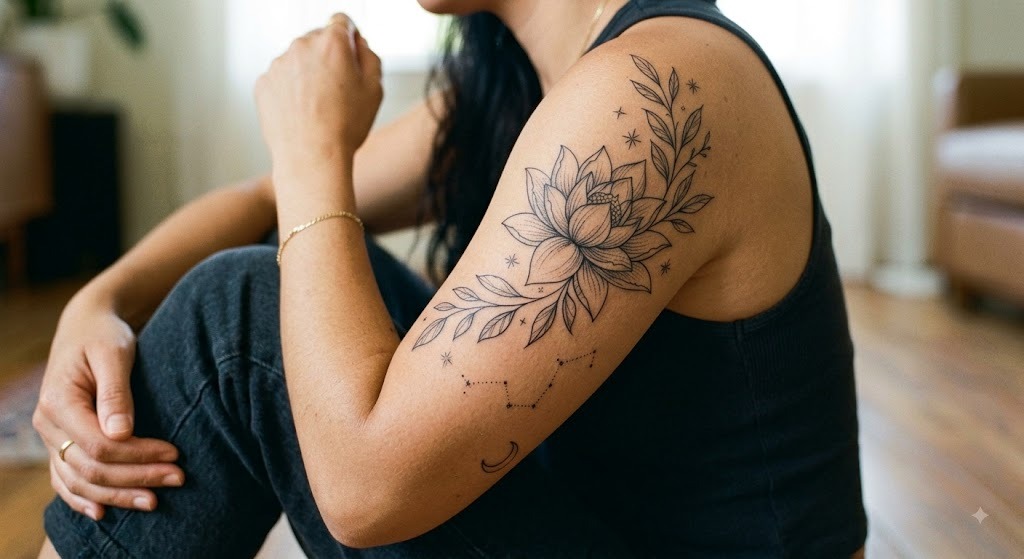
The lotus is the only flower whose entire meaning depends on where it grows.
It roots in mud. Thick, stagnant, unpleasant mud at the bottom of a pond. Then it pushes up through dark water and opens on the surface completely clean — no mud clings to the petals at all. That is the whole symbol. Not “beautiful flower”. Something that came through the worst of it and was not stained by it.
Which is why it means what it means to so many people, and why it appears in both Hindu and Buddhist tradition rather than belonging to either. If you are looking at lotus tattoo designs, this guide covers the meanings you can actually choose between — colour, petal count, pairings — and what survives on skin. We are Vulture Tattoos, an appointment-only studio in Sector 47, Gurgaon.
What the colours mean
Lotus colour is not decorative. Each one carries a specific traditional meaning, and choosing deliberately makes the tattoo yours.
- White lotus (pundarika). Purity of mind and spirit. Perfection. The most common choice, and it works beautifully as black and grey with the white being bare skin.
- Pink lotus (padma). The supreme lotus, associated with the Buddha himself and with the highest deities. If you want the most traditionally significant version, this is it.
- Blue lotus (utpala). Wisdom, knowledge, and victory of the spirit over the senses. Usually shown partly closed, because the wisdom is never fully revealed.
- Red lotus. Love, compassion and the heart. Associated with Avalokiteshvara.
- Purple lotus. Mysticism and the esoteric path. Often shown with eight petals representing the Noble Eightfold Path.
- Gold lotus. Full enlightenment — the rarest in tradition and in tattooing.
Petal counts carry meaning too
Most people do not know this, and it is a genuinely nice detail to build into a design.
- Eight petals — cosmic harmony, the eight directions, and in Buddhism the Noble Eightfold Path. The most common count in ornamental work.
- Twelve petals — the heart chakra (anahata).
- Sixteen petals — the throat chakra (vishuddha).
- A thousand petals — the crown chakra (sahasrara), the highest state. Rendered as a dense radiating bloom rather than literally counted.
If the piece is about a specific chakra or a specific idea, the petal count is a quiet way to say it. Nobody else has to know.
Lotus tattoo designs that work
- Simple outline lotus. Clean linework, no shading. Timeless, works small, and ages well.
- Lotus with unalome. The spiral path rising into a straight line, topped by the flower. The most requested combination — the journey through struggle to clarity. Our Buddha tattoo guide covers the unalome in more detail.
- Ornamental / mandala lotus. The flower built into symmetrical geometry with dotwork shading. Beautiful and durable — see our mandala guide.
- Lotus with Om. The symbol seated in the flower — see our Om tattoo designs guide for getting the character right.
- Lotus with Buddha. The figure seated on the bloom, or a face emerging from petals.
- Lotus with koi. Two symbols of coming through difficulty, together — see our koi fish guide.
- Half lotus, half mandala. One side rendered naturally, the other dissolving into geometry. Modern and striking.
- Watercolour lotus. Soft washes bleeding off the petals — see our watercolour guide.
- Lotus with water and roots. Showing the mud, the water and the bloom together. The most complete telling of the symbol, and one of the most meaningful.
- Chakra lotus. A stack of lotuses up the spine, one for each chakra — see our spine tattoo guide.
Why the lotus is one of the best-ageing flowers
It is genuinely more durable than most florals, and there is a structural reason.
A rose or a peony is built from overlapping petals with narrow gaps between them, and those gaps close first as ink settles. A lotus is built from radiating petals that fan outward from a centre, with naturally wider spaces between them.
That geometry buys it decades. Which is also why the ornamental and mandala versions hold up so well — they are essentially clean linework with generous negative space.
To keep that advantage:
- Keep the petal gaps open. Do not crowd them.
- Confident stroke weight, not hairline.
- Keep some solid dark value — a shaded centre, a solid petal tip, or dotwork. Pure hairline with nothing solid has nothing holding it together long term.
- Do not go tiny. Even a lotus needs room for the petals to stay separate.
Colour on Indian skin
If you want a coloured lotus, the palette choice is the whole game.
Deep saturated pinks, reds, blues and purples hold beautifully on medium and deeper Indian skin. Pale pinks and soft pastels — which is what most lotus tattoo inspiration online shows — have too little contrast against the skin and read faint once healed.
A deep magenta-pink lotus is stunning on Indian skin. A pastel one usually is not. That is not a limitation, just a palette decision made honestly. Our colour tattoo guide covers this in detail, and our black and grey guide explains why the no-colour route is the most durable.
Where to place it
- Inner or outer forearm. The best all-round placement. Flat, visible, ages well.
- Upper arm and shoulder. Comfortable, easy to cover, good for ornamental work.
- Spine. Perfect for a chakra stack or a single vertical bloom.
- Upper back and between the shoulder blades. Flat, sun-protected, ideal for a large mandala lotus.
- Sternum and chest. Symmetrical placement that suits the flower’s symmetry. Sharper to sit.
- Thigh. Roomy and comfortable, easy to keep out of the sun.
- Nape of the neck or behind the ear. Only for a small simple outline.
One thing to consider. The lotus is a sacred symbol in both Hindu and Buddhist tradition, and many people hold that sacred imagery should not be worn below the waist. Views differ genuinely and it is your decision, but we raise it at the consultation because placement is the most common source of regret with any devotional design.
Does it hurt?
The same as any tattoo of that size in that place. Outer forearm, upper arm and thigh are the most comfortable. Spine, sternum, ribs and collarbone are sharper.
A simple outline lotus is a short session. A large mandala or a chakra stack down the spine takes hours and may run across sittings. Our tattoo pain chart covers every placement.
Want to talk it through? Call or WhatsApp us on +91 96676 14250 or message us on WhatsApp.
Healing and aftercare in Gurgaon
- Keep the wrap on as long as your artist says, then wash gently with lukewarm water and mild fragrance-free soap.
- Pat dry, do not rub. Rubbing fresh linework pulls pigment out of thin strokes.
- Thin layer of balm. Thin is the word.
- Do not pick or scratch. A gap in ornamental linework is very visible.
- No swimming, sauna, gym sweat or soaking for two to three weeks.
- Keep it moisturised well past the peeling stage.
Forearm placements catch Gurgaon sun daily, and UV softens fine linework faster than anything else. On an ornamental lotus that shows up as the petal gaps closing. Use SPF 30 or higher once healed. Our full aftercare guide for Gurgaon covers each stage.
Why the artist matters
A lotus is a symmetry problem. The petals radiate from a centre, and the eye instantly spots when one side does not mirror the other — especially on a curved surface like an arm, where a design drawn flat will look skewed once it wraps.
Ornamental and mandala versions raise the bar further: dotwork shading has to be even, spacing has to be consistent, and the geometry has to stay true across the curve.
Ronny specialises in fine-line, botanical, script and geometric work — which covers ornamental lotus, mandala framing, dotwork and unalome. Ajay handles realism, devotional, portrait and cover-up work, which covers shaded and realistic versions and Buddha pairings. Our page on the tattoo artists in Gurgaon introduces both.
Every tattoo is done with single-use sterile needles opened in front of you, in an appointment-only studio. That is part of why our clients have left more than 270 five-star Google reviews.
Why book in Sector 47
Vulture Tattoos is at Shop F-04, Spaze Boulevard, Malibu Towne, Sector 47, Gurugram. Easy to reach from across Gurgaon, DLF, Sohna Road, Golf Course Road and South Delhi.
Book your lotus tattoo: call or WhatsApp +91 96676 14250. See our work on Instagram at @vulture_tattooz, or reach us through our contact page.
Frequently Asked Questions
What does a lotus tattoo mean?
Coming through something difficult without being stained by it. The lotus roots in mud, grows through dark water and opens completely clean on the surface — that is the entire symbol. It carries meanings of rebirth, spiritual growth and purity, and it appears in both Hindu and Buddhist tradition rather than belonging to either.
What do the different lotus colours mean?
White is purity of mind; pink is the supreme lotus, associated with the Buddha; blue is wisdom and victory of spirit over the senses, usually shown partly closed; red is love and compassion; purple is mysticism, often with eight petals for the Noble Eightfold Path; gold is full enlightenment. Choosing deliberately makes the tattoo more personal.
Does the number of petals matter?
Traditionally yes. Eight petals represent cosmic harmony and the Noble Eightfold Path; twelve is the heart chakra; sixteen the throat chakra; and a thousand petals represents the crown chakra, rendered as a dense radiating bloom. It is a quiet way to build a specific meaning into the design.
Do lotus tattoos age well?
Better than most flowers, and for a structural reason — a rose is built from overlapping petals with narrow gaps that close first, while a lotus radiates outward with naturally wider spaces between petals. Keep those gaps open, use confident stroke weight rather than hairline, and include some solid dark value somewhere.
What is the lotus and unalome tattoo?
The unalome is a Thai Buddhist symbol — a spiral path that straightens into a line, representing the journey from confusion to clarity. Topped with a lotus, it becomes the whole arc: the struggle, the straightening, and the bloom. It is our most requested lotus combination and it works well at modest size.
Which colour lotus works best on Indian skin?
Deep saturated shades — rich magenta-pink, deep red, strong blue or purple. Pale pinks and pastels, which is what most online lotus inspiration shows, have too little contrast against medium and deeper skin and read faint once healed. A deep pink lotus is stunning on Indian skin; a pastel one usually is not.
Where should I not place a lotus tattoo?
Many people hold that sacred imagery should not be worn below the waist, which makes calf, ankle and foot a consideration. Views differ genuinely and it is your decision, but it is worth deciding rather than discovering later. Forearm, upper arm, spine, upper back and chest all avoid the question.
How do I book and how much will it cost?
Booking is by appointment. Call or WhatsApp +91 96676 14250 to arrange a consultation. We discuss the style, colour, petal count, size and placement, and give you a clear written quote once the details are settled. Pricing depends on size, detail and time.