Vishnu Tattoo Designs: Meaning, the Four Symbols and the Avatars
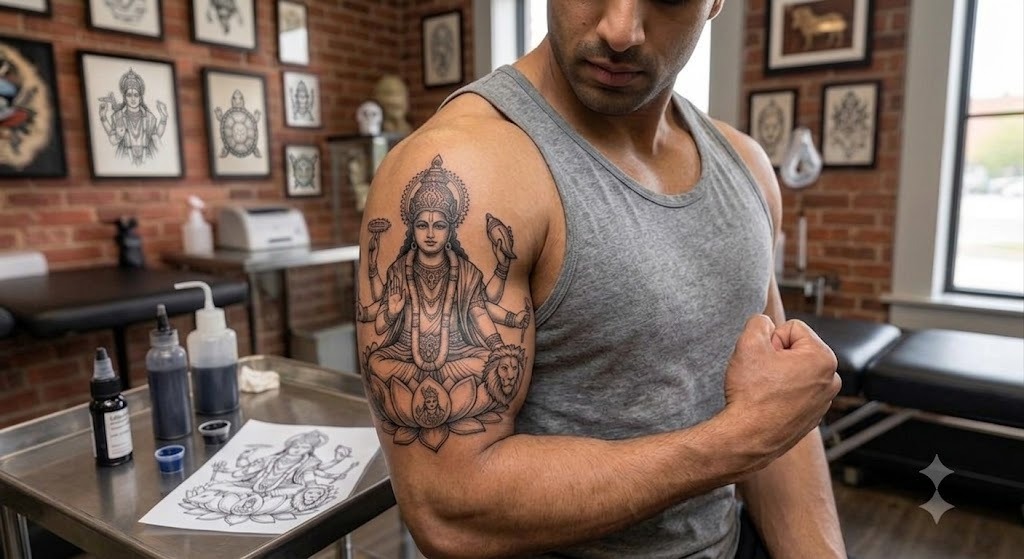
Vishnu is the preserver — the force that maintains balance in the universe, and the one who returns, again and again, whenever that balance is seriously threatened. That returning is the part that makes him different from most other devotional subjects: he is not one fixed image, but a whole family of avatars, and choosing which one you actually want is the first real decision in this tattoo.
If you are looking at vishnu tattoo designs, this guide covers his core symbols, the avatar question, and how to build a piece that reflects what he actually means to you. We are Vulture Tattoos, an appointment-only studio in Sector 47, Gurgaon.
What Vishnu represents
- Preservation and balance. Distinct from Brahma’s creation and Shiva’s destruction — Vishnu maintains what already exists.
- Protection. He returns in whatever form is needed, whenever dharma is seriously under threat, to restore order.
- Continuity. Often depicted resting on the cosmic serpent Ananta Shesha, floating on the ocean of existence — a symbol of stability that persists through everything.
- Righteousness in action. Unlike a purely contemplative deity, Vishnu’s avatars are active — Rama as the ideal king, Krishna as the guide in battle, each intervening directly in the world.
Vishnu, or one of his avatars?
This is the most important question to answer before you design anything, because it changes the whole tattoo.
- Vishnu directly — the four-armed form, usually blue-skinned, holding his four symbols. The base form, before any specific avatar.
- Narasimha — the man-lion avatar, fierce and protective, taken to destroy a demon who could not be killed by man or beast, by day or night, indoors or outdoors. A dramatic, powerful image.
- Vamana — the dwarf avatar, representing humility as a form of strength.
- Rama — see our note below; a hugely significant avatar with his own dedicated iconography.
- Krishna — see our Radha Krishna tattoo designs guide for this avatar’s own extensive symbolism.
- Varaha — the boar avatar, who rescued the earth from the depths of the cosmic ocean.
- Matsya, Kurma — the fish and tortoise avatars, associated with the earliest cosmic preservation stories.
Each of these has its own distinct visual language. Deciding which one resonates with you, rather than a generic “Vishnu” image, is what makes the final tattoo feel considered rather than assembled from a search result.
What each symbol means
Vishnu is traditionally shown with four objects, one in each hand, and each carries specific meaning.
- The shankha (conch shell). The primordial sound of creation, and a call to righteous action — it is blown before battle to announce a just cause.
- The chakra (discus, Sudarshana Chakra). The cycle of time and cosmic order, and a weapon of protection used to cut through evil while maintaining balance.
- The gada (mace, Kaumodaki). Physical and mental strength, and the power to enforce dharma when needed.
- The padma (lotus). Purity and spiritual liberation — see our lotus tattoo designs guide for the flower’s own layered meaning.
- The Kaustubha jewel. Sometimes shown at his chest, representing pure consciousness.
- Ananta Shesha, the serpent. Time itself, coiled and infinite, on which Vishnu rests between cycles of creation.
Vishnu tattoo designs that work
- Four-armed figure with the four symbols. The base traditional form, with conch, chakra, mace and lotus radiating outward. Needs the same spacing consideration as any multi-armed devotional figure — see our Durga tattoo designs guide for why arm spacing matters so much for longevity.
- Reclining on Ananta Shesha. The cosmic ocean scene — Vishnu resting on the coiled serpent. A striking, larger composition.
- Narasimha. The fierce man-lion form, one of the more dramatic and requested avatar choices.
- Sudarshana Chakra alone. The discus as a standalone symbol, carrying the meaning without the full figure. Works well at smaller sizes.
- Conch shell alone. A quieter, more contained symbol, good for a first devotional piece.
- Vishnu with Om or mantra. Paired with the symbol or a specific shloka in Devanagari — see our Om tattoo designs and script tattoo guide.
- Dashavatar composition. All ten avatars across a large piece — an ambitious, multi-session project for a back or full sleeve.
Why this piece needs honest scale, especially the avatars
The four-armed base form follows the same rule as any multi-armed devotional figure — each arm and symbol needs enough space to stay legible as ink settles over years. A forearm at minimum for this version, more for anything including the reclining serpent scene.
Narasimha is a portrait with distinctly non-human features — the lion’s face has to convey both ferocity and protection at once, which is a genuinely demanding expression to render. This is exactly the kind of detail-heavy portrait work our realism tattoo guide covers.
A Dashavatar composition — all ten avatars in one piece — is one of the most ambitious devotional tattoos we would take on, needing a back or full sleeve and multiple sessions, because each avatar needs its own recognisable identity within the larger scene.
Black and grey or colour?
Black and grey works well for most Vishnu compositions, holding contrast on every Indian skin tone and lasting longest in Gurgaon’s sun — see our black and grey tattoo guide.
Colour is traditional here specifically — Vishnu’s blue skin is one of the most recognisable elements of his iconography, alongside yellow silk garments. Deep saturated blue reads far better on Indian skin than a pale wash. Our colour tattoo guide covers the palette question.
Where to place it
- Forearm. The minimum sensible size for the four-armed form or an avatar face.
- Upper arm and shoulder. Comfortable, easy to cover, decent room for detail.
- Upper back. The best canvas for a reclining Ananta Shesha scene or a Dashavatar composition — see our back tattoo guide.
- Chest. Meaningful and symmetrical, good for a face-focused avatar composition.
- Thigh. Roomy, comfortable, easy to keep out of the sun.
Worth considering. Many people hold that sacred imagery should not be worn below the waist. We raise this at the consultation because placement, not design, is the most common source of regret with devotional work.
Does it hurt?
The same as any tattoo of that size in that place. Outer forearm, upper arm and thigh are the most comfortable. Chest, ribs and areas over bone are sharper.
A symbol-only piece is a manageable session. A full multi-armed figure or an avatar portrait is longer, and a reclining serpent scene or Dashavatar composition is a genuine project across sittings. Our tattoo pain chart covers every placement.
Want to talk through which avatar or symbol suits your idea? Call or WhatsApp us on +91 96676 14250 or message us on WhatsApp.
Healing and aftercare in Gurgaon
- Keep the wrap on as long as your artist says, then wash gently with lukewarm water and mild fragrance-free soap.
- Pat dry, do not rub. Rubbing a fresh shaded area, or fresh colour, pulls pigment out.
- Thin layer of balm. Thin is the word.
- Do not pick or scratch. A pale patch in a symbol or face is very visible.
- No swimming, sauna, gym sweat or soaking for two to three weeks after each session.
- Keep it moisturised well past the peeling stage.
If you chose the traditional blue colour, sun protection is not optional in Gurgaon. UV breaks down coloured pigment faster than black. Use SPF 30 or higher once healed. Our full tattoo aftercare guide for Gurgaon covers each stage.
Why the artist matters
Vishnu compositions demand both realism and composition skill together. A four-armed figure needs the same careful spacing as any multi-armed deity. An avatar like Narasimha needs a portrait’s worth of expression control on features that are not fully human. A Dashavatar piece needs ten distinct identities coexisting in one composition without any of them getting lost.
Ajay is our realism, devotional, portrait and cover-up specialist, so Vishnu and his avatars sit with him at any scale. Ronny specialises in fine-line, botanical, script and geometric work, which covers standalone symbols like the chakra or conch, and any Devanagari mantra alongside the figure. Our page on the tattoo artists in Gurgaon introduces both.
Every tattoo is done with single-use sterile needles opened in front of you, in an appointment-only studio. That is part of why our clients have left more than 270 five-star Google reviews.
How it works with us
- Consultation. Bring your reference and tell us whether you want Vishnu directly or a specific avatar. We talk symbols, scale and placement.
- Design. Drawn to your placement, with proper spacing for any multi-armed detail. You see it before any needle touches you.
- A written quote at consultation. Clear, with a realistic session plan for larger pieces. Our tattoo cost guide for Gurgaon explains what shapes it.
- The session, or sessions. Paced, with breaks, split across sittings for anything ambitious.
- Aftercare and touch-ups. A clear plan, and we are on WhatsApp throughout.
Why book in Sector 47
Vulture Tattoos sits at Shop F-04, Spaze Boulevard, Malibu Towne, Sector 47, Gurugram, easy to reach from across Gurgaon, DLF, Sohna Road, Golf Course Road and South Delhi. For an ambitious piece running across sessions, the same artist seeing it through keeps every avatar’s identity consistent. Appointment-only means a calm, private studio for detailed devotional work.
Book your Vishnu tattoo: call or WhatsApp +91 96676 14250 to start with a consultation.
See our work
Composition and portrait detail are what to judge, and both need to be seen. Browse our recent pieces on Instagram at @vulture_tattooz, read more about the studio at Vulture Tattoos, or reach out through our contact page. When you are ready, call or WhatsApp +91 96676 14250 and we will plan vishnu tattoo designs built to last.
Frequently Asked Questions
What does a Vishnu tattoo mean?
Preservation, balance and protection — Vishnu maintains what exists and returns whenever dharma is seriously threatened, taking whatever form the situation requires. That returning is why he is represented by so many different avatars rather than one fixed image, and choosing which avatar resonates with you is the first real design decision.
What do the four objects Vishnu holds mean?
The conch calls to righteous action, the chakra represents the cycle of cosmic order and cuts through evil while maintaining balance, the mace represents strength to enforce dharma, and the lotus represents purity and liberation. Together they define the traditional four-armed form.
Should I get Vishnu directly or one of his avatars?
That depends on what resonates with you. The base four-armed form represents Vishnu’s core role as preserver. Narasimha is fierce and protective, chosen for strength through adversity. Krishna carries his own extensive symbolism around love and guidance — see our dedicated Radha Krishna guide. Deciding this first makes the final tattoo feel considered rather than generic.
What is the Dashavatar tattoo?
All ten of Vishnu’s major avatars depicted together — Matsya, Kurma, Varaha, Narasimha, Vamana, Parashurama, Rama, Krishna, Buddha and Kalki in some traditions. It is one of the most ambitious devotional pieces we would take on, needing a back or full sleeve and multiple sessions so each avatar keeps its own recognisable identity.
How big does a Vishnu tattoo need to be?
The four-armed form needs a forearm at minimum, with each arm and symbol given room to stay legible over the decades. A reclining Ananta Shesha scene or a Dashavatar composition needs a back or full sleeve. A single standalone symbol like the chakra or conch works considerably smaller.
What colour is traditionally used for Vishnu?
Deep blue skin, alongside yellow silk garments, is the most recognisable traditional colouring and genuinely reads well on Indian skin because it is a saturated rather than pale shade. Black and grey is equally valid and holds up longest in Gurgaon’s sun if you would rather avoid the maintenance colour work needs.
Where should I not place a Vishnu tattoo?
Many people hold that sacred imagery should not be worn below the waist, which is worth considering for calf, ankle or foot placements. Views differ genuinely and it is your decision — we raise it at the consultation because placement, not the design, is the most common regret with devotional work.
How do I book and how much will it cost?
Booking is by appointment. Call or WhatsApp +91 96676 14250 to arrange a consultation, where we discuss which form or avatar, symbols, scale and placement, and give you a clear written quote once everything is settled. Pricing depends on size, detail and total hours, so we quote in person rather than online.