Durga Tattoo Designs: Meaning, Forms and Getting the Face Right
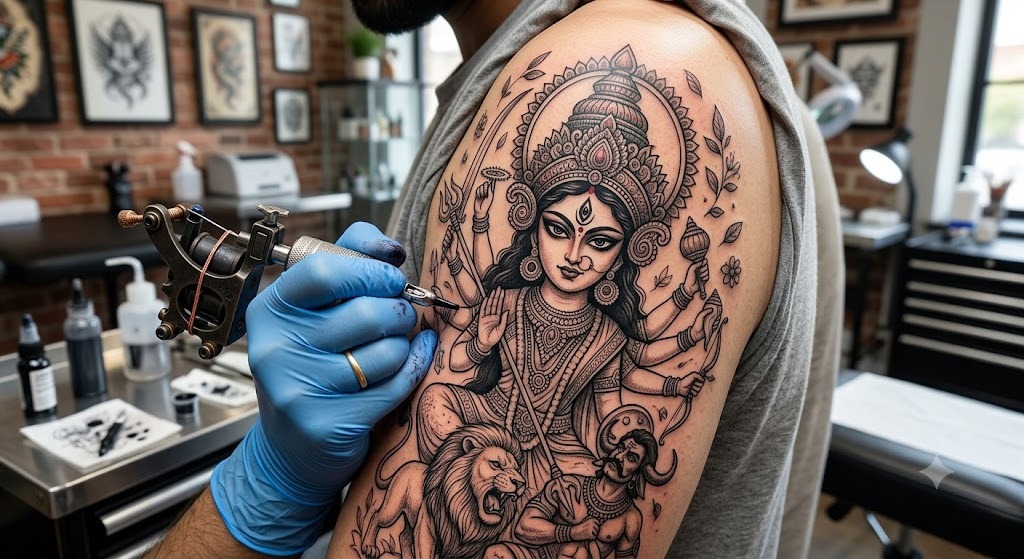
Durga is not one goddess with one story. She is created for a single purpose — to do what none of the gods could — and she carries a weapon from each of them into battle. That combination, feminine power built specifically to destroy what threatens everyone else, is why this is one of the most requested devotional tattoos we do, and one of the most demanding to get right.
If you are looking at durga tattoo designs, this guide covers the forms, what each weapon and detail means, and what a multi-armed goddess actually needs to work as a tattoo. We are Vulture Tattoos, an appointment-only studio in Sector 47, Gurgaon.
The story behind the tattoo
Mahishasura, a buffalo demon, could not be killed by any man or god — that was the boon he had won. So Brahma, Vishnu and Shiva combined their power into a single divine light, and from it Durga was formed. Every other god then gave her a weapon: Shiva’s trishul, Vishnu’s chakra, Indra’s vajra, and more, one from each hand. Riding a lion or tiger, she fought and killed Mahishasura, which is why the most iconic Durga image — Mahishasari Mardini, the slayer of Mahishasura — shows her mid-battle, weapons raised, the demon beneath her.
That origin is why Durga tattoos read differently from most devotional pieces. This is not a calm, meditative figure. She was built for a fight, and the tattoo usually carries that energy.
Durga, Devi, Amba — the same goddess
- Durga tattoo — the general term, usually meaning the eight or ten-armed warrior form.
- Devi tattoo / Maa Durga tattoo — the same figure, often with more emphasis on the maternal, protective reading.
- Ambe Maa / Amba tattoo — a regional name, particularly in Gujarati tradition, for the same goddess.
- Mahishasura Mardini tattoo — specifically the battle scene, Durga with the demon beneath her.
- Navadurga — the nine forms of Durga worshipped across Navratri, each with a different name and attribute. A rare but striking choice for a larger composition.
- Sherawali Maa tattoo — “she who rides the tiger/lion”, a popular devotional name focused on that specific image.
Durga tattoo designs that work
- Face with tiger. The most requested version — Durga’s face, calm or fierce, with the tiger positioned beside or beneath her. See our tiger tattoo designs guide for how the animal itself is rendered.
- Full battle scene. Mahishasura Mardini in full — Durga, weapons raised, the tiger, the demon. The most ambitious version, needing real scale.
- Multi-armed figure, weapons only. The arms and weapons rendered without a full battle scene — trishul, chakra, sword, bow, all radiating outward. Powerful and slightly more contained than a full scene.
- Durga’s face alone. Close cropped, usually calm rather than mid-battle. Works at a more moderate size than a full figure.
- Durga with Om or trishul. Paired with a symbol rather than a full figure — see our Om tattoo designs and trishul tattoo designs guides.
- Third eye Durga. Focused on the eye and forehead detail, a smaller and more symbolic treatment.
- Durga with mantra. “Jai Mata Di” or a specific shloka in Devanagari alongside the figure — read our script tattoo guide before committing to any text.
- Navadurga composition. All nine forms across a large back or full-sleeve piece. A serious, multi-session project.
What each weapon and detail means
If you want the piece to carry real meaning rather than just a striking image, the details are worth choosing deliberately.
- The trishul (from Shiva) — destruction of ignorance, ego and attachment.
- The chakra (from Vishnu) — the cycle of dharma, protection through cosmic order.
- The sword — the cutting away of illusion.
- The bow and arrow — focus and precision, hitting exactly what needs to be struck.
- The lotus — purity held even in battle. See our lotus tattoo designs guide for the symbol’s own meaning.
- The conch shell — the sound that announces victory of good over evil.
- The tiger or lion — her vahana, and the reason “Sherawali” is used as a name for her.
- Ten arms rather than eight — usually reserved for the most complete depiction, and a genuinely large undertaking to render clearly.
You do not need every weapon. The strongest small-to-medium pieces often choose two or three that mean the most, rather than trying to fit all ten.
Why a multi-armed figure is technically demanding
This is the part that decides whether the tattoo actually works, and it is worth being honest about.
A human portrait has one set of proportions to get right. Durga has multiple arms, each holding a different weapon, all radiating from a torso that still has to read as anatomically coherent. Get the arm spacing or the weapon proportions slightly wrong and the figure looks cluttered rather than powerful.
- Space is not optional. Each arm and weapon needs enough separation to stay legible. Cramming eight arms into a forearm-sized space is how the whole thing collapses into a tangle within a few years as ink spreads.
- The face carries the piece. Whether calm or fierce, the expression is what people respond to, and it needs the same care as any portrait — see our realism tattoo guide for how to judge that work.
- Full battle scenes need real scale. A back, chest or full forearm at minimum. Attempting the whole story — goddess, tiger, demon, all the weapons — on a small canvas is the single most common way this tattoo disappoints people later.
If your space is limited, choose a face-and-tiger composition or a smaller symbolic version rather than compressing the full battle scene.
Black and grey or colour?
Black and grey is what we recommend for most Durga work, particularly full battle scenes. The composition is complex enough already, and black and grey holds contrast on every Indian skin tone while lasting longest in Gurgaon’s sun. See our black and grey tattoo guide.
Colour works beautifully for the saree, gold jewellery detail and the red of a bindi or tilak, provided it is deep and saturated rather than pale — our colour tattoo guide covers how pigment behaves on Indian skin.
Where to place it
- Upper back. The best canvas for a full battle scene — flat, large, sun-protected. See our back tattoo guide.
- Chest. Powerful and symmetrical, good for a face-focused composition.
- Forearm. The minimum sensible size for a face-and-tiger version, or a reduced weapons-only design.
- Upper arm and shoulder. Comfortable, easy to cover, decent room for a moderate composition.
- Thigh. Roomy, comfortable to sit through, easy to keep out of the sun.
One thing worth considering. Many people hold that sacred imagery should not be worn below the waist. Views differ genuinely and it is your decision — we raise it at the consultation because placement, not the design itself, is the most common regret with devotional work.
Does it hurt?
The same as any tattoo of that size in that place. Outer forearm, upper arm and thigh are the most comfortable. Chest, ribs, sternum and areas over bone are sharper.
A weapons-only or face composition is a substantial session. A full battle scene with tiger and demon is a long project, usually split across multiple sittings. Our tattoo pain chart covers every placement.
Want to talk through the composition? Call or WhatsApp us on +91 96676 14250 or message us on WhatsApp.
Healing and aftercare in Gurgaon
- Keep the wrap on as long as your artist says, then wash gently with lukewarm water and mild fragrance-free soap.
- Pat dry, do not rub. Rubbing a fresh shaded area pulls pigment out.
- Thin layer of balm. Large shaded areas tempt over-application. Thin is still the word.
- Do not pick or scratch. A pale patch anywhere in a face or a weapon detail is very visible.
- No swimming, sauna, gym sweat or soaking for two to three weeks after each session.
- Keep it moisturised well past the peeling stage.
Sun flattens contrast over the years, and contrast is what gives a multi-figure composition its depth. Use SPF 30 or higher once healed. Our full tattoo aftercare guide for Gurgaon covers each stage.
Why the artist matters
This is realism and composition combined, which is a demanding pairing. Every arm has to sit correctly relative to the torso, every weapon needs its own clean proportion, and the whole thing has to still read as one coherent figure rather than a collection of parts. The face carries the emotional weight of the piece and needs the same shading discipline as any portrait.
Ajay is our realism, devotional, portrait and cover-up specialist, so Durga compositions of any scale sit with him. Ronny specialises in fine-line, botanical, script and geometric work, which covers ornamental framing, mandala backgrounds and any Devanagari mantra alongside the figure. Our page on the tattoo artists in Gurgaon introduces both.
Every tattoo is done with single-use sterile needles opened in front of you, in an appointment-only studio. That is part of why our clients have left more than 270 five-star Google reviews.
How it works with us
- Consultation. Bring your reference and tell us which form and which details matter most to you. We talk scale honestly before anything is designed.
- Design. Drawn to your placement, with each arm and weapon given proper space to survive the decades. You see it before any needle touches you.
- A written quote at consultation. Clear, with a realistic session plan for larger pieces. Our tattoo cost guide for Gurgaon explains what shapes it.
- The session, or sessions. Paced, with breaks, split across sittings for anything ambitious.
- Aftercare and touch-ups. A clear plan, and we are on WhatsApp throughout.
Why book in Sector 47
Vulture Tattoos sits at Shop F-04, Spaze Boulevard, Malibu Towne, Sector 47, Gurugram, easy to reach from across Gurgaon, DLF, Sohna Road, Golf Course Road and South Delhi. For a project running across sessions, having the same artist see it through is what keeps the composition consistent from start to finish. Appointment-only means a calm, private studio for detailed devotional work.
Book your Durga tattoo: call or WhatsApp +91 96676 14250 to start with a consultation.
See our work
Composition and expression are what to judge, and both need to be seen. Browse our recent pieces on Instagram at @vulture_tattooz, read more about the studio at Vulture Tattoos, or reach out through our contact page. When you are ready, call or WhatsApp +91 96676 14250 and we will plan durga tattoo designs built to last.
Frequently Asked Questions
What does a Durga tattoo mean?
Durga was created specifically to destroy a threat no god or man could defeat, formed from the combined power of Brahma, Vishnu and Shiva, and armed with a weapon from each deity. As a tattoo she represents protective strength built for exactly the fight in front of you — feminine power with a clear, righteous purpose rather than aggression for its own sake.
What is Mahishasura Mardini?
The specific image of Durga slaying the buffalo demon Mahishasura — weapons raised, her tiger beside her, the demon beneath her. It is the most iconic and most requested Durga composition, and the most demanding to tattoo well because it combines a portrait, an animal and a full battle scene in one piece.
How big does a Durga tattoo need to be?
A full battle scene needs a back, chest or full forearm at minimum, because eight or ten arms and their weapons all need space to stay legible as ink settles over the years. A face-and-tiger composition or a weapons-only design can work on a standard forearm. Compressing the full story onto a small canvas is the most common disappointment with this tattoo.
Should a Durga tattoo be black and grey or colour?
Black and grey suits most Durga work, especially full battle scenes, because the composition is already complex and black holds contrast on every Indian skin tone while lasting longest in Gurgaon’s sun. Colour works beautifully for saree detail, gold jewellery and a red bindi, provided the shades are deep and saturated rather than pale.
Which weapons should I include?
You do not need all ten. The trishul, chakra and lotus are among the most commonly chosen because of their individual meanings — destruction of ego, cosmic order, and purity held through battle. Choosing two or three that mean the most to you, with proper space around each, usually produces a stronger and more durable tattoo than fitting in every weapon.
Where should I not place a Durga tattoo?
Many people hold that sacred imagery should not be worn below the waist, which is worth considering for calf, ankle or foot placements. Views differ genuinely and it is your decision — we raise it at the consultation because placement, not the design, is the most common source of regret with devotional tattoos.
Can I get the Navadurga, all nine forms, in one tattoo?
Yes, and it is one of the most ambitious devotional pieces we do — a large back or full-sleeve project, usually across multiple sessions. Each of the nine forms needs its own identifiable detail to read correctly, so this is not a design to compress into a small space. We plan the whole composition before the first session begins.
How do I book and how much will it cost?
Booking is by appointment. Call or WhatsApp +91 96676 14250 to arrange a consultation, where we discuss the form, the details you want included, scale and placement, and give you a clear written quote once everything is settled. Pricing depends on size, detail and total hours, so we quote in person rather than online.