Realism Tattoo in Gurgaon: The Honest Guide to Photo-Real Ink
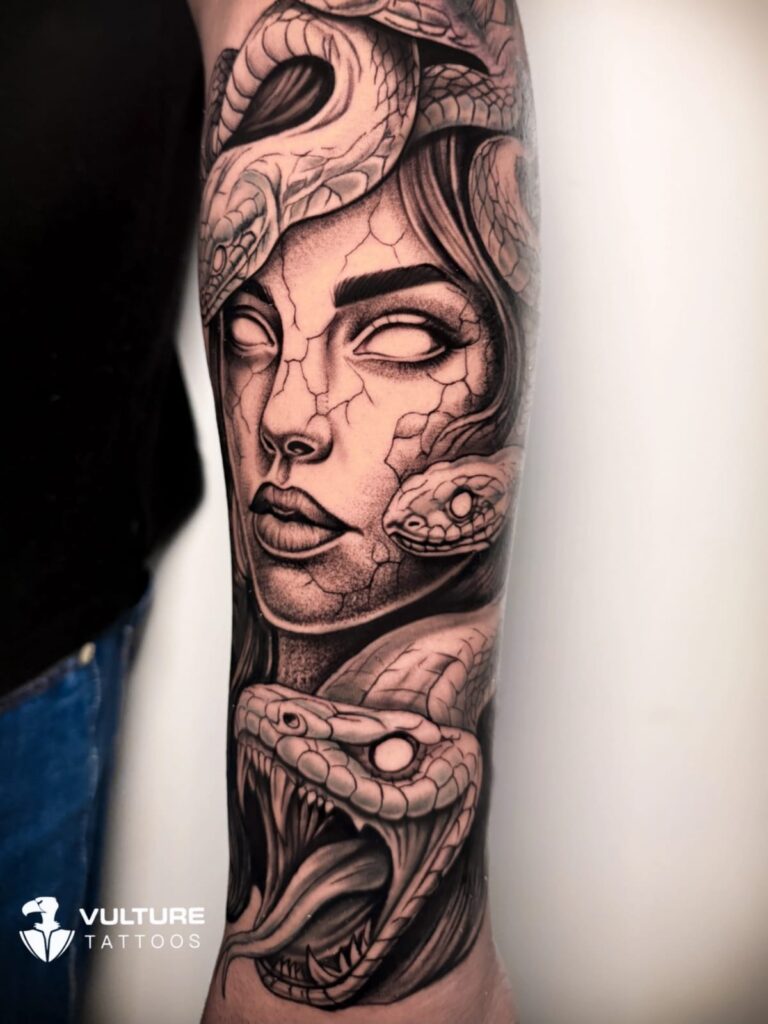
There is a moment, when a realism tattoo is done right, where a stranger squints at your arm and asks if that is a photograph printed on your skin. No outlines. No cartoon edges. Just light, shadow, and skin that reads like a lens captured it. That is the whole point of realism, and it is also the reason so many people end up disappointed. Realism is the hardest style in tattooing to pull off, and most studios treat it like just another item on the menu.
At Vulture Tattoos in Sector 47, Gurgaon, realism is not a side offering. It is Ajay’s specialty. This guide walks through what a **realism tattoo in Gurgaon** actually is, why it demands a genuine specialist and not a generalist, and how to judge whether an artist can really deliver before you sit in the chair.
What realism actually means (it is bigger than portraits)
Most people hear “realism” and immediately picture a face. A grandfather, a child, a departed parent rendered in grey shadow. That is portrait realism, and it is one branch of the tree. But realism as a style covers anything that is rendered to look like a real photograph rather than a stylised drawing.
That includes a lot more than human faces:
- Animals and wildlife — a lion’s mane with every strand catching light, a pet dog’s eyes, an eagle mid-flight, the scales on a snake.
- Nature — roses with dew, mountains, waves, a single feather where you can almost feel the texture.
- Objects — a pocket watch, a compass, jewellery, a rosary, a bike, anything with metal, glass, or reflection.
- 3D and micro-realism — pieces designed to look raised off the skin, or tiny detailed scenes that trick the eye at small scale.
- Devotional and religious realism — deities, idols, and spiritual imagery rendered with photographic depth rather than flat line art.
So a portrait is a subset of realism, not the whole thing. If what you specifically want is a human face — a loved one, a hero, a likeness that has to be perfect — that is a discipline of its own, and it is worth reading our dedicated portrait tattoo in Gurgaon page, because capturing a real person’s likeness carries a margin for error that a lion or a rose does not. Get an animal’s fur slightly off and it still looks like a lion. Get your mother’s jawline slightly off and it stops looking like her. Both are realism. They are not the same job.
Black and grey realism vs colour realism
Realism splits into two broad camps, and the choice matters more than most people realise when they walk in.
Black and grey realism uses only black ink diluted into a full range of greys, from the deepest saturated shadow to the softest wash. This is where a huge amount of realism lives, and it is what black and grey realism artists build their reputation on. Done well, it looks like a black-and-white photograph living under the skin. It also tends to age more gracefully, because black ink holds its structure longer than coloured pigment and there are no separate hues to shift or fade at different rates over the years.
Colour realism is arguably the most technically complex form of all. The artist has to understand how pigment behaves inside living skin — how colours blend, how they shift as they heal, how to layer to hit the exact green of a leaf or the precise tone of a subject’s skin. Skin is not a white canvas. It has its own warmth underneath, and every colour you lay down is filtered through that. That is why a colour realism piece that looked incredible fresh can heal into something muddy in less capable hands.
Neither is “better.” Black and grey is often the smarter call for portraits and for anything you want to age well over decades. Colour is unbeatable when the subject genuinely lives in colour — a parrot, a sunset, a specific flower. A good realism artist will tell you honestly which one suits your idea, and Ajay does exactly that during the consultation rather than just saying yes to whatever you ask for.
Why realism is the hardest style in tattooing
Every tattoo style has its difficulty, but realism is in a category of its own, and here is the honest reason why.
Most tattoo styles are forgiving because they are built on lines. Traditional, neo-traditional, fine-line, script, geometric — they all use a black outline to define the shape. The outline does the heavy lifting. If your shading is slightly uneven inside a bold outline, the eye still reads the image correctly because the border holds it together.
Realism has no outline to hide behind. There is no line telling your eye where the edge of a cheek is. The edge is created purely by the difference between light and shadow — by values. So every millimetre of shading has to be correct, because the shading is the drawing. There is nothing to fall back on.
That creates a few very specific technical demands:
- Smooth, band-free shading — the grey has to fade gradient-smooth from dark to light with no visible steps or “bands.” Bands are the dead giveaway of an artist working outside their skill level. A true specialist blends so cleanly you cannot find where one tone ends and the next begins.
- Correct values — realism is really the science of light. The artist has to read the reference and understand exactly how dark each shadow should be relative to every other part. Get the values wrong and the whole thing looks flat, even if the “drawing” is technically accurate.
- No harsh lines where there should be none — a real face, a real animal, a real object has almost no hard black outlines in nature. The moment a harsh line creeps in, the illusion breaks and it looks like a drawing of a thing rather than the thing itself.
- Density and patience — realism needs far more passes and far more time than almost any other style. It cannot be rushed. A serious piece is often built over multiple sessions.
This is why a **realism tattoo in Gurgaon** is not something to hand to whoever has a free slot at a walk-in shop. It needs someone who has spent years specifically training their eye for value and their hand for smooth shading. A generalist who does a bit of everything will almost never have the reps in this one narrow, brutal discipline.
How to judge a realism artist — look at HEALED work, not fresh
This is the single most important thing in this entire guide, and almost nobody tells you this before they book.
A fresh realism tattoo, photographed under good light an hour after it is finished, looks stunning. It is wet, high-contrast, and every shade pops. Almost any tattoo looks its best in that first hour. The problem is you do not walk around for the next thirty years with a fresh tattoo. You walk around with a healed one.
Healing is where realism is won or lost. As the skin recovers and settles, softer greys can drop out, subtle blends can vanish, and a piece that had no strong dark anchors can heal washed-out and cloudy. The pieces that survive healing are the ones built on a genuine full tonal range — real saturated blacks holding down the deepest shadows, and clean bright highlights where the skin is left untouched. That structure is what keeps a realism tattoo looking three-dimensional years later.
So when you look at any realism artist’s portfolio, including Ajay’s, ask a specific question:
- Is this healed or fresh? A confident specialist will happily show you healed photos, sometimes months or years old. Be cautious of a portfolio that is only fresh, glossy shots.
- Are the greys still smooth after healing? Look for banding or patchiness that has appeared as the piece settled.
- Do the darks still anchor it? A healed piece should still have depth, not look grey and flat all over.
- Can you see the same piece fresh and healed? The best proof is seeing both, so you understand how that artist’s work actually ages.
Anyone can post a good fresh photo. Healed work is the real portfolio. If you take only one thing from this article, take that.
How realism ages, and why size matters so much
Realism relies on lots of tiny tonal information packed close together. That is what tricks your eye into seeing a photograph. But skin is a living, moving thing, and over years, ink spreads very slightly — this is normal and happens to every tattoo.
Here is the trap. If you cram a highly detailed realism portrait or scene into a tiny space, all those fine tones sit very close together. As the ink softens and spreads over time, those close-packed details blur into each other and merge. The technical word artists use is that it “muds up.” A small, over-detailed realism piece can heal and age into a grey blob where you can no longer tell what it is.
The fix is size. Realism needs room to breathe. Giving each shadow and highlight enough physical space means that even as the ink softens over decades, the tones stay separate and the image stays readable. This is why a serious realism artist will sometimes tell you your idea needs to be bigger than you planned, or that a particular spot is too small for the amount of detail you want. That is not upselling. It is the difference between a piece that still looks like your dog in twenty years and one that looks like a smudge.
A good realism specialist will also steer placement toward areas that hold detail well and stretch less. All of this is part of the consultation, and it is exactly the kind of honest guidance you get from a dedicated artist rather than someone just trying to get the stencil on and move to the next client.
Reference photos — garbage in, garbage out
Realism is copying reality, which means the artist can only be as good as the reference you bring. This is the part clients control, and it makes an enormous difference.
- High resolution matters — a blurry, pixelated phone screenshot cannot become a sharp tattoo. The artist cannot invent detail that is not in the photo.
- Good lighting matters most of all — because realism is the study of light and shadow, a well-lit reference where you can clearly see the shadows and highlights is gold. A flat, evenly-lit or dark photo gives the artist nothing to work with.
- For portraits, use the best photo you have of that person — not necessarily your favourite emotional photo, but the sharpest, best-lit one. If the likeness is going to be permanent, the source has to be strong.
- Bring several angles or options if you can — it gives the artist room to build the best possible composition.
If your reference is weak, a good artist will tell you before starting rather than push ahead and blame the photo later. Ajay would rather delay a session and get a better reference than commit a compromised image to your skin forever.
Realism is quoted on hours more than on inches, because the detail is where the time goes. If you want to understand what shapes the number, read our tattoo cost in Gurgaon guide before your consultation.
Why Ajay is the realism specialist at Vulture Tattoos
Realism is the work Ajay is known for. Alongside devotional pieces, portraits, and cover-ups, black and grey realism is his core discipline, and he has built it over years of specifically training the eye and hand this style demands. He is not a generalist who happens to also do realism. It is the centre of what he does.
That specialisation shows up in the way a project runs at Vulture Tattoos:
- A real consultation first — before anything touches skin, you sit down with your reference and talk through size, placement, black and grey vs colour, and whether the idea will hold up over time. Honest answers, even when the honest answer is “make it bigger” or “this photo is too weak.”
- Custom every time — realism cannot be traced off a flash sheet. Every piece is built specifically around your reference and your body.
- Built over the sessions it needs — serious realism is not rushed into one sitting. The work takes the time the work takes.
- A clean, appointment-only studio — single-use sterile needles opened in front of you, so the environment matches the quality of the art.
If you want to know more about how Ajay’s work stacks up across styles, our guide to the best tattoo artist in Gurgaon goes into more detail, and if your realism idea is devotional or spiritual in nature, the god tattoo in Gurgaon page covers that side specifically.
Vulture Tattoos sits in Sector 47 in Gurgaon (Gurugram), and the studio has earned 270+ five-star Google reviews from clients across the city. The team is Ajay on realism, devotional work, portraits and cover-ups, and Ronny handling fine-line, script and geometric work — so whatever the style, there is a specialist for it under one roof.
Realism vs a face-only portrait — clearing up the confusion
Because these two terms get mixed up constantly, it is worth being clear.
A portrait tattoo specifically means capturing a real person’s face and likeness. It is the highest-stakes version of realism, because the human eye is astonishingly good at spotting when a face is even slightly wrong. There is no margin. It either looks like them or it does not.
Realism is the broader style — the photographic technique — applied to anything: animals, nature, objects, 3D, deities, and yes, faces too. Every portrait is realism, but not every realism piece is a portrait.
Practically, this matters when you book. If you want your grandmother’s face, tell the artist it is a portrait and expect the extra care and reference scrutiny that a likeness demands — and read the portrait tattoo in Gurgaon page. If you want a photo-real tiger, a rose, a watch, or a spiritual scene, that is realism in the wider sense, and the reference and value rules in this guide are what you focus on. Ajay handles both — the point is just to walk in knowing which one you are asking for.
See our work and get in touch
The best way to judge a realism artist is to see the actual work, so take a proper look at Ajay’s healed and fresh pieces on Instagram at @vulture_tattooz, then browse the rest of the studio’s work over at vulturetattoos.com. When you have a reference in mind and you are ready to talk it through, the fastest way to reach us is a call or WhatsApp to +91 96676 14250, or message us any time on WhatsApp. Vulture Tattoos is appointment-only, so a quick message to lock a consultation is always the right first step.
You can also plan your visit or ask anything through the contact page. The studio is at Shop F-04, Spaze Boulevard, Sector 47, Gurgaon, Haryana 122018.
Frequently Asked Questions
What is a realism tattoo?
A realism tattoo is any design rendered to look like a real photograph rather than a stylised drawing, using light and shadow instead of hard outlines. It covers portraits, animals, nature, objects, 3D effects and devotional imagery. A **realism tattoo in Gurgaon** done by a genuine specialist should look three-dimensional and photo-real, not like a flat cartoon.
Is a realism tattoo the same as a portrait tattoo?
Not exactly. A portrait is a specific type of realism that captures a real person’s face and likeness. Realism is the broader style applied to anything — animals, objects, scenes and faces. Every portrait is realism, but not every realism piece is a portrait. If you specifically want a face, treat it as a portrait and expect extra reference scrutiny.
Why is realism considered the hardest tattoo style?
Because it has no outlines to hide behind. Most styles use a bold black line to define shapes, which forgives uneven shading. Realism creates every edge purely through smooth, band-free grey shading and correct values. There is no margin for error, it demands years of specific training, and it takes far more time than most other styles.
Should I get black and grey or colour realism?
It depends on the subject. Black and grey realism suits portraits and anything you want to age well, since black ink holds its structure longer and heals more predictably. Colour realism is unbeatable when the subject genuinely lives in colour, like a parrot or a sunset, but it is more technically demanding. Ajay will advise honestly during the consultation.
How do I know if a realism artist is actually good?
Look at their healed work, not just fresh photos. Almost any tattoo looks great in the first hour. Ask to see pieces healed after months or years, and check that the greys are still smooth, the darks still anchor the image, and it still looks three-dimensional. Healed work is the real portfolio.
Why does my realism tattoo need to be a certain size?
Realism packs a lot of fine tonal detail close together to trick the eye. Over years, ink softens and spreads slightly, which is normal. If the piece is too small, those close details merge and “mud up” into a grey blob. Giving the design enough size keeps the tones separate so it stays readable for decades.
What kind of reference photo should I bring?
Bring the sharpest, best-lit, highest-resolution photo you can find. Because realism is the study of light and shadow, good lighting where you can clearly see the highlights and shadows matters most. A blurry or flat photo limits the result, since the artist cannot invent detail that is not there. For a person, use the clearest photo of them, not just your favourite one.
How do I book a realism consultation at Vulture Tattoos?
Call or WhatsApp +91 96676 14250, message us on WhatsApp, or use the contact page. Vulture Tattoos is appointment-only and located at Shop F-04, Spaze Boulevard, Sector 47, Gurgaon. Bring your reference photo and Ajay will talk through size, placement and whether black and grey or colour suits your idea.