Koi Fish Tattoo Designs: Direction, Colour Meaning and Placement
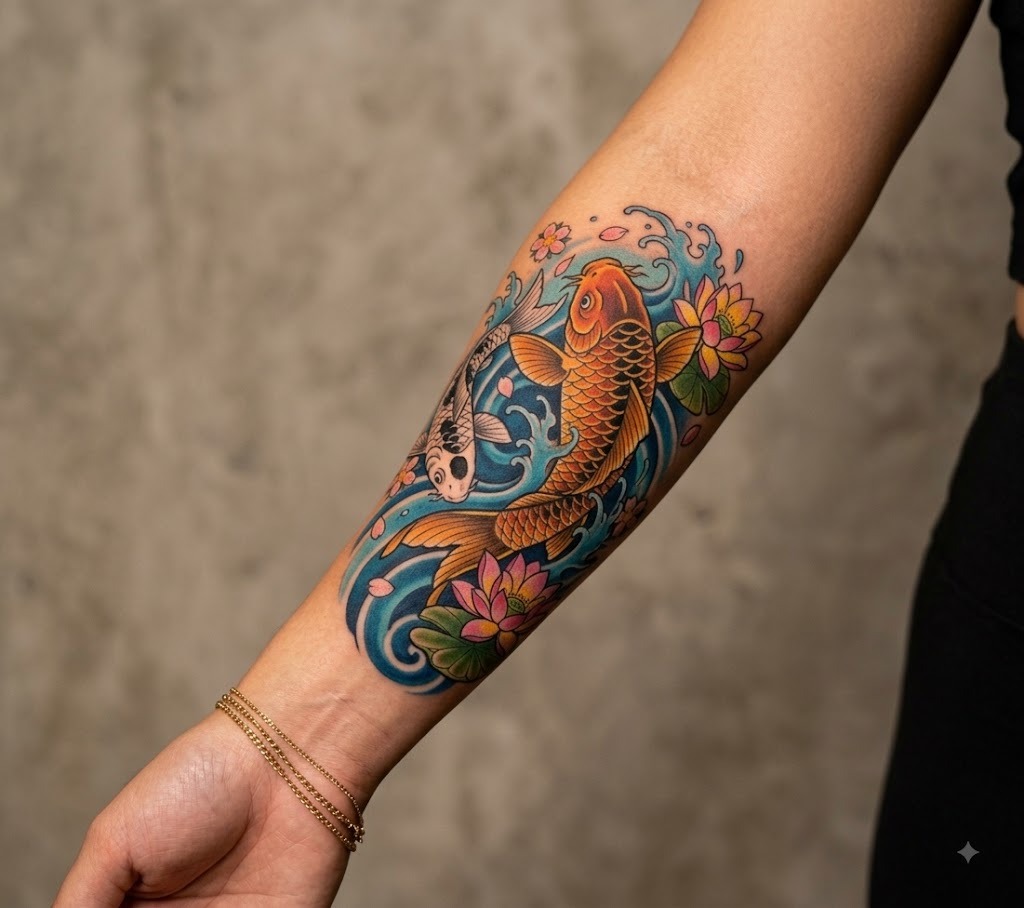
The koi is one of the few tattoos where a single design decision changes the entire meaning — and most people make it by accident.
Which way your fish is swimming matters. A koi facing upstream and a koi facing downstream say two different things about where you are in your life. Studios rarely ask. People find out afterwards, usually from someone who knows, and it is not a detail you can flip later.
If you are looking at koi fish tattoo designs, this guide covers the direction question, what each colour means, and how to build one that ages well. We are Vulture Tattoos, an appointment-only studio in Sector 47, Gurgaon.
The legend behind it
The meaning comes from one story, and it is worth knowing because everything else follows from it.
A school of carp swims up the Yellow River against the current. Most turn back. A few reach the waterfall at the Dragon Gate and keep going — leaping again and again at the falling water. The ones that finally make it over are transformed into dragons.
So the koi is not a symbol of success. It is a symbol of the struggle before success. Determination, perseverance, refusing to turn back when the current is against you. That is why it resonates with people at a hard point rather than a comfortable one.
It also explains why koi and dragons appear together so often — see our dragon tattoo designs guide.
Swimming up or swimming down?
This is the question we get asked most, so here is the honest answer including the disagreement.
The traditional reading:
- Swimming upstream (facing up) — still fighting the current. You are in the middle of the struggle, and you have not turned back. This is what most people mean and what most people should choose.
- Swimming downstream (facing down) — the goal has been reached. The fish has cleared the Dragon Gate and can now travel with the current.
Where people disagree: some read a downstream koi as giving up rather than arriving. There is no single authority that settles it, and both interpretations exist genuinely.
What we tell clients: if the meaning matters to you, go upstream. It is unambiguous, it is what most people recognise, and it does not need explaining. Choose downstream only if the “I got there” reading is specifically what you want and you are comfortable that some people read it differently.
What each colour means
Koi colours carry meanings in Japanese tradition, and this is where the tattoo becomes personal.
- Black (Karasu). Overcoming a major obstacle or a difficult period. Traditionally associated with the father, and often chosen after a hard chapter has closed.
- Red or orange (Kohaku). Love, strength and courage. Traditionally associated with the mother.
- Gold or yellow (Yamabuki). Wealth, prosperity and fortune.
- Blue (Asagi). Calm, tranquillity, and traditionally the son.
- White with red markings. Success in career or a turning point at work.
- Silver or platinum. Business success and material wellbeing.
A lot of people build a family piece this way — a black koi and a red koi together for parents, a blue one for a child. It is a quiet way to carry people without using names.
Black and grey works too. If you would rather avoid the colour question entirely, a black and grey koi is beautiful and more durable in Gurgaon sun. Our black and grey guide explains why, and our colour tattoo guide covers which shades hold on Indian skin.
How many koi?
- One koi — your own journey. The most common.
- Two koi — often arranged in a yin-yang circle. Balance, or a relationship. Also a popular couple’s piece.
- Three or more — a family, or a longer story. Needs real room.
Koi fish tattoo designs that work
- Koi with water. The classic. Waves and splash around the body give the piece its movement, and the water is what makes it read as a swimming fish rather than a fish shape.
- Koi with lotus. Rising clean from muddy water — the two symbols reinforce each other beautifully.
- Koi with maple leaves. Traditional Japanese pairing, adds autumn colour and movement.
- Koi and dragon. The transformation mid-way — front half dragon, back half koi. Ambitious and striking.
- Yin-yang koi pair. Two fish circling. Balance, and it fits a shoulder or upper back naturally.
- Fine-line koi. Delicate linework rather than heavy shading — see our fine line tattoo guide.
- Koi sleeve. The full Japanese treatment with background — see our Japanese tattoo guide and sleeve tattoo guide.
- Koi with chrysanthemum or peony. Traditional flowers that fill the space around the fish.
What decides whether it lasts
Do not skip the water. This is the most common mistake. A koi tattooed on bare skin with no waves around it looks unfinished forever, because the background is what gives the fish direction and movement. In traditional Japanese work the water is not decoration — it is half the design.
Keep the outlines confident. Traditional koi work has bold outlines around the body and each fin. Those outlines contain the colour and shading as pigment spreads over the years, and they are why thirty-year-old koi pieces still read clearly.
Do not over-detail the scales. Individual scales at small size merge into a texture within a decade. A good artist suggests scales rather than drawing every one.
Give it length. A koi is a long, curved shape. It needs a limb or a panel where the body can flow — a forearm, calf, thigh, back or shoulder. Squeezed into a small square, it stops looking like a fish in motion.
Where to place it
- Forearm. The most popular. The shape suits a koi swimming up the arm.
- Upper arm and shoulder. Comfortable, easy to cover, good for a yin-yang pair.
- Thigh and calf. Roomy, comfortable to sit, easy to keep out of the sun.
- Upper back and shoulder blade. Flat and protected — ideal for multiple fish.
- Ribs. Dramatic for a long vertical composition, though sharper to sit.
- Full or half sleeve. Where the traditional version truly works, with water as the background.
Does it hurt?
The same as any tattoo of that size in that place. Outer forearm, upper arm, thigh and calf are the most comfortable. Ribs, sternum and the inner arm are sharper.
The factor here is time. Colour packing and water background mean many passes over the same skin, so a full koi piece takes hours and larger work runs across sittings. Our tattoo pain chart covers every placement.
Want to talk it through? Call or WhatsApp us on +91 96676 14250 or message us on WhatsApp.
Healing and aftercare in Gurgaon
- Keep the wrap on as long as your artist says, then wash gently with lukewarm water and a mild fragrance-free soap.
- Pat dry, do not rub. Rubbing fresh colour work pulls pigment straight out.
- Use a thin layer of balm. Thin is the word.
- Do not pick or scratch. Colour scabs more than linework, and a lost patch in a red fin needs a touch-up.
- No swimming, sauna, gym sweat or soaking for two to three weeks. Chlorine is hard on fresh colour.
- Keep it moisturised well past the peeling stage.
If your koi is in colour, sun protection is essential here. UV breaks down coloured pigment faster than black, and reds and oranges are among the first to go. Use SPF 30 or higher once healed, every time it is exposed. Our full tattoo aftercare guide for Gurgaon covers each stage.
Why the artist matters
A koi looks simple and is not. The body is a long curve, and the fins and tail trail behind it — get the flow wrong and the fish looks stiff rather than swimming. The water is harder still: waves have to move around the body convincingly, and badly drawn water is the clearest sign of an inexperienced hand in Japanese-style work.
Colour packing matters too. Thin, patchy red does not settle into a soft look; it settles into a faded one within a couple of years.
Ajay handles realism, devotional, portrait and cover-up work, which covers colour depth and shading on larger koi pieces. Ronny specialises in fine-line, botanical, script and geometric work, which covers fine-line koi, lotus and linework discipline. Our page on the tattoo artists in Gurgaon introduces both.
Every tattoo is done with single-use sterile needles opened in front of you, in an appointment-only studio. That is part of why our clients have left more than 270 five-star Google reviews.
How it works with us
- Consultation. Bring your idea. We talk direction, colour meaning, how many fish, and how much water — and we look at your actual skin.
- Design. Drawn to your placement with the water planned as part of the composition. You see it before any needle touches you.
- A written quote. Clear, at the consultation. Our tattoo cost guide for Gurgaon explains what shapes it.
- The session. Paced, with breaks, split across sittings if needed.
- Aftercare. A clear plan, and we are on WhatsApp while it heals.
Why book in Sector 47
Vulture Tattoos is at Shop F-04, Spaze Boulevard, Malibu Towne, Sector 47, Gurugram. Easy to reach from across Gurgaon, DLF, Sohna Road, Golf Course Road and South Delhi.
Appointment-only means one client at a time, so long colour sessions happen in a calm studio rather than around walk-in traffic. For a piece where the background matters as much as the subject, that planning time is not optional.
Book your koi tattoo: call or WhatsApp +91 96676 14250.
See our work
Flow and water are what to judge, and both have to be seen. Browse our recent pieces on Instagram at @vulture_tattooz, read more at Vulture Tattoos, or reach us through our contact page. When you are ready, call or WhatsApp +91 96676 14250 and we will plan koi fish tattoo designs built to last.
Frequently Asked Questions
Should my koi swim up or down?
Upstream, if the meaning matters to you. A koi facing up means you are still fighting the current and have not turned back — the traditional reading, and the one most people recognise. Downstream traditionally means the goal has been reached, but some read it as giving up. Since there is genuine disagreement, upstream is the unambiguous choice.
What do the different koi colours mean?
Black is overcoming a major obstacle, traditionally linked to the father. Red or orange is love, strength and courage, linked to the mother. Gold is wealth and prosperity. Blue is calm, traditionally the son. White with red markings is career success. Many people build a family piece using these — a quiet way to carry people without names.
Does a koi tattoo need water around it?
Yes, in almost every case. The water is what gives the fish direction and movement, and in traditional Japanese work it is half the design rather than a background. A koi tattooed on bare skin with nothing around it looks unfinished permanently. This is the most common mistake we are asked to fix.
Can a koi tattoo be small?
A simple fine-line koi can work at modest size. A traditional koi with water, scales and colour cannot — a koi is a long curved shape that needs a limb or panel to flow across, and the detail closes up when shrunk. If space is limited, choose a fine-line version rather than a miniature of a full piece.
What does a koi and dragon tattoo mean?
It refers to the legend directly — the carp that swims up the Dragon Gate waterfall and transforms into a dragon. A popular version shows the transformation mid-way, front half dragon and back half koi. It reads as “the struggle became the reward”, and it is one of the most meaningful compositions in Japanese tattooing.
Two koi in a circle — what does that mean?
The yin-yang arrangement, usually two koi circling each other. It represents balance between opposites, and it is a popular couples’ piece as well as a personal one. The circular shape suits a shoulder, upper back or the outside of the arm particularly well.
Do koi tattoos age well?
Yes, when built traditionally. Bold outlines around the body and each fin contain the colour and shading as pigment spreads over the decades. The two things that undermine them are hairline outlines and over-detailed scales — individual scales merge into texture within about ten years, so a good artist suggests them rather than drawing every one.
How do I book and how much will it cost?
Booking is by appointment. Call or WhatsApp +91 96676 14250 to arrange a consultation. We discuss direction, colour, how many fish, placement and size, and give you a clear written quote once the design is settled. Pricing depends on size, detail and time, so we quote in person rather than online.