Buddha Tattoo Designs: Meaning, Placement and the Travel Warning
Before anything else, one thing that almost no studio page will tell you, and that has landed real people in real trouble.
In several Buddhist countries, a Buddha tattoo can get you refused entry, detained or deported. Sri Lanka has denied entry and deported tourists over visible Buddha tattoos. Myanmar has jailed people for it. Thailand’s Ministry of Culture has publicly asked visitors not to get them. In those countries, wearing an image of the Buddha on your skin — particularly below the waist — is treated as a serious insult rather than a tribute.
That does not mean you should not get one. Millions of people have. It means you should know before, not at an immigration desk.
If you are looking at buddha tattoo designs, this guide covers the meanings, the versions that work, and the practical things worth deciding first. We are Vulture Tattoos, an appointment-only studio in Sector 47, Gurgaon.
Buddha, Gautam Buddha, Laughing Buddha — not the same
People use these interchangeably and two of them are genuinely different figures.
- Buddha tattoo / Gautam Buddha tattoo — Siddhartha Gautama, the historical Buddha. Slim, serene, usually meditating or in a calm profile.
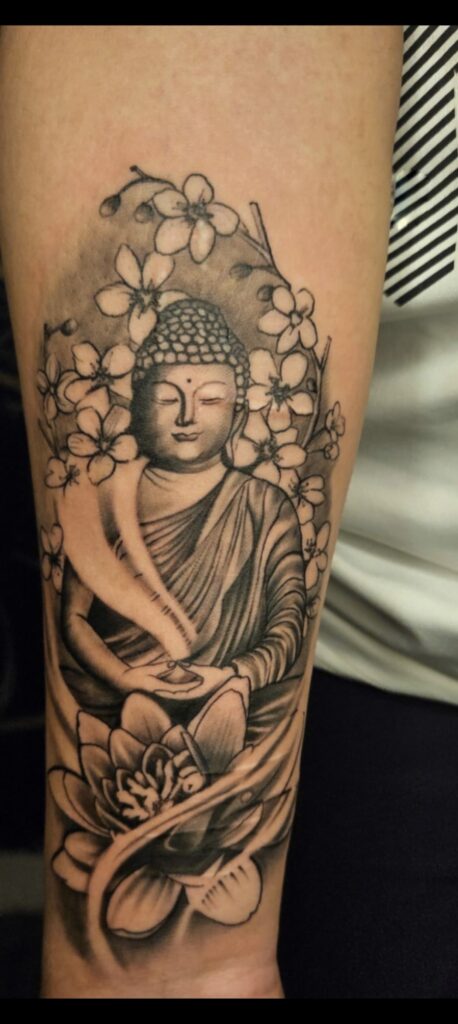
- Meditating Buddha tattoo — the seated lotus pose, eyes closed. The most requested version.
- Laughing Buddha tattoo — a completely different figure. This is Budai, a Chinese folk monk associated with contentment and good fortune. Round, cheerful, carrying a sack. Not the historical Buddha.
- Buddha face tattoo — just the face, often half-shaded or emerging from lotus petals.
- Zen tattoo / enso tattoo — the single brushstroke circle. Related tradition, no figure involved.
- Unalome tattoo — the spiral path with a straight line. Thai Buddhist symbol for the journey to enlightenment. Works beautifully small.
- Lotus tattoo — rising clean from muddy water. Buddhist and Hindu both, and one of the safest options if you want the meaning without the figure.
What it actually means
Most people getting this tattoo are marking a change in how they want to live rather than a religious identity.
- Peace and stillness — the most common reason by far.
- Detachment — letting go of things you cannot control.
- The middle path — neither indulgence nor denial.
- Awakening — the moment something finally became clear.
- Compassion — towards others, and often towards yourself.
The mudras — hand positions — carry specific meanings too. Dhyana (both hands in the lap) is meditation. Bhumisparsha (right hand touching the earth) is the moment of enlightenment. Abhaya (raised palm) is fearlessness and protection. Worth choosing deliberately rather than copying whichever reference you found.
Buddha tattoo designs that work
- Meditating Buddha. Full seated figure, calm, often on a lotus. The classic, and it needs real room — upper arm, thigh, back or chest.
- Face profile. Serene half-face, eyes closed. Works well on a forearm.
- Buddha with lotus. The figure rising from or seated on the flower. Softer and highly requested.
- Half face, half lotus. One side rendered, the other dissolving into petals. Modern and striking.
- Buddha in a mandala. Framed by ornamental geometry — see our mandala tattoo guide.
- Dotwork Buddha. Built from stippling rather than smooth shading. Ages very well.
- Unalome. The spiral-and-line path. One of the few options that genuinely works small.
- Enso circle. A single sweeping brushstroke ring. Deceptively hard — it must be done in one confident pass or it looks laboured.
- Buddha with a quote. Text alongside the figure. Read our script tattoo guide first, because lettering ages hardest.
- Fine-line Buddha. Minimal and delicate — see our fine line tattoo guide for how thin work holds up.
The placement rule that actually matters
This is the practical version of the warning at the top.
Do not place a Buddha image below the waist. In Buddhist tradition, the head is the most sacred part of the body and the feet the least. An image of the Buddha on a calf, ankle or foot is read as deliberate disrespect in countries where this matters — and it is the specific thing that has caused travellers real problems.
Placements that work:
- Upper arm and shoulder. Comfortable, roomy, and easy to cover when travelling.
- Forearm. Excellent for a face profile. Visible, though — worth thinking about if you travel to Southeast Asia.
- Chest. Meaningful placement, easy to cover, plenty of space.
- Upper back and between the shoulder blades. The largest canvas and completely coverable.
- Ribs. Private and roomy, though sharper to sit.
If you travel to Sri Lanka, Thailand, Myanmar or Cambodia, the upper arm, chest and back are the sensible choices — all easily covered by a sleeve.
Size, and what survives
A Buddha face is a portrait, and portraits fail on small errors. The serenity of the expression comes from very subtle shading around the eyes and mouth. Shrink it too far and the calm face becomes an unreadable grey oval.
- Full figure: upper arm, thigh, chest or back. Not a wrist.
- Face profile: forearm at minimum.
- Unalome, enso or lotus: these work small, and they carry the same meaning. If you want something discreet, choose one of these rather than shrinking a face.
- Push the darks. A piece built on genuinely deep shadows still reads as three-dimensional decades later. One built on gentle mid-greys flattens out.
Black and grey or colour?
Black and grey suits this subject best and it is what we recommend for most Buddha work. The stillness of the image comes from tone rather than colour, and black holds contrast on every Indian skin tone. It also lasts longest in Gurgaon’s sun. Our black and grey guide explains why.
Colour works for gold leaf detail, a saffron robe, or a coloured lotus. On Indian skin, deep saturated shades read far better than pale washes — our colour tattoo guide covers the palette question.
Does it hurt?
The same as any tattoo of that size in that place. Outer upper arm, forearm and thigh are the most comfortable. Ribs, sternum and areas over bone are sharper.
The factor here is time. A meditating figure with smooth shading takes hours, and large pieces may run across sittings. The sensation is a dull warmth rather than a sharp sting. Our tattoo pain chart covers every placement.
Want to talk it through? Call or WhatsApp us on +91 96676 14250 or message us on WhatsApp.
Healing and aftercare in Gurgaon
- Keep the wrap on as long as your artist says, then wash gently with lukewarm water and a mild fragrance-free soap.
- Pat dry, do not rub. Rubbing a fresh shaded area pulls pigment out.
- Use a thin layer of balm. Thin is the word.
- Do not pick or scratch. A pale patch on a serene face is very visible.
- No swimming, sauna, gym sweat or soaking for two to three weeks.
- Keep it moisturised well past the peeling stage.
Sun flattens shading over the years, and shading is what gives this piece its calm. Once healed, use SPF 30 or higher every time it is exposed. Our full tattoo aftercare guide for Gurgaon covers each stage.
Why the artist matters
A Buddha face is the hardest kind of portrait to get right, because the whole thing rests on expression. A few millimetres of difference around the eyes or the corner of the mouth turns serene into blank, or calm into sad. There is no outline to hide behind and no pattern to distract the eye.
Smooth gradients matter too. Patchy shading on a face reads as a mistake rather than as texture, and it does not improve with healing.
Ajay is our realism, devotional, portrait and cover-up specialist, so Buddha faces and figures sit with him. Ronny specialises in fine-line, botanical, script and geometric work, which covers unalome, enso, lotus, dotwork and mandala framing. Our page on the tattoo artists in Gurgaon introduces both, and our realism tattoo guide explains how to judge portrait work before you book.
Every tattoo is done with single-use sterile needles opened in front of you, in an appointment-only studio. That is part of why our clients have left more than 270 five-star Google reviews.
How it works with us
- Consultation. Bring your reference and tell us what it means to you. We talk about mudra, expression, size and placement — including whether you travel.
- Design. Drawn custom for your placement and sized so the expression survives. You see it before any needle touches you.
- A written quote. Clear, at the consultation. Our tattoo cost guide for Gurgaon explains what shapes it.
- The session. Calm and paced, split across sittings if needed.
- Aftercare. A clear plan, and we are on WhatsApp while it heals.
Why book in Sector 47
Vulture Tattoos is at Shop F-04, Spaze Boulevard, Malibu Towne, Sector 47, Gurugram. Easy to reach from across Gurgaon, DLF, Sohna Road, Golf Course Road and South Delhi.
Appointment-only means one client at a time in a quiet studio. For long portrait sessions, that is not a luxury — it is what lets the artist concentrate on an expression that has to be exactly right.
Book your Buddha tattoo: call or WhatsApp +91 96676 14250.
See our work
Smooth gradients and a correct expression are what to judge, ideally on healed work rather than fresh photos. Browse our recent pieces on Instagram at @vulture_tattooz, read more at Vulture Tattoos, or reach us through our contact page. When you are ready, call or WhatsApp +91 96676 14250 and we will plan buddha tattoo designs built to last.
Frequently Asked Questions
Can a Buddha tattoo cause problems when travelling?
Yes, in some countries. Sri Lanka has denied entry and deported tourists over visible Buddha tattoos, Myanmar has jailed people for it, and Thailand has officially discouraged them. A tattoo below the waist is treated as especially disrespectful. If you travel to Southeast Asia, choose a placement you can cover — upper arm, chest or back.
Where should I not place a Buddha tattoo?
Not below the waist. In Buddhist tradition the head is the most sacred part of the body and the feet the least, so a Buddha image on a calf, ankle or foot reads as deliberate disrespect. This is the specific placement that has caused travellers real trouble. Upper arm, chest, back and forearm are all fine.
Is the Laughing Buddha the same as Gautam Buddha?
No — they are different figures. The Laughing Buddha is Budai, a Chinese folk monk linked to contentment and good fortune. Gautam Buddha is Siddhartha Gautama, the historical Buddha, usually shown slim and serene in meditation. People often ask for one and mean the other, so it is worth being clear at the consultation.
How small can a Buddha tattoo be?
A face is a portrait, and its calm comes from very subtle shading around the eyes and mouth. Below a certain size that shading merges and the face becomes an unreadable oval — a forearm is the minimum for a face, and a full figure needs an upper arm or larger. If you want something small, an unalome, enso or lotus carries the same meaning and genuinely works at small scale.
What do the hand positions mean?
The mudras carry specific meanings. Dhyana, with both hands in the lap, is meditation. Bhumisparsha, right hand touching the earth, is the moment of enlightenment. Abhaya, palm raised, is fearlessness and protection. Choosing one deliberately makes the tattoo more personal than simply copying whatever reference you found first.
Do I need to be Buddhist to get one?
No. Most people who get this tattoo are marking peace, detachment or a change in how they want to live rather than a religious identity. What does matter is knowing the placement convention and the travel issue, because those are the things that cause genuine offence rather than the tattoo itself.
Black and grey or colour?
Black and grey suits this subject best. The stillness comes from tone rather than colour, black holds contrast on every Indian skin tone, and it lasts longest in Gurgaon’s sun. Colour is worth considering for gold detail, a saffron robe or a coloured lotus — using deep saturated shades rather than pale washes.
How do I book and how much will it cost?
Booking is by appointment. Call or WhatsApp +91 96676 14250 to arrange a consultation. We discuss the design, mudra, size and placement, and give you a clear written quote once the details are settled. Pricing depends on size, detail and time, so we quote in person rather than online.