Dragon Tattoo Designs: Japanese, Chinese and What the Claws Mean
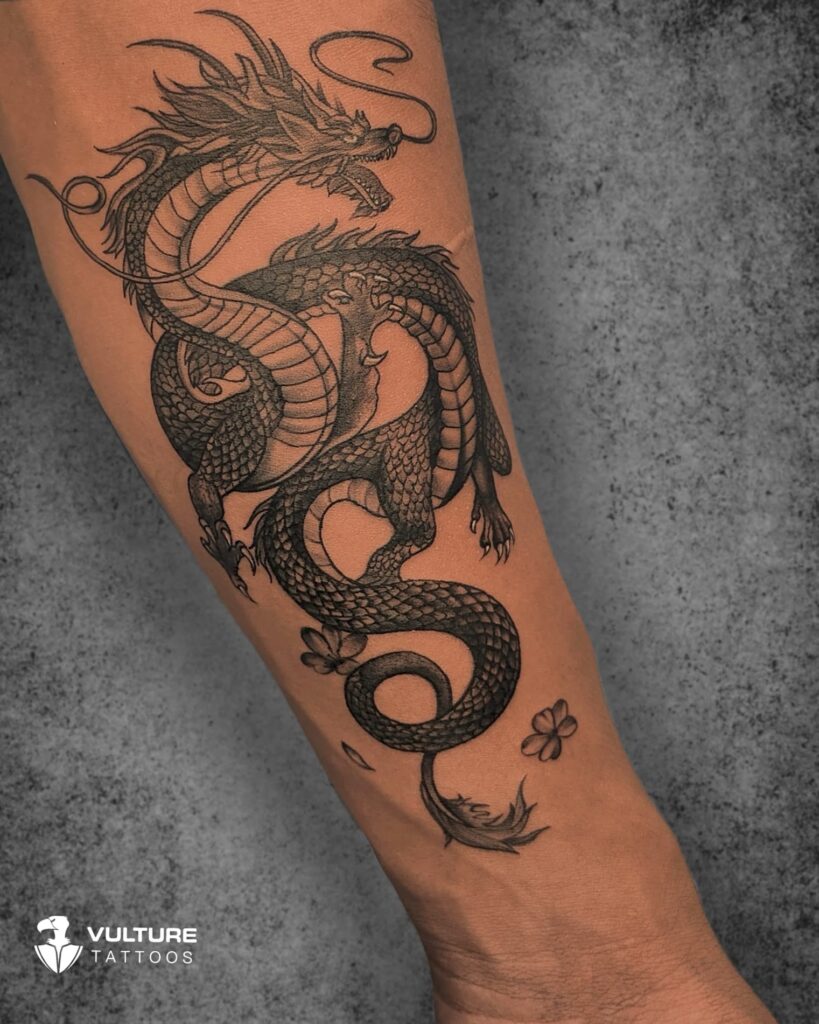
Here is something most people do not know before they book: the number of claws on your dragon means something.
In the traditional reading, a Chinese dragon has five claws and was reserved for the emperor. Four claws was for nobility. A Japanese dragon has three. Get a “Japanese” dragon tattooed with five claws and you have a Chinese imperial dragon wearing a Japanese style — which nobody will arrest you for, but which anyone familiar with the tradition will notice immediately.
That is the kind of detail that separates a dragon tattoo that looks considered from one that looks like it came off a search results page. If you are looking at dragon tattoo designs, this guide covers the differences that actually matter and how to build one that ages well. We are Vulture Tattoos, an appointment-only studio in Sector 47, Gurgaon.
Japanese, Chinese, Western — three different creatures
These are not style variations of one animal. They are separate beings with opposite meanings, and choosing the wrong one is the most common mistake with this tattoo.
Japanese dragon (ryu)
- A water deity, not a fire creature. Associated with rain, rivers and the sea.
- Benevolent. Wisdom, strength, protection. A guardian rather than a threat.
- Three claws. Long serpentine body, no wings.
- Paired with clouds, wind bars or waves. See our Japanese tattoo guide for how these compositions are built.
Chinese dragon (lung)
- Also benevolent, and a bringer of rain, luck and prosperity.
- Five claws for imperial, four for nobility, three for common use.
- Often shown chasing a flaming pearl — wisdom, or the thing you are pursuing.
- Fuller body, more mane, more whiskers than the Japanese version.
Western dragon
- The opposite meaning. A hoarder and an adversary — the thing the knight kills.
- Winged, four-legged, fire-breathing, scaled like a reptile.
- Modern readings soften this into power, independence and refusing to be tamed.
So decide first: do you want a protector, a bringer of fortune, or a force of raw power? They look completely different and they say completely different things.
Dragon tattoo designs that work
- Forearm wrap. The body coiling around the arm, head at the wrist or elbow. The most popular version and one of the best uses of the shape.
- Full or half sleeve. Where a dragon truly comes alive, because the body can travel properly. See our sleeve tattoo guide.
- Back piece. The largest canvas and the traditional home for the most ambitious work — see our back tattoo guide.
- Dragon and tiger. The classic Japanese pairing — dragon as sky and wisdom, tiger as earth and instinct. Usually on opposite arms or as one large composition.
- Dragon and phoenix. Balance of opposites, often chosen by couples.
- Dragon with koi. Referencing the legend where the carp becomes a dragon — see our koi fish tattoo guide.
- Dragon head only. Just the head and mane, no body. Fits a smaller space while keeping the impact.
- Fine-line dragon. Delicate linework rather than heavy shading. Modern, and one of the few versions that works small — see our fine line tattoo guide.
- Dragon around a leg or calf. The leg’s shape suits a wrapping body as well as an arm does.
- Dragon with a pearl. The Chinese version, chasing wisdom.
Why dragons need length, not just size
This is the practical thing to understand about the shape.
A dragon is serpentine. It is long, it curves, and its whole character comes from the way the body moves. A dragon squeezed into a square space loses exactly what makes it a dragon — you get a coiled lump instead of a creature in motion.
- Give it a limb. A forearm, an upper arm, a calf, a spine. Anywhere the body can travel.
- Plan the wrap before starting. The design has to look right from the front, the side and the back — a wrapping dragon that only works from one angle is a design that was drawn flat.
- Stencil in more than one position. Arm raised and lowered, because the body moves with you.
- Do not crop the tail. A tail that stops abruptly at the edge of the space is the clearest sign the piece was not planned.
If you only have a small area, a dragon head or a fine-line version is a far better choice than a shrunken full body.
How dragons age
Well — better than most detailed designs, and for a specific reason.
Traditional dragon work uses bold outlines around every scale group and body section. Those outlines contain the shading as pigment naturally spreads over the decades. That is why thirty-year-old Japanese dragons still read clearly while more delicate work from the same era has gone soft.
- Keep the outlines confident. Not hairline. This is what holds the piece together long term.
- Do not over-detail the scales. Individual scales at small size merge into texture within a decade. Suggest them rather than drawing every one.
- Strong darks beat gentle mid-greys. Contrast is what survives — see our black and grey guide.
Black and grey or colour?
Both are traditional and both work.
Black and grey is the more durable choice and it suits the Japanese style particularly well. It holds contrast on every Indian skin tone and lasts longest in Gurgaon’s sun.
Colour is spectacular on a dragon — deep reds, strong blues and greens through the body, gold on the claws and pearl. On Indian skin, deep saturated shades read far better than pale ones. Our colour tattoo guide covers the palette question.
Where to place it
- Forearm. The most popular. Naturally suits a wrapping body.
- Full or half sleeve. The best canvas for a complete composition.
- Back. The most ambitious option, and the traditional home for a full dragon.
- Calf and thigh. Comfortable to sit, roomy, easy to keep out of the sun.
- Chest and shoulder. Works well for a head with the body running down the arm.
- Spine. A vertical dragon down the back is striking — see our spine tattoo guide.
Does it hurt?
The same as any tattoo of that size in that place. Outer forearm, upper arm, thigh and calf are the most comfortable. Ribs, sternum, spine and the inner arm are sharper.
The real factor is time. A wrapping dragon covers a lot of skin, and heavy outlining plus shading means long sessions. Larger pieces are almost always split across sittings. Our tattoo pain chart covers every placement.
Want to talk it through? Call or WhatsApp us on +91 96676 14250 or message us on WhatsApp.
Healing and aftercare in Gurgaon
- Keep the wrap on as long as your artist says, then wash gently with lukewarm water and a mild fragrance-free soap.
- Pat dry, do not rub. Rubbing fresh work pulls pigment out.
- Use a thin layer of balm. Large areas tempt over-application. Thin is still the word.
- Do not pick or scratch. Heavy black and dense colour scab more than linework.
- No swimming, sauna, gym sweat or soaking for two to three weeks after each session.
- Keep it moisturised well past the peeling stage.
If you went with colour, sun protection is not optional here. UV breaks down coloured pigment faster than black, and a colour dragon is a lot of pigment to protect. Use SPF 30 or higher once healed. Our full tattoo aftercare guide for Gurgaon covers each stage.
Why the artist matters
A dragon is a flow problem before it is a drawing problem. Anyone can draw a dragon head. Far fewer people can wrap a long body around a moving, cone-shaped limb so it reads correctly from every angle and still looks like one creature when your arm is at rest and when it is raised.
Consistency matters too. On a piece that runs across several sessions, the scale rhythm, the line weight and the shading depth all have to match from one sitting to the next — which is a strong argument for finishing with the artist who started it.
Ajay handles realism, devotional, portrait and cover-up work, which covers the rendering and shading depth of large dragon pieces. Ronny specialises in fine-line, botanical, script and geometric work, which covers linework discipline and fine-line dragons. Our page on the tattoo artists in Gurgaon introduces both.
Every tattoo is done with single-use sterile needles opened in front of you, in an appointment-only studio. That is part of why our clients have left more than 270 five-star Google reviews.
How it works with us
- Consultation. Bring your idea and references. We talk Japanese, Chinese or Western, claw count, scale and how far the piece should run.
- Design. The whole composition planned before the first session, including how it wraps. You see it before any needle touches you.
- Stencil check in motion. Arm raised and lowered, because a wrapping design has to work when you move.
- A written quote. Clear, at the consultation, with a realistic session plan. Our tattoo cost guide for Gurgaon explains what shapes it.
- Aftercare. A clear plan after every sitting, and we are on WhatsApp throughout.
Why book in Sector 47
Vulture Tattoos is at Shop F-04, Spaze Boulevard, Malibu Towne, Sector 47, Gurugram. Easy to reach from across Gurgaon, DLF, Sohna Road, Golf Course Road and South Delhi.
For a project running across several sessions, being local stops being a convenience and becomes a requirement — consistency of hand across sittings is what makes a dragon look like one creature rather than three sessions stitched together.
Book your dragon tattoo: call or WhatsApp +91 96676 14250.
See our work
Flow and even black packing are what to judge, and both have to be seen. Browse our recent pieces on Instagram at @vulture_tattooz, read more at Vulture Tattoos, or reach us through our contact page. When you are ready, call or WhatsApp +91 96676 14250 and we will plan dragon tattoo designs built to last.
Frequently Asked Questions
What is the difference between a Japanese and Chinese dragon tattoo?
The Japanese ryu is a water deity — rain, rivers, the sea — shown with three claws and paired with clouds or waves. The Chinese lung brings rain, luck and prosperity, has four or five claws, a fuller body and more mane, and is often chasing a flaming pearl. Both are benevolent, unlike the Western dragon, which is an adversary.
How many claws should my dragon have?
Three for a Japanese dragon. For a Chinese dragon, five was traditionally imperial, four for nobility and three for common use. It is a small detail that anyone familiar with the tradition notices immediately, so it is worth deciding deliberately rather than copying whichever reference you found first.
Can a dragon tattoo be small?
A full body, no — a dragon is a long serpentine creature and squeezing it into a small square gives you a coiled lump rather than a creature in motion. A dragon head works well at modest size, and a fine-line dragon can work small. If space is limited, choose one of those rather than shrinking a full body.
Do dragon tattoos age well?
Better than most detailed designs. Traditional dragon work uses bold outlines around each body section, and those outlines contain the shading as pigment spreads over the decades. Keep the outlines confident rather than hairline, and do not over-detail individual scales — those merge into texture within ten years.
What does a dragon and tiger tattoo mean?
It is the classic Japanese pairing — the dragon as sky, wisdom and control, the tiger as earth, strength and instinct. Together they represent balance between opposite forces. They usually work best on opposite arms, or as one large composition across the back or chest.
Where is the best placement for a dragon?
Anywhere the body can travel — a forearm, a full or half sleeve, a calf, the spine or the back. The forearm wrap is the most popular. Whatever you choose, the design has to be planned around the wrap and stencilled with the limb in more than one position, because the body moves with you.
Should it be black and grey or colour?
Both are traditional. Black and grey is more durable and suits the Japanese style particularly well, holding contrast on every Indian skin tone and lasting longest in Gurgaon’s sun. Colour is spectacular on a dragon — deep reds, blues and greens with gold detail — provided you choose saturated shades rather than pale ones.
How do I book and how much will it cost?
Booking is by appointment. Call or WhatsApp +91 96676 14250 to arrange a consultation. We discuss the style, scale, placement and session plan, and give you a clear written quote once the design is settled. Pricing depends on size, detail and total hours, so we quote in person rather than online.