Kali Tattoo Designs: Meaning, Symbols and Why the Details Matter
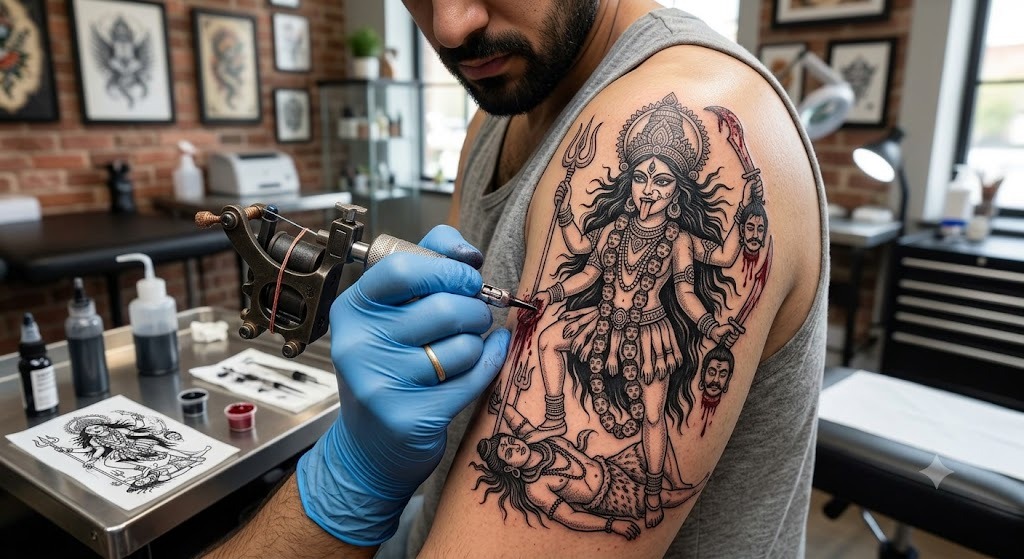
Kali is the goddess people misread most often, and it is worth clearing that up before anything else. A tattoo showing a dark-skinned figure, a garland of skulls, a protruding tongue and a raised sword looks, to someone unfamiliar with the tradition, like a symbol of pure destruction. It is closer to the opposite. Kali destroys the ego, time itself, and everything false — she is a symbol of liberation, not violence for its own sake.
That gap between how the imagery reads and what it actually means is exactly why the details in a Kali tattoo matter so much. If you are looking at kali tattoo designs, this guide covers what each element represents, the forms she is shown in, and what a fierce, complex figure like this needs to survive as a tattoo. We are Vulture Tattoos, an appointment-only studio in Sector 47, Gurgaon.
What Kali actually represents
Kali’s name comes from kala, time, and she is often described as the destroyer of time itself — the force that dissolves illusion, ego and everything temporary so that what is real can be seen clearly.
- Destruction of the ego. Not people, not the world — the false self that stands between a person and truth.
- Liberation from fear. Kali is invoked specifically against fear, including the fear of death.
- Transformation. The fierce imagery represents the intensity of real change, which is rarely gentle.
- The Divine Mother. Despite the fierce form, Kali is deeply worshipped as a maternal, protective figure across Bengal and much of India — the ferocity is protective, aimed outward at what threatens her children.
Knowing this changes how the tattoo reads to you every day. It is not a symbol of anger. It is a symbol of what it actually takes to burn away what is false.
What each symbol means
Every element of the traditional image carries specific meaning, and knowing it is what lets you choose which ones matter to you.
- Dark or blue skin. Represents the vastness of space and the infinite, formless nature of reality beyond the visible world.
- The garland of skulls (mundamala). Usually fifty skulls, representing the fifty letters of the Sanskrit alphabet — the sound and knowledge from which all creation arises. Not a symbol of death for its own sake, but of the primal building blocks of existence.
- The protruding tongue. Several readings exist. One is shock or shame at realising she has stepped on Shiva. Another, more esoteric, reads it as the expulsion of rajas — restless energy — leaving only pure consciousness.
- Multiple arms and weapons. Similar to Durga — see our Durga tattoo designs guide — each weapon representing a different destructive-protective power.
- A severed head in one hand. The destroyed ego, held as proof of the work done.
- Standing on Shiva. A profound image — Shakti, active energy, standing upon Shiva, pure consciousness, showing that consciousness without active energy is inert. It is a statement about the two being inseparable, not a literal act of dominance.
Kali tattoo designs that work
- Face, fierce form. The most requested — the intense expression, tongue and dark skin, without the full figure. Works at a moderate to large size.
- Full figure, standing on Shiva. The complete traditional composition. Ambitious, and needs real scale — see the sizing section below.
- Kali with skull garland only. The garland worked into an ornamental piece, sometimes without the full figure, using the mundamala’s meaning without the entire iconography.
- Kali with sword and severed head. A focused composition on the destruction of ego, without the full multi-armed figure.
- Kali with Om or mantra. Paired with the symbol or a specific invocation in Devanagari — see our Om tattoo designs and script tattoo guide.
- Fine-line or geometric Kali. A more contemporary, stylised treatment rather than full realism — see our fine line tattoo guide.
Why this piece is demanding, honestly
Kali combines everything that makes devotional tattoos technically difficult, in one figure.
- It is a portrait. The expression carries the entire meaning of the piece — fierce but not cartoonish, intense but not simply angry. This is exactly the kind of nuance that separates a skilled artist’s work from a flat, generic face. See our realism tattoo guide for how to judge that skill.
- It is often multi-armed. If you include the full figure with weapons, the same spacing rules apply as any multi-armed composition — each arm needs enough room to stay legible for decades.
- The skull garland has fine repeating detail. Fifty small skulls close together will merge into a dark ring as ink spreads unless each one has genuine space around it.
None of this means avoid the full traditional image. It means a small, cramped version will not do the symbolism justice, and a good artist will tell you honestly what size the details you want actually need.
Black and grey or colour?
Black and grey is the traditional and, for most people, the better choice for Kali. The fierce expression depends on contrast and shading rather than colour, and black holds that contrast on every Indian skin tone while lasting longest in Gurgaon’s sun. Our black and grey tattoo guide explains why.
Colour is occasionally used for the deep blue skin tone specifically, or a red tongue detail, but this is a piece where restraint generally serves the imagery better than a full palette.
Where to place it
- Upper back. The best canvas for a full figure, particularly one including Shiva beneath her. See our back tattoo guide.
- Chest. Powerful and symmetrical, well suited to a face-focused composition.
- Forearm. The minimum sensible size for a face, or a reduced garland-and-symbol design.
- Upper arm and shoulder. Comfortable, easy to cover.
- Thigh. Roomy and comfortable, good for a mid-sized composition.
Worth considering. Many people hold that sacred imagery should not be worn below the waist. We raise this at the consultation because placement, not design, is the most common source of regret with devotional work.
Does it hurt?
The same as any tattoo of that size in that place. Outer forearm, upper arm and thigh are the most comfortable. Chest, ribs and areas over bone are sharper.
A face composition is a substantial session. A full figure with skull garland and weapons is a long project, often split across sittings. Our tattoo pain chart covers every placement.
Want to talk through the composition? Call or WhatsApp us on +91 96676 14250 or message us on WhatsApp.
Healing and aftercare in Gurgaon
- Keep the wrap on as long as your artist says, then wash gently with lukewarm water and mild fragrance-free soap.
- Pat dry, do not rub. Rubbing a fresh shaded area pulls pigment out.
- Thin layer of balm. Thin is the word.
- Do not pick or scratch. A pale patch inside a shaded face or garland detail is very visible.
- No swimming, sauna, gym sweat or soaking for two to three weeks after each session.
- Keep it moisturised well past the peeling stage.
Sun flattens contrast over the years, and the fierce expression this piece depends on comes entirely from contrast. Use SPF 30 or higher once healed. Our full tattoo aftercare guide for Gurgaon covers each stage.
Why the artist matters
A Kali tattoo lives or dies on the expression. Too soft and it loses the intensity that gives the piece its meaning. Too crude and it reads as aggressive rather than powerful. Getting that balance right, session after session as shading builds, is a skill that shows most clearly in healed work rather than fresh photos.
Ajay is our realism, devotional, portrait and cover-up specialist, so Kali compositions of any scale sit with him. Ronny specialises in fine-line, botanical, script and geometric work, which covers ornamental garland detail, mandala framing and any Devanagari mantra. Our page on the tattoo artists in Gurgaon introduces both.
Every tattoo is done with single-use sterile needles opened in front of you, in an appointment-only studio. That is part of why our clients have left more than 270 five-star Google reviews.
How it works with us
- Consultation. Bring your reference and tell us which form and which symbols matter to you. We talk scale honestly before anything is designed.
- Design. Drawn to your placement, with the garland and any weapons given proper space to survive the decades. You see it before any needle touches you.
- A written quote at consultation. Clear, with a realistic session plan for larger pieces. Our tattoo cost guide for Gurgaon explains what shapes it.
- The session, or sessions. Paced, with breaks, split across sittings for anything ambitious.
- Aftercare and touch-ups. A clear plan, and we are on WhatsApp throughout.
Why book in Sector 47
Vulture Tattoos sits at Shop F-04, Spaze Boulevard, Malibu Towne, Sector 47, Gurugram, easy to reach from across Gurgaon, DLF, Sohna Road, Golf Course Road and South Delhi. For a piece running across sessions, the same artist seeing it through keeps the expression and shading consistent from start to finish. Appointment-only means a calm, private studio for detailed devotional work.
Book your Kali tattoo: call or WhatsApp +91 96676 14250 to start with a consultation.
See our work
Expression and shading depth are what to judge, and both need to be seen. Browse our recent pieces on Instagram at @vulture_tattooz, read more about the studio at Vulture Tattoos, or reach out through our contact page. When you are ready, call or WhatsApp +91 96676 14250 and we will plan kali tattoo designs built to last.
Frequently Asked Questions
What does a Kali tattoo mean?
Kali represents the destruction of the ego, illusion and fear, and liberation through that destruction — not violence for its own sake. Her name comes from kala, time, and she is often read as the force that dissolves everything temporary so what is real can be seen. She is also deeply worshipped as a protective, maternal figure, particularly in Bengal.
What does the garland of skulls mean?
Traditionally fifty skulls, representing the fifty letters of the Sanskrit alphabet — the sound and knowledge from which all creation arises. It is a symbol of primal knowledge rather than death for its own sake, and it is one of the most recognisable elements of the traditional image.
Why does Kali stand on Shiva?
It represents Shakti, active energy, standing on Shiva, pure consciousness — a statement that consciousness without active energy is inert, and the two are inseparable. It is not depicted as an act of dominance but as a profound teaching about how the two forces relate to each other.
How big does a Kali tattoo need to be?
A full figure with skull garland and weapons needs a back, chest or full forearm at minimum, because the repeating skull detail closes up into a dark ring if it does not have proper space. A face composition works on a standard forearm. Compressing the whole traditional image onto a small canvas will not do the symbolism justice.
Should a Kali tattoo be black and grey or colour?
Black and grey is the traditional and generally better choice — the fierce expression depends on contrast and shading rather than colour, and black holds that contrast on every Indian skin tone while lasting longest in Gurgaon’s sun. Colour is occasionally used sparingly for the blue skin tone or a red tongue detail.
Is a Kali tattoo disrespectful?
No, provided it is approached with an understanding of what the imagery actually means rather than treated as generic “dark goddess” horror aesthetic. Kali is a deeply revered figure across much of India, and the fierce imagery represents liberation and protection rather than aggression. Knowing the meaning of each element is part of wearing the tattoo respectfully.
Where should I not place a Kali tattoo?
Many people hold that sacred imagery should not be worn below the waist, which is worth considering for calf, ankle or foot placements. Views differ genuinely and it is your decision — we raise it at the consultation because placement, not the design, is the most common regret with devotional work.
How do I book and how much will it cost?
Booking is by appointment. Call or WhatsApp +91 96676 14250 to arrange a consultation, where we discuss the form, symbols and scale, and give you a clear written quote once everything is settled. Pricing depends on size, detail and total hours, so we quote in person rather than online.