Evil Eye Tattoo Designs: Meaning, Ideas, Placement and Ageing
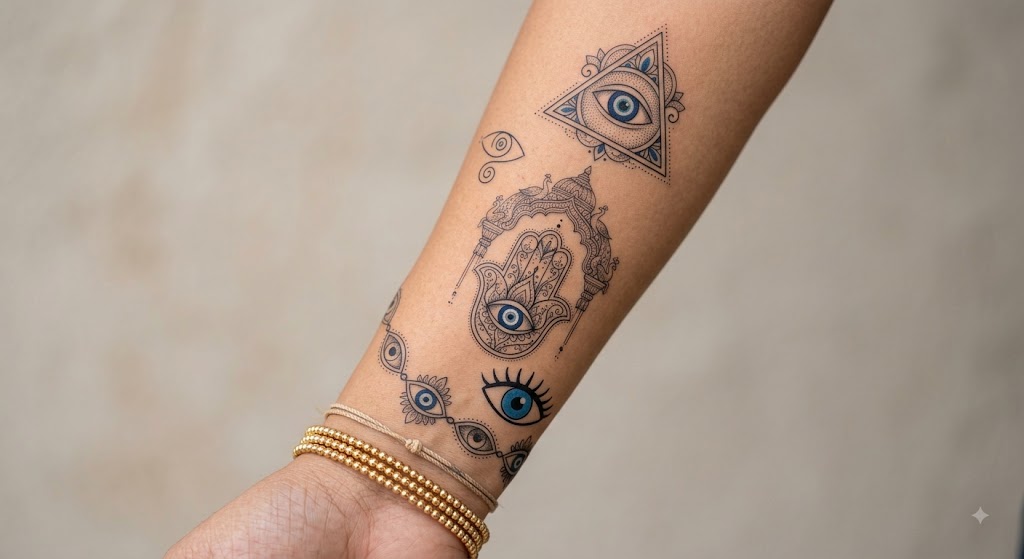
You already know this symbol, even if you have never called it by name. It is the blue eye hanging in your grandmother’s doorway. It is the black dot she put behind your ear before a wedding. It is nazar — the belief that other people’s envy can actually harm you, and that you need something to absorb it.
The evil eye tattoo has become one of the most requested small designs in Gurgaon, and it makes sense here. This is a belief nobody has to explain to an Indian family.
But it is also a design with one specific weakness that almost nobody warns you about, and it decides whether your tattoo still looks right in ten years. If you are looking at evil eye tattoo designs, this guide covers it honestly. We are Vulture Tattoos, an appointment-only studio in Sector 47, Gurgaon.
What the evil eye actually means
The nazar amulet is not a symbol of the evil eye. It is protection against it. That is worth knowing, because people occasionally worry they are wearing something negative.
The belief spans Turkey, Greece, the Middle East, and South Asia, where we call it nazar or buri nazar. The idea is the same everywhere: a look given in envy carries real weight, and a blue eye absorbs it before it reaches you.
- The classic blue nazar — dark blue outer ring, light blue, white, black pupil. The version most people picture.
- The black dot (kala tika) — the Indian version. Placed on a baby’s forehead or behind the ear for exactly the same reason.
- Hamsa hand — the palm with an eye at its centre. Protection with a longer history, often chosen alongside.
Evil eye tattoo designs that work
- Classic blue nazar. The full amulet with its concentric rings. The most requested version by a distance.
- Fine-line eye outline. Just the eye shape in black linework, no colour. Subtle and modern — see our fine line tattoo guide.
- Hamsa with eye. The protective palm with the nazar at its centre. Beautiful, and it gives the eye a frame that helps it hold up.
- Eye with lashes or teardrops. A more illustrated, decorative treatment.
- Evil eye in a mandala. The eye framed by ornamental geometry — see our mandala tattoo guide.
- Eye with a moon or sun. Combined with celestial elements. Popular on the spine and forearm.
- Eye with a snake. Two protective symbols together — see our snake tattoo designs guide.
- Realistic eye. A human eye rendered in black and grey realism rather than the amulet. A completely different tattoo — see our realism tattoo guide.
- Matching pairs. One for you, one for a sister or friend. Protection for each other.
The problem nobody warns you about
The classic nazar is built from concentric rings — dark blue, light blue, white, black pupil, one inside the other. That structure is exactly what makes it recognisable, and it is also its weakness.
Ink spreads slightly in living skin over the years. On a large tattoo you never notice. On a small design made of rings sitting close together, that spread closes the gaps between them. The rings merge, and a nazar that has merged is no longer a nazar — it is a blue-black blob.
What keeps it clean:
- Do not go tiny. A 2 cm nazar has almost no margin. Around 4–5 cm gives the rings real room.
- Keep the white ring generous. The white in the design is usually bare skin, not white ink, and it is the gap that keeps the rings separate. Squeeze it and the design closes fastest.
- Use deep, saturated blue. Not pale. Pale blue is the first colour to fade on Indian skin, and a faded nazar loses its whole identity.
- Consider the outline version. A black fine-line eye has no rings to merge, so it ages more predictably than the full colour amulet.
A word about white ink
Many nazar references show a bright white ring. On skin, that white is almost always bare skin left untouched, not white pigment.
Actual white ink sits under the skin rather than on it. On most Indian skin tones it fades to nearly nothing within a couple of years, or shifts slightly yellow. Any artist promising a bright white ring that stays bright is not being straight with you.
We plan the design so the white is your own skin. That way it stays exactly as bright as it was on day one, forever.
Colour on Indian skin
The nazar is a colour tattoo, so the palette matters more here than in most small designs.
Deep blues hold beautifully on medium and deeper Indian skin. Pale sky blue does not — it has too little contrast against the skin and reads faint once healed. Since blue is the whole identity of this symbol, going deep is not a style choice, it is what keeps the tattoo readable.
Our colour tattoo guide for Gurgaon covers how pigment behaves on Indian skin in detail, and our black and grey guide explains the no-colour alternative.
Where to place it
- Inner forearm. The best all-round placement. Flat, low sun, low friction, ages well.
- Back of the arm or upper arm. Comfortable, easy to cover, well protected.
- Behind the ear. Very popular and it echoes where the kala tika traditionally goes. Keep the design very simple at this size.
- Back of the neck. Protection facing behind you — a meaning a lot of people like. Easy to cover with hair.
- Ankle. Understated and easy to hide. Bony, so sharper to sit.
- Wrist. The most requested and the most demanding — highest friction and sun. If you want a wrist nazar, go slightly larger than feels necessary. Our wrist tattoo guide explains why.
- Finger. We will be straight: finger tattoos fade fastest anywhere on the body, often visibly within a year. Coloured finger tattoos fade faster still.
Does it hurt?
The same as any tattoo of that size in that place. Most evil eye tattoos are small, so sessions are short — often under an hour. The outer forearm and upper arm are the most comfortable. Behind the ear, the ankle, the neck and the inner wrist are sharper because the skin is thin and the bone is close. Our tattoo pain chart covers every placement.
Want to talk it through? Call or WhatsApp us on +91 96676 14250 or message us on WhatsApp.
Healing and aftercare in Gurgaon
- Keep the wrap on as long as your artist says, then wash gently with lukewarm water and a mild fragrance-free soap.
- Pat dry, do not rub. Rubbing a fresh colour tattoo can pull pigment straight out.
- Use a thin layer of balm. Thin is the word.
- Do not pick or scratch. Colour scabs more than linework, and a lost patch in a small ring is a large fraction of the design.
- No swimming, sauna, gym sweat or soaking for two to three weeks. Chlorine is hard on fresh colour.
- Keep it moisturised well past the peeling stage.
Sun protection is not optional on a colour piece here. UV is the biggest enemy of coloured pigment, and Gurgaon summers are severe. Once healed, use SPF 30 minimum — 50 is better — every time it is exposed. Our full tattoo aftercare guide for Gurgaon covers each stage.
Why the artist matters, even on something small
A nazar is a set of concentric circles. That sounds simple and it is not. The rings have to be genuinely circular, evenly spaced, and concentric — and the human eye spots an off-centre circle instantly. There is no shading or detail to hide behind.
The colour also has to be packed solidly. Thin, patchy colour on a small design does not settle into a soft look; it settles into a faded one within a year or two.
Ronny specialises in fine-line, botanical, script and geometric work, which covers outline versions, mandala framing and clean circular work. Ajay handles realism, devotional, portrait and cover-up work, including realistic eyes. Our page on the tattoo artists in Gurgaon introduces both.
Every tattoo is done with single-use sterile needles opened in front of you, in an appointment-only studio. That is part of why our clients have left more than 270 five-star Google reviews.
How it works with us
- Consultation. Bring your idea. We talk about version, size, colour and placement, and look at your actual skin in real light.
- Design. Drawn custom and sized so the rings survive. You see it before any needle touches you.
- A written quote. Clear, at the consultation. Our tattoo cost guide for Gurgaon explains what shapes it.
- The session. Short, calm, at your pace.
- Aftercare. A clear plan, and we are on WhatsApp while it heals.
Why book in Sector 47
Vulture Tattoos is at Shop F-04, Spaze Boulevard, Malibu Towne, Sector 47, Gurugram. Easy to reach from across Gurgaon, DLF, Sohna Road, Golf Course Road and South Delhi.
Appointment-only means a quiet studio and one client at a time. If this is your first tattoo — and for a lot of people an evil eye is — that makes a real difference.
Book your evil eye tattoo: call or WhatsApp +91 96676 14250.
See our work
Clean circles and solid colour packing are what to judge, and both have to be seen. Browse our recent pieces on Instagram at @vulture_tattooz, read more at Vulture Tattoos, or reach us through our contact page. When you are ready, call or WhatsApp +91 96676 14250 and we will plan evil eye tattoo designs built to stay sharp.
Frequently Asked Questions
Does an evil eye tattoo bring bad luck?
No. The nazar is protection against the evil eye, not a symbol of it. The belief runs across Turkey, Greece, the Middle East and South Asia, and it is the same idea as the kala tika your family may have used on you as a child — something that absorbs envy before it reaches you.
How big should an evil eye tattoo be?
Around 4–5 cm at minimum for the classic amulet. It is built from concentric rings, and as ink spreads over the years those rings merge if they were too close together to begin with. A 2 cm nazar has almost no margin. If you want something genuinely tiny, a simple black outline eye is the better choice.
Will the white part stay white?
Only if it is your own skin rather than white ink. White pigment sits under the skin and on most Indian skin tones it fades to almost nothing within a couple of years, sometimes shifting slightly yellow. We plan the design so the white ring is bare skin — that way it stays exactly as bright as day one.
Which blue works best on Indian skin?
Deep, saturated blue. Pale sky blue has too little contrast against medium and deeper skin and reads faint once healed. Since blue is the entire identity of this symbol, going deep is not a style preference — it is what keeps the tattoo recognisable in ten years.
Can I get an evil eye tattoo without colour?
Yes, and it is often the more durable option. A black fine-line eye outline has no concentric colour rings to merge, so it ages more predictably. It is also more discreet. Plenty of people prefer it for exactly those reasons.
Where is the best placement?
The inner forearm for durability, or behind the ear if you want it discreet and traditional — that is where the kala tika usually goes. Back of the neck is popular for the idea of protection facing behind you. Wrists and fingers are the most requested and the least durable, because of constant friction and sun.
Can two people get matching evil eye tattoos?
Yes, and it is a common request between sisters and close friends — protection for each other. Design both at the same consultation so they match properly, even if you get inked on different days.
How do I book and how much will it cost?
Booking is by appointment. Call or WhatsApp +91 96676 14250 to arrange a consultation. We discuss the design, size, colour and placement, and give you a clear written quote once the details are settled. Pricing depends on size, detail and time, so we quote in person rather than online.