Snake Tattoo Designs & Meaning: A Complete Guide
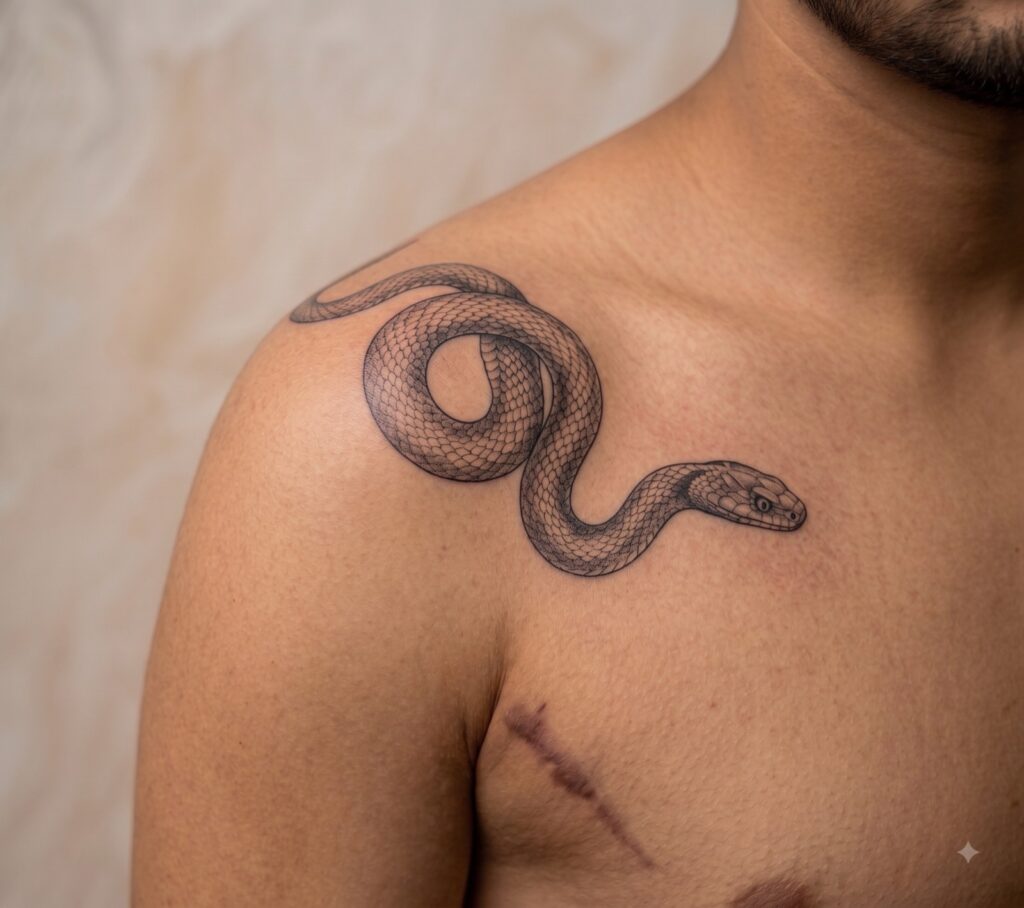
Ask ten people why they want a snake on their skin and you’ll get ten different answers. Somebody just left a bad relationship and wants to mark the shedding. Somebody else grew up around Naga imagery and wants that protection on their arm. A few just think a coiled cobra looks incredible wrapping the forearm, and honestly, they’re right. Snakes have been one of the most requested designs at our studio for years, and they don’t seem to be going anywhere.
This guide walks through what snakes actually mean, the styles that suit them, the combinations people keep asking for, and the practical stuff nobody tells you about placement and aging. We’re Vulture Tattoos, an appointment-only studio in Sector 47, Gurgaon, and we’ve put a lot of serpents on a lot of people. So this comes from the chair, not from a Pinterest board.
Why the snake carries so much weight
Very few animals show up across this many cultures with this much meaning attached. The snake is old imagery. It predates most of the symbols we tattoo today, and that history is part of why a good snake piece feels heavier than a lot of other designs.
The core idea most people connect with is rebirth. A snake sheds its skin and crawls out looking new. That’s about as clean a metaphor for personal change as nature gives us, which is why so many people book a snake after a divorce, a recovery, a career blow-up, or any moment where they walked out of an old version of themselves. The shed isn’t just visual, it’s the whole point.
But rebirth is only one thread. Here’s the wider picture of what people bring to us:
- Rebirth and shedding: letting go of an old chapter and starting clean. The most common reason people cite, and usually the most personal.
- Protection and vigilance: a snake with its head raised is watchful. In a lot of traditions it guards rather than attacks, which suits people who see themselves as protectors.
- Temptation and duality: the Garden of Eden reading, beauty and danger in the same body. A snake can be seductive and threatening at once, and that tension is the appeal.
- Wisdom and healing: the serpent coiled around a staff is still the symbol on pharmacies and medical logos. Knowledge, medicine, the sense that the snake knows something you don’t.
- Eternity and cycles: this is where the Ouroboros comes in, the snake eating its own tail, endless renewal with no beginning or end.
The Naga and snakes in Indian culture
We’re in India, so this deserves its own mention. The Naga is a serpent being that runs deep through Hindu and Buddhist tradition, tied to water, fertility, protection and the underworld. Shiva wears a snake around his neck. Vishnu rests on the coils of Shesha, the thousand-headed serpent. Nag Panchami is a whole festival built around venerating snakes.
For a lot of our clients in Gurgaon, a snake tattoo isn’t borrowed from Japanese or Western imagery at all, it’s rooted in something they grew up with. A Naga design can lean devotional, with a hooded cobra rising in a way that echoes temple carving, or it can stay abstract and let the meaning sit quietly underneath. Ajay, one of our artists, does a lot of devotional work, and a Naga piece with that intent behind it tends to be some of the most meaningful ink we put down.
The Ouroboros
The circle-shaped snake swallowing its own tail shows up in Egyptian, Greek and Norse imagery, and it never really went out of style. It reads as eternity, wholeness, the idea that endings feed beginnings. People often place it where a circle fits naturally, around a wrist, on the back of the shoulder, or framing another element in the middle. It’s a quiet tattoo that carries a big idea, and it ages well because the shape is simple.
Snake tattoo designs by style
The animal is flexible. A snake bends and coils, so it drapes across the body in a way few other subjects can, and it translates into almost every tattoo style you can name. The style you pick changes the whole feel, so this is worth thinking about before you commit. Good **snake tattoo designs** start with matching the style to what you actually want the piece to say.
Japanese and Irezumi
This is the classic. Japanese snakes, or hebi, are one of the oldest and most refined subjects in irezumi, and there’s a reason they show up on so many full sleeves and back pieces. The style uses bold outlines, strong colour, and movement, wind bars and waves that push the snake across the skin. In Japanese tradition the snake carries protection, good luck and recovery from misfortune, so the meaning is baked into the style itself.
Irezumi snakes are almost always paired with something, most often a peony for beauty and wealth, sometimes a skull for the life-and-death cycle. If you want scale and drama, this is the direction. It’s built for large areas and it holds up over decades because the whole language of the style assumes bold lines that survive aging.
Realism
A realistic snake looks like it could slide off your arm. Scale-by-scale detail, real light and shadow, the wet shine on the eye. Done well it’s stunning, and a coiled realistic cobra or python is one of the more impressive things you can wear. This is technical work, and it lives or dies on the artist. Our realism work is where a lot of clients push us hardest, and if that’s your direction it’s worth looking at examples of realism tattoo work before you book, so you know the artist can actually deliver the detail you’re picturing.
One honest note on realism: extremely fine scale detail can soften over the years as ink settles. A skilled artist builds in enough contrast that the snake still reads as sharp a decade later. Ask to see healed photos, not just fresh ones.
Blackwork and dotwork
Strip out the colour and you get something graphic and bold. Blackwork snakes use heavy black fill, negative space, and pattern instead of realism. Dotwork builds the scales and shading out of stippled dots, which gives a softer, almost textured look. These styles age beautifully because there’s no delicate colour to fade, just strong black that holds. If you want something that reads clearly from across a room and stays that way, blackwork is a smart pick.
Fine-line and minimalist
On the other end, a thin single-needle snake can be delicate and quiet, a slim serpent curling around a finger, a wrist, or the side of a forearm. Fine-line is popular right now and it suits people who want the symbolism without the surface area. Ronny handles most of our fine-line and script work, and a small, clean snake done in that style can be genuinely elegant.
The trade-off is honesty about longevity. Very thin lines with no bold anchor can blur faster than heavier work, especially on high-movement spots like fingers. It’s still a great choice, you just want to place it well and go in knowing a fine-line piece may need a touch-up sooner than a bold one.
Popular snake combinations
A snake rarely travels alone. The animal pairs with almost anything, and the pairing usually sharpens or shifts the meaning. These are the combos we get asked for most.
- Snake and flower: the most requested combination by a distance. A rose or peony against the snake sets beauty next to danger, softness next to threat. Roses lean romantic and Western, peonies lean Japanese and opulent. Either way the contrast is what makes it work.
- Snake and dagger: a snake coiled around a blade is pure old-school traditional energy. It reads as danger, protection, sometimes betrayal or revenge depending on how it’s staged. Bold and timeless.
- Snake wrapping the arm or hand: less a combo than a composition, the snake spiralling down the forearm and curling over the back of the hand. It uses the body’s shape instead of a second element, and when it’s planned properly it looks like the snake was always meant to be there.
- Snake and skull: mortality, the cycle of life and death, a slightly darker read. Common in both Japanese and blackwork approaches.
- Snake and eye or moon: pushes toward the mystical and watchful side, wisdom and the unseen. Popular in fine-line and dotwork.
If you’re combining elements, tell your artist the meaning you’re after before the drawing stage. The same snake and rose can be staged to feel romantic or menacing, and that decision belongs at the sketch, not halfway through the session.
Placements that suit a long snake
Here’s where snakes really earn their popularity. The body is full of long, curving surfaces, and a snake is a long, curving subject. Matching the two is most of the battle. A snake that follows the natural line of a limb looks intentional. One that’s crammed into the wrong shape looks stuck on.
Forearm
The forearm is the single most popular spot, and for good reason. It’s long, it curves, and a snake can spiral down it or run straight along the muscle. Pain is moderate, healing is straightforward, and you get to see the piece every day. A cobra with its hood raised near the elbow, tapering to the tail at the wrist, is a composition we do often and it never gets old.
Spine
A snake running down the spine is one of the most striking placements there is. The body’s centre line gives the serpent a natural track, and a long snake from the nape to the lower back is genuinely dramatic. Be warned, the spine is a tender area to tattoo, bone close to the surface and not much cushion. It’s worth it for the right person, but go in prepared.
Thigh
The thigh gives you a big, forgiving canvas with more padding, which usually means an easier session. A coiled snake or a large Japanese-style piece with flowers has room to breathe here, and the thigh holds detail well over time because it’s low-friction skin that doesn’t stretch much day to day.
Arm sleeve and beyond
If a single snake isn’t enough, the full arm is the natural next step. A serpent is one of the best subjects for a sleeve because it gives the whole composition a spine to build around, everything else can flow off the snake’s body. If you’re thinking that big, it’s worth reading up on how a sleeve tattoo is planned as one connected piece rather than a collection of separate tattoos. A well-mapped snake sleeve is a project, and planning it properly at the start saves a lot of regret later.
How snake tattoos age
Every tattoo changes over time. Ink settles, skin ages, lines soften a fraction. That’s not a flaw, it’s just biology, and a good design accounts for it from day one. Snakes actually age well when they’re done right, because the strongest snake styles rely on bold structure.
A few things that help a snake last:
- Bold outlines survive. The reason traditional and Japanese snakes look sharp for decades is that the linework is confident and the contrast is high. Delicate detail is beautiful fresh, but the bones of the design need to be strong.
- Placement matters for longevity. High-friction, high-stretch areas like fingers, feet and the inner wrist wear faster. A forearm or thigh snake holds up far better than one wrapped around a finger.
- Scale detail needs breathing room. Pack scale texture too tightly and it can blur into a solid mass over the years. A good artist spaces the detail so it stays readable as ink spreads slightly.
- Colour fades before black. If you want maximum longevity with minimum touch-ups, black-heavy work wins. Colour is worth it for the right piece, you just accept it may want a refresh down the line.
- Sun is the enemy. Nothing ages a tattoo faster than UV. Sunscreen on a healed snake is the cheapest way to keep it looking new for decades.
The short version, pick a style that suits the placement, don’t cram detail into a spot that stretches, and look after it. Do that and a snake will look intentional twenty years from now, not tired.
Getting a snake done at Vulture Tattoos in Gurgaon
We run an appointment-only studio in Sector 47, Gurgaon, and snakes are one of the designs we genuinely enjoy putting down. Whether you want a devotional Naga, a full irezumi hebi, a photoreal cobra or a thin fine-line serpent on the wrist, the process starts the same way, a conversation about what it means to you and where it’s going.
Ajay handles realism, devotional and portrait work along with cover-ups, so if you want a detailed or spiritually rooted snake he’s your artist. Ronny leads on fine-line, script and geometric work, ideal for the cleaner, more minimal serpents. Between them we cover most of what a snake can be. We work with single-use sterile needles every session, no exceptions, and the studio holds 270+ five-star Google reviews from people across Gurugram and the wider NCR.
If you’re still deciding whether your idea is even feasible, that’s fine, that’s what the consult is for. Bring reference, bring the story behind it, and we’ll tell you honestly what will work on your body and what won’t. If you want a sense of who you’d be sitting with, have a look at our tattoo artists in Gurgaon before you book.
Ready to talk it through? Call or WhatsApp us on +91 96676 14250, or message us on WhatsApp and we’ll help you shape the idea. You can also reach us through our contact page to set up an appointment.
See our work and get in touch
The best way to judge an artist is to look at healed, real work rather than polished renders. See our snake pieces and everything else on Instagram at @vulture_tattooz, browse the full site at Vulture Tattoos, and when you’re ready to book, call or WhatsApp +91 96676 14250. We’re in Shop F-04, Spaze Boulevard, Sector 47, Gurgaon, and we’re happy to talk through your snake idea start to finish, no pressure to commit on the spot.
Frequently Asked Questions
What does a snake tattoo mean?
Most often rebirth and transformation, because snakes shed their skin and start over. Beyond that, snakes carry protection, wisdom, temptation, healing and eternity depending on the design. A shedding snake leans toward renewal, a raised cobra toward protection, and an Ouroboros toward endless cycles. In Indian culture the Naga adds a devotional layer tied to Shiva, Vishnu and temple imagery. The meaning is really whatever you bring to it, so the design should be built around your reason.
Which snake tattoo style lasts the longest?
Bold styles age best. Japanese irezumi, traditional and blackwork all rely on strong outlines and high contrast, which hold up for decades. Realism and fine-line are beautiful but can soften over time, especially very delicate detail. Whatever style you choose, confident linework and good placement matter more for longevity than the style label itself.
Does a forearm snake tattoo hurt a lot?
The forearm is moderate on the pain scale, one of the more comfortable spots for a longer piece. There’s muscle underneath and no bone right at the surface across most of it. The inner wrist and the area near the elbow are more sensitive than the outer forearm, but overall it’s very manageable, which is part of why the forearm is such a popular home for snakes.
What pairs well with a snake tattoo?
Flowers are the classic, a rose for a romantic Western feel or a peony for Japanese opulence, both setting beauty against danger. A dagger gives it traditional edge, a skull leans into mortality, and an eye or moon pushes it mystical. The snake also pairs well with nothing at all, using the shape of your arm or spine as its only companion.
How long does a snake tattoo take?
It depends entirely on size and style. A small fine-line snake can be a single short session. A detailed forearm cobra might be a few hours. A full Japanese snake sleeve is a project spread across multiple sessions. We’ll give you a realistic timeline at your consultation once we know the scale and level of detail you want.
Is a Naga or cobra tattoo appropriate as a devotional piece?
Yes, and it’s meaningful to a lot of our clients. The Naga runs deep through Hindu and Buddhist tradition, and a hooded cobra rising in a temple-carving style can carry real devotional weight. Ajay does a lot of devotional work and can help you shape a design that feels respectful and rooted rather than decorative. Bring the story behind it and we’ll build around it.
Will a fine-line snake tattoo blur over time?
Fine-line work can soften faster than bold work, particularly on high-movement areas like fingers. That doesn’t make it a bad choice, it just means placement and aftercare matter more. Put a fine-line snake somewhere stable like the forearm, keep it out of the sun, and expect it may want a small touch-up sooner than a heavier piece. Done thoughtfully, it stays clean for a long time.
Do you use safe, hygienic equipment?
Always. Every session uses single-use sterile needles, opened fresh in front of you, and we run an appointment-only studio so each client gets a clean, unhurried setup. Hygiene isn’t something we cut corners on, and our 270+ five-star reviews across Gurgaon reflect that. If you have any questions about our process before booking, just ask.