Cross Tattoo Designs: Meaning, Styles and Choosing With Care
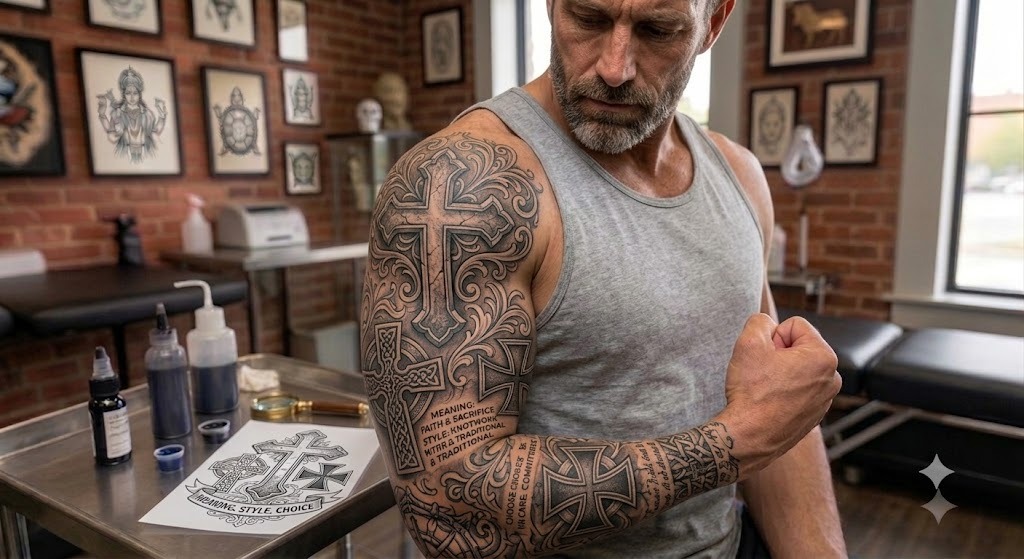
A cross means something specific to the person wearing it, and it is one of the few tattoos where the meaning genuinely differs from person to person more than the design does. For some it is a direct statement of faith. For others it marks someone lost, or a moment of survival, or simply an aesthetic they find beautiful with no religious weight attached at all. None of these readings is more correct than another, but knowing which one is yours shapes almost every decision that follows.
If you are looking at cross tattoo designs, this guide covers what the symbol means across its different readings, the design traditions worth knowing, and how to build a piece with the care a symbol like this deserves. We are Vulture Tattoos, an appointment-only studio in Sector 47, Gurgaon.
What a cross can represent
- Faith. A direct expression of Christian belief, the most traditional reading and still the most common reason people choose one.
- Remembrance. Frequently chosen as a memorial, often with a name or date, marking someone specific rather than a general belief.
- Survival and gratitude. Carried by people who came through something difficult — illness, an accident, a hard period — as a marker of having made it.
- A quieter, non-religious aesthetic. The shape has become part of general tattoo visual language for some people, particularly in minimalist and fine-line work, without carrying religious meaning specifically.
If your reason is faith, we would gently suggest thinking about which specific tradition of cross matters to you, since there are real differences worth knowing rather than defaulting to whichever reference image looked cleanest.
Cross styles worth knowing
- Latin cross. The simplest and most widely recognised form, with a longer vertical bar. The default most people picture and the most common choice by far.
- Celtic cross. A cross with a circle intersecting the arms, often filled with intricate knotwork. Carries additional Celtic heritage meaning alongside the Christian symbolism, and it needs real space for the knotwork to read clearly — cramming it small closes up the fine linework within a decade.
- Rosary cross. A crucifix hanging from a chain of beads, often wrapped around the wrist or forearm as though worn. A popular and visually striking treatment.
- Crucifix. The cross with the figure of Christ, a more devotional and detailed treatment than a plain cross, requiring the same portrait-level care as any figurative religious tattoo — see our realism tattoo guide.
- Simple fine-line cross. Just the shape, minimal and clean — see below on why this specific version deserves particular care in its execution.
- Cross with wings. Faith paired with a memorial or protection reading — see our angel wings tattoo designs guide for how wings are built and sized.
- Cross with rays or light. Radiating lines behind the cross, a common devotional treatment representing grace or divine light.
- Cross with name or dates. Combined with script for a memorial piece — read our script tattoo guide before committing to any text.
Why a simple cross deserves particular care
This is worth understanding regardless of which style you choose. A plain cross is one of the most stripped-down shapes we tattoo — two straight bars, no shading, often no other detail at all.
- There is nowhere to hide an uneven line. With this little detail, every millimetre of the bars has to be precisely straight and correctly proportioned, or the imperfection is immediately obvious.
- Proportion between the arms matters enormously. The vertical bar, the horizontal bar and where they intersect all follow specific conventions depending on the style, and getting this slightly wrong is more noticeable on a symbol this simple than it would be on a more detailed design.
- Confident stroke weight, not hairline. A very thin cross will soften at the ends and corners over the years exactly like the anchor’s sharp edges — see our anchor tattoo designs guide for the same principle applied to another minimal, straight-edged shape.
The simplicity that makes a cross quick to tattoo is exactly what makes it demanding to tattoo well.
If it is a memorial piece
Many cross tattoos are chosen to remember someone. Two honest things worth saying, in the same spirit as the memorial guidance across our other pages.
There is no rush. Grief moves, and so does what you want to carry. Some people book within days of a loss and later find the design belonged to the very worst week rather than to the person. Nobody here will push you to book faster.
Check any dates twice, then once more. Memorial dates are the single most emotionally costly detail to get wrong. Confirm the format — 03/05 is two different days depending on where you learned to write dates — and if you are including their handwriting instead of a font, our guide to handwriting replication covers how we approach that.
Black and grey or colour?
Black and grey suits almost every cross treatment, and it holds contrast on every Indian skin tone while lasting longest in Gurgaon’s sun — see our black and grey tattoo guide.
Colour works for a rosary’s beads, or a crucifix with subtle skin-tone shading, but is genuinely uncommon for the cross shape itself, which almost always reads best as clean solid black or careful shading.
Where to place it
- Forearm. The most popular placement — visible, easy to see yourself, straightforward for a straight-edged shape.
- Upper arm and shoulder. Comfortable, easy to cover, good for a Celtic cross with room for knotwork.
- Chest, over the heart. A deeply meaningful placement for a faith or memorial piece.
- Wrist. Popular for a small, simple cross — keep it bold rather than hairline given the friction that placement sees. See our wrist tattoo guide.
- Behind the ear or collarbone. For a very small, discreet version.
- Back. The best canvas for an elaborate crucifix or a Celtic cross with extensive knotwork detail.
Does it hurt?
The same as any tattoo of that size in that place. Outer forearm and upper arm are the most comfortable. Chest, wrist and collarbone are sharper.
A simple cross is a short session, often under thirty minutes. A detailed crucifix or Celtic cross with knotwork takes considerably longer. Our tattoo pain chart covers every placement.
Want to talk through your idea, whatever the reason behind it? Call or WhatsApp us on +91 96676 14250 or message us on WhatsApp.
Healing and aftercare in Gurgaon
- Keep the wrap on as long as your artist says, then wash gently with lukewarm water and mild fragrance-free soap.
- Pat dry, do not rub. Rubbing fresh linework pulls pigment out of thin strokes.
- Thin layer of balm. Thin is the word.
- Do not pick or scratch. A gap in a clean, simple line is very visible.
- No swimming, sauna, gym sweat or soaking for two to three weeks.
- Keep it moisturised well past the peeling stage.
Forearm and wrist placements catch Gurgaon sun daily, and UV softens fine outlines faster than anything else. Use SPF 30 or higher once healed. Our full tattoo aftercare guide for Gurgaon covers each stage.
Why the artist matters
Precisely because a cross is so simple, it is unforgiving. Straight bars, correct proportion between them, and a clean intersection at the centre — there is nothing else in the design to distract from an error in any of these. A Celtic cross adds the further demand of clean, evenly spaced knotwork, and a crucifix adds full portrait-level figure work.
Ronny specialises in fine-line, botanical, script and geometric work, which covers simple crosses, Celtic knotwork and rosary detail. Ajay handles realism, devotional, portrait and cover-up work, which covers a full crucifix with the figure of Christ. Our page on the tattoo artists in Gurgaon introduces both.
Every tattoo is done with single-use sterile needles opened in front of you, in an appointment-only studio. That is part of why our clients have left more than 270 five-star Google reviews.
How it works with us
- Consultation. Bring your idea and tell us what the piece means to you. We talk style, proportion and placement.
- Design. Drawn to your placement, with the proportions and any knotwork given the care a simple shape actually needs. You see it before any needle touches you.
- A written quote at consultation. Clear, before anything begins. Our tattoo cost guide for Gurgaon explains what shapes it.
- The session. Calm and unhurried, whatever the size.
- Aftercare. A clear plan, and we are on WhatsApp while it heals.
Why book in Sector 47
Vulture Tattoos sits at Shop F-04, Spaze Boulevard, Malibu Towne, Sector 47, Gurugram, easy to reach from across Gurgaon, DLF, Sohna Road, Golf Course Road and South Delhi. Appointment-only means a quiet, private studio, which most people getting a faith or memorial piece genuinely want.
Book your cross tattoo: call or WhatsApp +91 96676 14250 to start with a consultation.
See our work
Clean proportion and confident linework are what to judge on a design this pared back, and both need to be seen. Browse our recent pieces on Instagram at @vulture_tattooz, read more about the studio at Vulture Tattoos, or reach out through our contact page. When you are ready, call or WhatsApp +91 96676 14250 and we will plan cross tattoo designs built with the care this symbol deserves.
Frequently Asked Questions
What does a cross tattoo mean?
It varies genuinely by person more than most tattoo symbols. For some it is a direct statement of Christian faith. For others it is a memorial for someone specific, a marker of survival through something difficult, or simply an aesthetic without religious weight attached. None of these readings is more correct than another.
What is the difference between a Latin cross and a Celtic cross?
A Latin cross is the simplest and most widely recognised form, a longer vertical bar with a shorter horizontal one. A Celtic cross adds a circle intersecting the arms, often filled with intricate knotwork, carrying additional Celtic heritage meaning alongside the Christian symbolism. The knotwork needs real space to stay legible, so it does not work well at very small size.
Why does a simple cross need a skilled artist?
Precisely because it is so stripped down. Two straight bars and an intersection, with no shading or detail to distract from an error, mean every millimetre of proportion and every line has to be right. Simplicity is not the same as ease — a design this minimal is genuinely unforgiving of small mistakes.
Should I wait before getting a memorial cross tattoo?
There is no rule, and many people are glad they did it early. What we would gently say is that grief moves, and some people later find the design belonged to the worst week rather than to the person. Nobody here will push you to book faster, and if you have their handwriting, bring it — a name in their own hand carries more than a font.
What is a crucifix, and how is it different from a plain cross?
A crucifix includes the figure of Christ on the cross, requiring the same portrait-level shading and expression work as any figurative religious tattoo. It is a more devotional and detailed treatment than a plain cross, needing real size and considerably more session time.
Can I add a name or dates to a cross tattoo?
Yes, commonly worked in alongside the shape as a memorial piece. Keep any text reasonably short and have it verified for spelling and date format before it becomes a stencil — see our script tattoo guide for how lettering is planned to age well.
Where is the best placement for a cross tattoo?
The forearm is the most popular and works well for the straight-edged shape. The chest suits a faith or memorial piece meaningfully. A back gives the room a detailed crucifix or Celtic knotwork needs. Wrist and behind the ear work for a small, simple version, kept bold rather than hairline.
How do I book and how much will it cost?
Booking is by appointment. Call or WhatsApp +91 96676 14250 to arrange a consultation, where we discuss the style, any additional elements and placement, and give you a clear written quote once the details are settled.