Anchor Tattoo Designs: Meaning, Nautical Details and What Ages Well
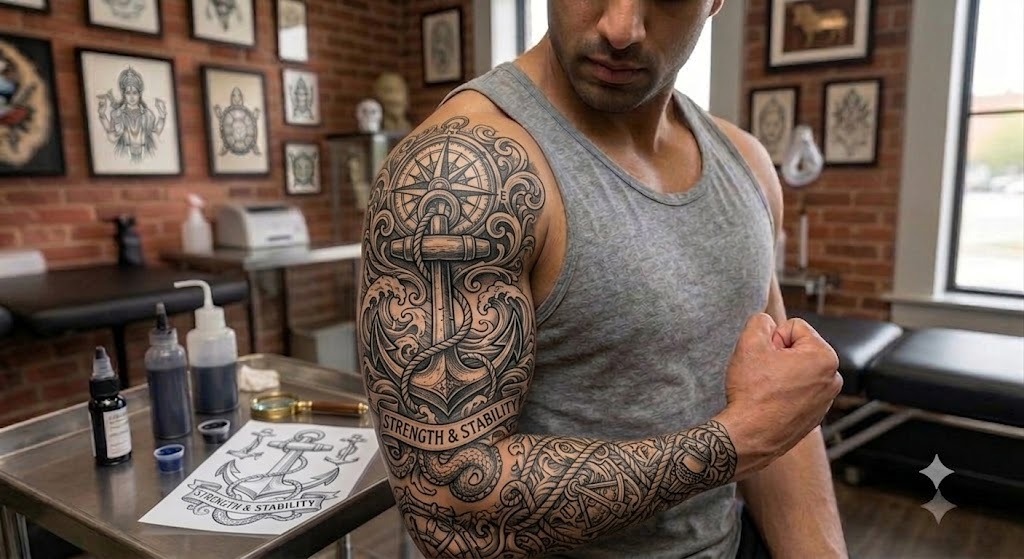
An anchor is one of the oldest tattoo symbols there is, going back to sailors who used it to mark safe returns from long voyages and stability in a life that was otherwise entirely unpredictable. It has since travelled a long way from the docks, and today most people who choose one have never been near a ship — they are marking the same idea in a completely different kind of storm.
If you are looking at anchor tattoo designs, this guide covers what the symbol represents now, the traditional versus modern style question, and what a shape this simple actually needs to hold up on skin for decades. We are Vulture Tattoos, an appointment-only studio in Sector 47, Gurgaon.
What an anchor represents
- Stability. The core, most direct meaning — something that holds firm when everything else is moving.
- A safe return. Traditionally tattooed by sailors who had successfully crossed the Atlantic, later broadened to mean coming through any difficult journey and returning to solid ground.
- Being grounded by someone or something specific. Frequently chosen to represent a person, a family, or a belief that keeps someone steady — often paired with a name or a set of initials.
- Hope. A less common but historically real reading, connected to the anchor’s use as an early Christian symbol representing steadfast hope.
- Refusing to drift. A more personal, contemporary reading — a deliberate choice to stay committed rather than be carried wherever circumstance pushes.
Anchor tattoo designs that work
- Traditional bold anchor. Thick outlines, minimal shading, the classic American traditional style. The most durable version by a wide margin, discussed below.
- Anchor with rope. Rope wrapped around the shaft or looped through the ring at the top — one of the most requested combinations, adding movement to an otherwise static shape.
- Anchor and rose. A classic traditional pairing — strength held alongside beauty. See our flower tattoo designs guide for the rose’s own symbolism.
- Anchor with banner and text. A ribbon or banner wrapped through the design carrying a name, date or short phrase — read our script tattoo guide before committing to any text.
- Fine-line minimal anchor. A simplified outline rather than the bold traditional treatment — see our fine line tattoo guide for how thin work like this ages, because it matters more here than for most subjects.
- Anchor with compass or waves. Combined with other nautical or travel symbols — see our travel tattoo designs guide.
- Watercolour anchor. Soft colour washes around a solid black outline — see our watercolour tattoo guide.
- Small standalone anchor. No additions, just the shape itself — one of the few designs on this site that genuinely works well very small, provided the style is right.
Traditional versus fine-line — this decision matters more than usual
This is genuinely the single most important choice for an anchor tattoo, more so than for most subjects, because of how the shape itself is built.
The traditional bold style — thick, confident outlines with minimal or no fine internal detail — is not just an aesthetic choice. It is the reason a hundred-year-old sailor’s anchor tattoo still reads perfectly clearly today. Bold lines contain their own shape as pigment naturally spreads through skin over the decades, and a design with almost no fine detail has very little to lose in the first place.
A fine-line, delicate anchor looks elegant and modern fresh out of the studio, but the shape has straight edges and sharp corners throughout — the crossbar, the shaft, the flukes at the bottom — and thin lines at sharp corners are exactly where softening shows first. A fine-line anchor at small size is one of the designs most likely to lose its crisp shape within a decade.
If longevity matters to you more than trend, the honest recommendation is the bold traditional treatment, even at a modest size. If you specifically want the delicate look, go a little larger than feels necessary and expect the design to soften somewhat with age — that trade-off is worth knowing upfront rather than discovering later.
Where to place it
- Forearm. The most popular placement by a distance — visible, easy to see yourself, and the anchor’s vertical shape suits the forearm naturally.
- Upper arm and shoulder. Comfortable, easy to cover, good for a slightly larger traditional version with rope and banner.
- Calf. A classic sailor placement historically, and it still suits the shape well today.
- Wrist or ankle. Workable for a small standalone anchor in the bold traditional style — avoid fine-line here specifically, given the friction and sun both placements see.
- Behind the ear or collarbone. For a very small, minimal version — see our collarbone tattoo guide.
Does it hurt?
The same as any tattoo of that size in that place. Outer forearm, upper arm and calf are the most comfortable. Wrist, ankle and collarbone are sharper.
A small anchor is a short, straightforward session, usually under an hour. A larger traditional piece with rope and banner takes longer because of the additional detail. Our tattoo pain chart covers every placement.
Want to talk through traditional versus fine-line for your idea? Call or WhatsApp us on +91 96676 14250 or message us on WhatsApp.
Healing and aftercare in Gurgaon
- Keep the wrap on as long as your artist says, then wash gently with lukewarm water and mild fragrance-free soap.
- Pat dry, do not rub. Rubbing fresh linework pulls pigment out of thin strokes.
- Thin layer of balm. Thin is the word.
- Do not pick or scratch. A gap in a clean outline is very visible on a simple, graphic shape like this.
- No swimming, sauna, gym sweat or soaking for two to three weeks.
- Keep it moisturised well past the peeling stage.
Forearm and wrist placements catch Gurgaon sun daily, and UV softens outlines faster than anything else — especially relevant on this design’s sharp corners. Use SPF 30 or higher once healed. Our full tattoo aftercare guide for Gurgaon covers each stage.
Why the artist matters, even on something this simple
An anchor looks like an easy design and it is not. Every edge is straight and every corner is sharp, which means there is nowhere to hide a wobbling line — no shading, no organic curve to distract from an uneven crossbar or a lopsided fluke. Symmetry between the two flukes at the base is what separates a clean traditional anchor from one that looks slightly off forever.
Ronny specialises in fine-line, botanical, script and geometric work, which covers both the bold traditional treatment and any fine-line version, along with rope, banner and text detail. Ajay handles realism, devotional, portrait and cover-up work. Our page on the tattoo artists in Gurgaon introduces both.
Every tattoo is done with single-use sterile needles opened in front of you, in an appointment-only studio. That is part of why our clients have left more than 270 five-star Google reviews.
How it works with us
- Consultation. Bring your idea. We talk traditional versus fine-line honestly, along with any rope, banner or text you want included.
- Design. Drawn to your placement, with stroke weight chosen deliberately for how long you want the crisp shape to last. You see it before any needle touches you.
- A written quote at consultation. Clear, before anything begins. Our tattoo cost guide for Gurgaon explains what shapes it.
- The session. Short and straightforward for most sizes.
- Aftercare. A clear plan, and we are on WhatsApp while it heals.
Why book in Sector 47
Vulture Tattoos sits at Shop F-04, Spaze Boulevard, Malibu Towne, Sector 47, Gurugram, easy to reach from across Gurgaon, DLF, Sohna Road, Golf Course Road and South Delhi. Appointment-only means unhurried attention to symmetry, even on a straightforward-looking design.
Book your anchor tattoo: call or WhatsApp +91 96676 14250 to start with a consultation.
See our work
Clean symmetry and line confidence are what to judge on a design this simple, and both need to be seen. Browse our recent pieces on Instagram at @vulture_tattooz, read more about the studio at Vulture Tattoos, or reach out through our contact page. When you are ready, call or WhatsApp +91 96676 14250 and we will plan anchor tattoo designs built to stay sharp.
Frequently Asked Questions
What does an anchor tattoo mean?
Stability, most directly — something that holds firm when everything else is moving. It comes from sailors marking safe returns from long, unpredictable voyages, and today it is most often chosen to represent staying grounded through difficulty, or being anchored by a specific person or belief.
Should I get a traditional or fine-line anchor?
For longevity, traditional bold outlines are the better choice, more so than for most designs. An anchor has sharp corners and straight edges throughout, and thin lines at those sharp points are exactly where softening shows first as ink spreads over the decades. Fine-line looks elegant fresh but ages less predictably on this particular shape.
Does an anchor tattoo age well?
Very well, if built in the bold traditional style — this is one of the most durable classic tattoo designs there is, which is why century-old sailor anchor tattoos still read clearly today. Thick, confident lines with minimal fine internal detail have very little to lose as pigment naturally settles over the years.
What does an anchor and rose together mean?
A classic traditional pairing representing strength held alongside beauty — stability and something delicate coexisting rather than one overpowering the other. It is one of the most requested anchor combinations and suits the bold traditional style particularly well.
Can I add a name or date to an anchor tattoo?
Yes, usually worked into a banner or ribbon wrapped through the design. Keep any text short — length is the enemy of legible lettering over time — and have it verified for spelling before it becomes a stencil, especially for dates or names in another script.
How small can an anchor tattoo be?
Smaller than most detailed designs, provided it stays in the bold traditional style. A clean, confidently drawn small anchor genuinely holds its shape at modest size. A fine-line version at very small scale is the riskiest combination here — go a little larger if you want the delicate look.
Where is the best placement for an anchor tattoo?
The forearm is the most popular by a distance and suits the shape’s natural verticality. The calf is a classic historical placement. Wrist and ankle work for a small bold anchor but are worth avoiding for fine-line versions, given the friction and sun both spots see.
How do I book and how much will it cost?
Booking is by appointment. Call or WhatsApp +91 96676 14250 to arrange a consultation, where we discuss traditional versus fine-line, any additional elements, size and placement, and give you a clear written quote once the details are settled.