Hanuman Tattoo Designs: Ideas, Meaning, Placement and What Lasts
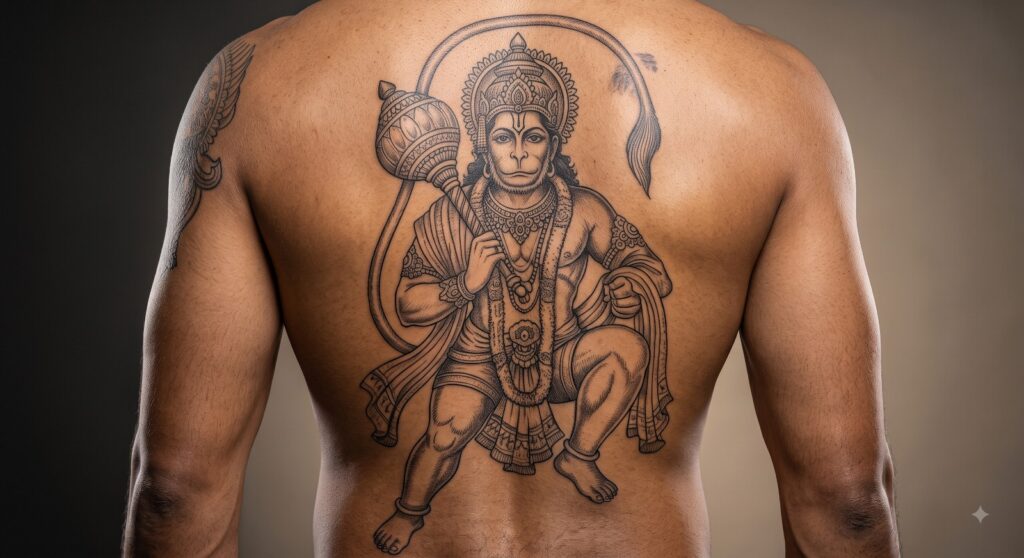
Hanuman tattoos come from a different place than most devotional work. People rarely choose this one for the look. They choose it because they need what it stands for — strength when things are hard, loyalty that does not break, and the courage to keep going.
That shows in who asks for it. Students before exams. People starting over after a bad year. Someone who lost a parent. It is a tattoo about getting through something.
But it is also a portrait, and portraits are the hardest thing to tattoo well. If you are looking at hanuman tattoo designs, this guide covers the versions that work, what decides whether the face comes out right, and where to put it. We are Vulture Tattoos, an appointment-only studio in Sector 47, Gurgaon.
What Hanuman stands for
Knowing the meaning helps you choose the right version, so it is worth a minute.
- Strength and courage. Physical and mental. The most common reason people get it.
- Devotion and loyalty. Hanuman’s bhakti towards Ram is the model for it. This is why the chest-opening image is so powerful.
- Protection. A guardian figure. Many people wear it as a shield rather than a statement.
- Humility with power. Hanuman is enormously strong and never uses it for himself. That combination is the whole point of the figure.
- Overcoming fear. The Hanuman Chalisa is recited for exactly this, and a lot of people carry the tattoo for the same reason.
Hanuman, Bajrangbali, Sankat Mochan — the same tattoo?
People ask for this piece under several names, and each one hints at a slightly different form.
- Hanuman tattoo — the general term, and the most common.
- Bajrangbali tattoo — “strong as a thunderbolt”. Usually the powerful, muscular form, often with the gada.
- Sankat Mochan tattoo — “remover of troubles”. Chosen by people going through something difficult, usually a calm protective face.
- Hanuman ji tattoo — the respectful form of address, same subject.
- Pawanputra tattoo — “son of the wind”. Often the flying form.
- Maruti Nandan tattoo — another name, same figure.
- Veer Hanuman tattoo — the warrior aspect, fierce expression.
All of them are the same deity. What changes is the expression and the pose, and that is the decision that actually matters at the design stage — a calm Sankat Mochan face and a roaring Veer Hanuman need different shading and different reference photos.
Hanuman tattoo designs that work
- Face profile. The most requested version. Strong jaw, calm or determined expression, crown. Works well on a forearm because the shape is vertical.
- Panchmukhi Hanuman. The five-faced form — Hanuman, Narasimha, Garuda, Varaha and Hayagriva. Extremely powerful and extremely demanding. Needs a chest, back or full forearm, and a very good artist.
- Hanuman with gada. The mace across the shoulder. Adds structure and fills a vertical space naturally.
- Chest-opening (Ram bhakt). Hanuman parting his chest to show Ram and Sita in his heart. The most emotional version of this tattoo and the one that means the most to people who choose it.
- Hanuman lifting the mountain. The Sanjeevani story. Dynamic, needs room, and it tells a whole story in one image.
- Flying Hanuman. Mid-leap, often with a mountain or sun behind. Great for a calf or forearm.
- Bal Hanuman. The child form reaching for the sun. Softer, and popular as a smaller piece.
- Hanuman with Ram Naam. The face or figure with राम written in Devanagari. Read our script tattoo guide before committing to any text.
- Hanuman silhouette. A clean black outline of the figure. The one version that genuinely works small.
- Hanuman with Om or trishul. Devotional elements around the figure — see our Om tattoo designs and trishul tattoo designs guides.
Getting the face right
A Hanuman face is harder than most people expect, and for a specific reason. It is not a human face. It has features that a human face does not — the muzzle, the jaw, the brow — and if the proportions drift even slightly, it stops looking like Hanuman and starts looking like an animal.
Three things decide the result.
1. The reference photo. Bring the sharpest image you can find, at full resolution. Most problems with these tattoos begin with a blurry picture forwarded on WhatsApp. If your image came from Instagram, try to find the original artwork instead of a screenshot.
2. The expression. Calm and devotional, or fierce and roaring? These are two different tattoos. They need different shading, different eyes and different reference. Decide before the design stage, because you cannot switch halfway.
3. The size. A face needs room, and Hanuman needs a little more than most because of the crown, the jaw and the shading around the eyes. A forearm is usually the smallest sensible canvas. If you want something small, a silhouette or Ram Naam works far better than a shrunken face.
Black and grey or colour?
Black and grey is the usual choice and the one we recommend for most Hanuman pieces. The face is built entirely from shading, and black holds contrast on every Indian skin tone. It also lasts longest in Gurgaon’s sun. Our black and grey tattoo guide explains why.
Colour suits the orange sindoor, the red of the flag, and gold crown detail. On Indian skin, deep saturated colours read far better than pale washes. Our colour tattoo guide covers the palette question properly.
Where to place it
- Forearm. The best all-round placement for a face or a flying figure. Vertical, flat, and there is room for detail.
- Upper arm and shoulder. Comfortable, easy to cover, good for a gada composition.
- Chest. The natural home for the chest-opening design. Meaningful and roomy.
- Upper back. The largest canvas. Best for Panchmukhi or the mountain-lifting scene.
- Calf. Works well for a flying Hanuman — but see the note below.
Worth thinking about. Many Hindus believe sacred images should not be worn below the waist. That makes calf, ankle and foot placements a real question for a lot of people. Views differ and it is your decision. We raise it at the consultation because placement, not design, is the most common regret we hear about with devotional tattoos.
Does it hurt?
The same as any tattoo of that size in that place. Outer forearm, upper arm and thigh are the most comfortable. Ribs, sternum and areas over bone are sharper.
The real factor here is time. A detailed face means a lot of shading, and shading means many passes over the same skin. Expect a long session, and expect a Panchmukhi or a full scene to run across two or more sittings. The feeling is a dull warmth, not a sharp sting. Our tattoo pain chart covers every placement.
Want to talk it through? Call or WhatsApp us on +91 96676 14250 or message us on WhatsApp.
Healing and aftercare in Gurgaon
- Keep the wrap on as long as your artist says, then wash gently with lukewarm water and a mild fragrance-free soap.
- Pat dry, do not rub. Rubbing a fresh shaded area pulls pigment out.
- Use a thin layer of balm. Thin is the word.
- Do not pick or scratch. A pale patch in the middle of a face is the most obvious flaw there is.
- No swimming, sauna, gym sweat or soaking for two to three weeks.
- Keep it moisturised well past the peeling stage.
Sun is the main long-term threat here. Gurgaon UV breaks down shading, and shading is what gives a face its depth. Once healed, use SPF 30 or higher every time it is exposed. Our full tattoo aftercare guide for Gurgaon covers each stage.
Why the artist matters
Portrait work has nowhere to hide. There is no outline covering a weak line and no pattern distracting the eye. On a Hanuman face the risk is higher still, because the features are not human — get the muzzle or brow slightly wrong and the whole face changes.
A good artist knows how much detail your size will hold, keeps shading smooth rather than patchy, matches the expression you asked for, and tells you honestly when a reference is not usable.
Ajay is our realism, devotional, portrait and cover-up specialist, so Hanuman work sits with him. Ronny specialises in fine-line, botanical, script and geometric work, which covers silhouettes, ornamental framing and Devanagari. Our page on the tattoo artists in Gurgaon introduces both, and our realism tattoo guide explains how to judge portrait work before booking.
Every tattoo is done with single-use sterile needles opened in front of you, in an appointment-only studio. That is part of why our clients have left more than 270 five-star Google reviews.
How it works with us
- Consultation. Bring your reference and tell us what the piece means to you. We talk expression, size and placement, and look at your actual skin.
- Design. Drawn custom and sized so the features survive the years. You see it before any needle touches you.
- A written quote. Clear, at the consultation. Our tattoo cost guide for Gurgaon explains what shapes it.
- The session. Paced, with breaks, split across sittings if needed.
- Aftercare. A clear plan, and we are on WhatsApp while it heals.
Why book in Sector 47
Vulture Tattoos is at Shop F-04, Spaze Boulevard, Malibu Towne, Sector 47, Gurugram. Easy to reach from across Gurgaon, DLF, Sohna Road, Golf Course Road and South Delhi.
Appointment-only means one client at a time. For a long portrait session, that means a quiet room and an artist who is not being pulled away — which matters when the work is a face.
Book your Hanuman tattoo: call or WhatsApp +91 96676 14250.
See our work
Portraits have to be seen to be judged, ideally healed rather than fresh. Browse our recent pieces on Instagram at @vulture_tattooz, read more at Vulture Tattoos, or reach us through our contact page. When you are ready, call or WhatsApp +91 96676 14250 and we will plan hanuman tattoo designs built to last.
Frequently Asked Questions
What does a Hanuman tattoo mean?
Strength, courage, devotion, loyalty and protection. Most people who choose it are marking something they got through, or something they are still getting through. The humility side matters too — Hanuman is immensely strong and never uses that strength for himself, which is a large part of why the figure resonates.
How big does a Hanuman tattoo need to be?
A face needs a forearm at minimum. Hanuman needs slightly more room than most portraits because of the crown, the jaw and the shading around the eyes. Panchmukhi needs a chest, back or full forearm. If you want something small, a silhouette or राम in Devanagari works far better than a shrunken face.
What is Panchmukhi Hanuman?
The five-faced form — Hanuman with Narasimha, Garuda, Varaha and Hayagriva. It represents protection in all directions. As a tattoo it is one of the most demanding pieces we do, because five faces have to work together in one composition. It needs real size and an artist who does portrait work regularly.
Where should I not place a Hanuman tattoo?
Many Hindus believe sacred images should not be worn below the waist, which makes calf, ankle and foot placements a real question. Views genuinely differ and it is your decision. We raise it at the consultation because placement is the most common source of regret with devotional work, far more than the design itself.
Should it be calm or fierce?
Decide before you book. Calm and devotional needs soft shading and a settled expression. Fierce and roaring needs sharper contrast and completely different reference. They are two different tattoos and you cannot switch once the design is under way, so it is worth being clear at the consultation.
Can I add Ram Naam to my Hanuman tattoo?
Yes, and it is a common pairing. The one condition is verification — have the exact Devanagari confirmed by someone who reads the script before it becomes a stencil, and allow enough height for the matras. Our script tattoo guide covers this in detail.
How long will a Hanuman tattoo take?
A silhouette or small element is a single short session. A detailed face usually takes several hours. Panchmukhi or a full scene runs across multiple sittings. We give an honest estimate at the consultation before anything is booked, because rushing shading is the fastest way to ruin a portrait.
How do I book and how much will it cost?
Booking is by appointment. Call or WhatsApp +91 96676 14250 to arrange a consultation. We discuss the design, expression, size and placement, and give you a clear written quote once the details are settled. Pricing depends on size, detail and time, so we quote in person rather than online.