Greek Mythology Tattoo Designs: Meaning, Ideas and What Ages Well
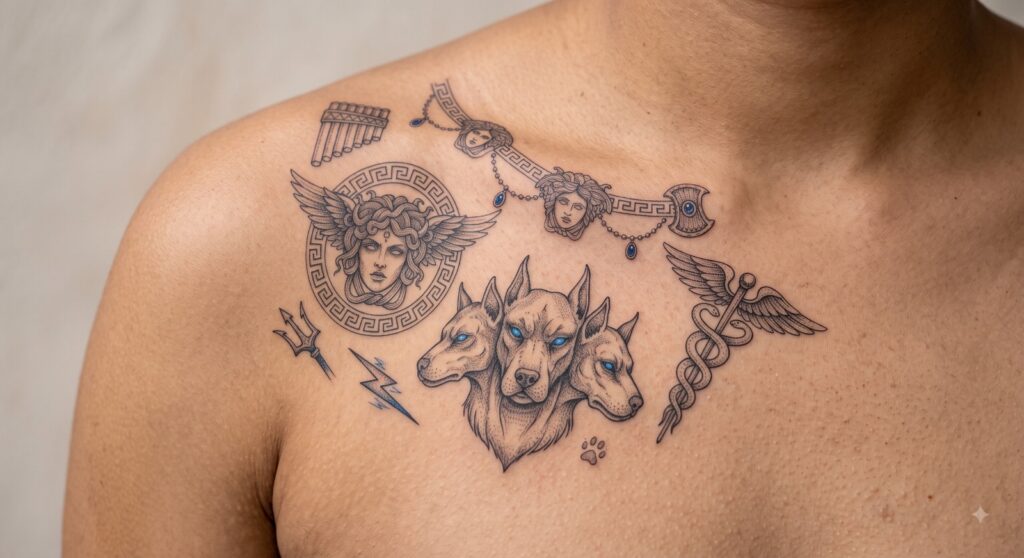
Greek mythology has quietly become one of the most requested tattoo themes in India, and it is easy to see why. The stories are about the same things everyone gets tattooed for — endurance, revenge, betrayal, grief, the price of ambition — but they come with images that are already carved in marble. You are not inventing a symbol. You are borrowing one that has held up for two and a half thousand years.
It also happens to be one of the best-ageing themes in tattooing, for a technical reason most people never think about. If you are looking at greek mythology tattoo designs, this guide covers the subjects, their real meanings, and what actually survives on skin. We are Vulture Tattoos, an appointment-only studio in Sector 47, Gurgaon.
The subjects, and what they really mean
Meaning matters here more than in most themes, because several of these figures mean something quite different from what people assume.
- Medusa. Once read as a monster, now widely worn as a survivor’s symbol — she was punished for something done to her, not by her. That reading has made Medusa one of the most requested pieces among women. She is also visually perfect for tattooing: the snakes fill space naturally and give the composition movement.
- Spartan warrior / helmet. Discipline, brotherhood, standing your ground. The helmet alone is one of the most durable designs in this whole list — strong shapes, deep shadow, nothing fragile.
- Zeus. Authority and power. Usually a bearded face with lightning. Needs real size to work.
- Athena. Wisdom and strategy rather than brute force. Helmet, owl, sometimes with the aegis.
- Poseidon. The sea and things you cannot control. Trident, waves, storm.
- Achilles. Glory with a fatal flaw. Often as armour, a heel, or the shield.
- Icarus. Ambition and the cost of it. Wings, sun, falling. One of the most emotionally loaded pieces we do.
- Atlas. Carrying a weight you did not choose. Enormously popular with people who feel exactly that.
- Hermes / Mercury. Travel, messages, movement. Winged helmet or sandals.
- Broken statue. A classical bust with cracks or missing pieces — imperfection and endurance. Modern, and technically superb for tattooing.
- Greek key (meander). The interlocking border pattern. Perfect for armbands — see our armband tattoo designs guide.
Why this theme ages so well
Here is the technical reason, and it is genuinely unusual.
Most Greek mythology tattoos are based on marble sculpture. Marble has no colour and no texture detail — all its form comes from light and shadow across a smooth surface. That is exactly what black and grey tattooing does best.
So when you tattoo a Greek statue, you are not translating a photograph into a different medium. You are using a medium that already matches the source.
- Strong contrast is built in. Deep shadows in the eye sockets and under the jaw, bright highlights on the brow and nose. That contrast is what survives decades.
- No fine colour detail to lose. Nothing pale and delicate to fade out.
- Bare skin does the highlights. The brightest part of a marble face is untouched skin, which never fades.
Our black and grey tattoo guide explains why contrast matters more than anything else in tonal work, and our realism tattoo guide covers how to judge this kind of shading before you book.
What still goes wrong
Going too small. These are portraits and sculptures. A Medusa face with individual snakes, or a Zeus with a full beard, needs room for the shading to breathe. Below a certain size, the shadows merge and the face flattens into a grey shape. A forearm is usually the smallest sensible canvas for a face.
Weak mid-greys instead of real darks. A statue reads as three-dimensional because of the depth of its shadows. Shade the whole thing in polite mid-grey and it looks flat on day one and worse in five years.
Too many figures at once. A composition with Zeus, Medusa, a Spartan and a temple, all in one forearm, gives none of them the space they need. Pick one subject and let it be the piece.
Where to place it
- Forearm. The best all-round placement for a single face or bust. Flat, vertical, and there is room for real shading.
- Upper arm and shoulder. Comfortable, easy to cover, good curve for a helmet or armour.
- Full or half sleeve. Where this theme truly comes alive — a whole scene can wrap the arm. See our sleeve tattoo guide.
- Chest. Powerful for a symmetrical piece like a Spartan helmet or Athena.
- Upper back. The largest canvas, ideal for a full scene — see our back tattoo guide.
- Thigh and calf. Roomy, comfortable, easy to keep out of the sun.
Does it hurt?
The same as any tattoo of that size in that place. Outer forearm, upper arm, thigh and calf are the most comfortable. Ribs, sternum, inner arm and areas over bone are sharper.
The real factor is time. Heavy shading means many passes over the same skin, so expect a long session and expect a large piece to be split across sittings. The feeling is a dull warmth rather than a sharp sting. Our tattoo pain chart covers every placement.
Want to talk it through? Call or WhatsApp us on +91 96676 14250 or message us on WhatsApp.
Healing and aftercare in Gurgaon
- Keep the wrap on as long as your artist says, then wash gently with lukewarm water and a mild fragrance-free soap.
- Pat dry, do not rub. Rubbing a fresh shaded area pulls pigment out.
- Use a thin layer of balm. Thin is the word. Large shaded areas tempt people to over-apply.
- Do not pick or scratch. A pale patch inside a shadow breaks the illusion of depth at the worst possible place.
- No swimming, sauna, gym sweat or soaking for two to three weeks after each session.
- Keep it moisturised well past the peeling stage.
Sun is what flattens this style over time. The whole effect depends on the gap between your darkest shadow and your brightest bare skin, and UV compresses that gap. Once healed, use SPF 30 or higher every time it is exposed. Dry skin also dulls contrast, so daily moisturiser genuinely changes how the piece looks. Our full tattoo aftercare guide for Gurgaon covers each stage.
Why the artist matters
This theme is realism, and realism has nowhere to hide. There is no outline covering a weak edge and no pattern distracting the eye. Every value decision is visible.
Marble is also harder than it looks. Skin has texture and colour variation that helps disguise uneven shading. Marble is smooth — so any patchiness in the gradient reads instantly as a mistake rather than as texture.
A skilled artist commits to a light direction and holds it, keeps the darks genuinely dark instead of settling for safe mid-grey, uses bare skin as the highlight, and tells you honestly how much detail your chosen size will hold.
Ajay is our realism, devotional, portrait and cover-up specialist, so Greek statue and figure work sits squarely with him. Ronny specialises in fine-line, botanical, script and geometric work, which covers Greek key patterns, geometric framing and lettering. Our page on the tattoo artists in Gurgaon introduces both.
Every tattoo is done with single-use sterile needles opened in front of you, in an appointment-only studio. That is part of why our clients have left more than 270 five-star Google reviews.
How it works with us
- Consultation. Bring your reference and the reason. We talk subject, scale, light direction and placement, and look at your actual skin.
- Design. Drawn to your placement and sized so the shading survives. You see it before any needle touches you.
- A written quote. Clear, at the consultation, with a realistic session plan. Our tattoo cost guide for Gurgaon explains what shapes it.
- The session. Paced, with breaks, split across sittings if the piece needs it.
- Aftercare. A clear plan, and we are on WhatsApp while it heals.
Why book in Sector 47
Vulture Tattoos is at Shop F-04, Spaze Boulevard, Malibu Towne, Sector 47, Gurugram. Easy to reach from across Gurgaon, DLF, Sohna Road, Golf Course Road and South Delhi.
Appointment-only means long shading sessions happen in a calm, well-lit studio. Lighting matters more than it sounds — you cannot judge subtle greys properly in a badly lit room.
Book your Greek mythology tattoo: call or WhatsApp +91 96676 14250.
See our work
Smooth gradients and genuine dark shadows are the two things to judge, ideally on healed work rather than fresh photos. Browse our recent pieces on Instagram at @vulture_tattooz, read more at Vulture Tattoos, or reach us through our contact page. When you are ready, call or WhatsApp +91 96676 14250 and we will plan greek mythology tattoo designs built to last.
Frequently Asked Questions
What does a Medusa tattoo mean?
Modern readings treat Medusa as a survivor rather than a monster — she was punished for something done to her, not by her. That interpretation has made her one of the most requested pieces among women, often worn as a mark of surviving something. She is also ideal visually, because the snakes fill space naturally and give the composition movement.
How big does a Greek mythology tattoo need to be?
A face or bust needs a forearm at minimum. These are portraits built from shading, and below a certain size the shadows merge and the face flattens into a grey shape. A Spartan helmet or a Greek key pattern works considerably smaller, because those are built from strong shapes rather than fine tonal detail.
Why do Greek statue tattoos age so well?
Because marble already looks like black and grey tattooing. All its form comes from light and shadow on a smooth surface, with no colour and no fine texture. That means strong built-in contrast, nothing pale to fade out, and bare skin doing the highlights — which never fades at all.
Should it be black and grey or colour?
Black and grey, almost always. The source material is stone, and colour adds nothing that the shadow does not already do better. Black and grey also holds contrast on every Indian skin tone and lasts longest in Gurgaon’s sun. Colour is only worth considering if you are building a scene with sky, fire or sea around the figure.
Can I combine several Greek figures in one tattoo?
You can, but not in a small space. Zeus, Medusa and a Spartan crammed into one forearm gives none of them room to work. Either pick one subject and let it be the piece, or plan a half or full sleeve where each element genuinely has space. We will tell you honestly at the design stage which one your placement allows.
What is the Greek key pattern used for?
The meander border works beautifully as an armband, a sleeve border, or a frame around a central figure. It is bold, geometric and extremely durable — exactly the kind of design that still reads clearly in thirty years. Our armband guide covers how bands are planned and where the join goes.
Is Icarus or Atlas better for a first big piece?
Both work, and the choice is about meaning rather than difficulty. Icarus is about ambition and its cost — wings, sun, falling. Atlas is about carrying weight you did not choose. People usually know instantly which one is theirs. Either sits well on a forearm or upper arm as a first substantial tattoo.
How do I book and how much will it cost?
Booking is by appointment. Call or WhatsApp +91 96676 14250 to arrange a consultation. We discuss the subject, size, placement and session plan, and give you a clear written quote once the details are settled. Pricing depends on size, detail and time, so we quote in person rather than online.