Armband Tattoo Designs: Styles, Meaning, Placement & How They Age
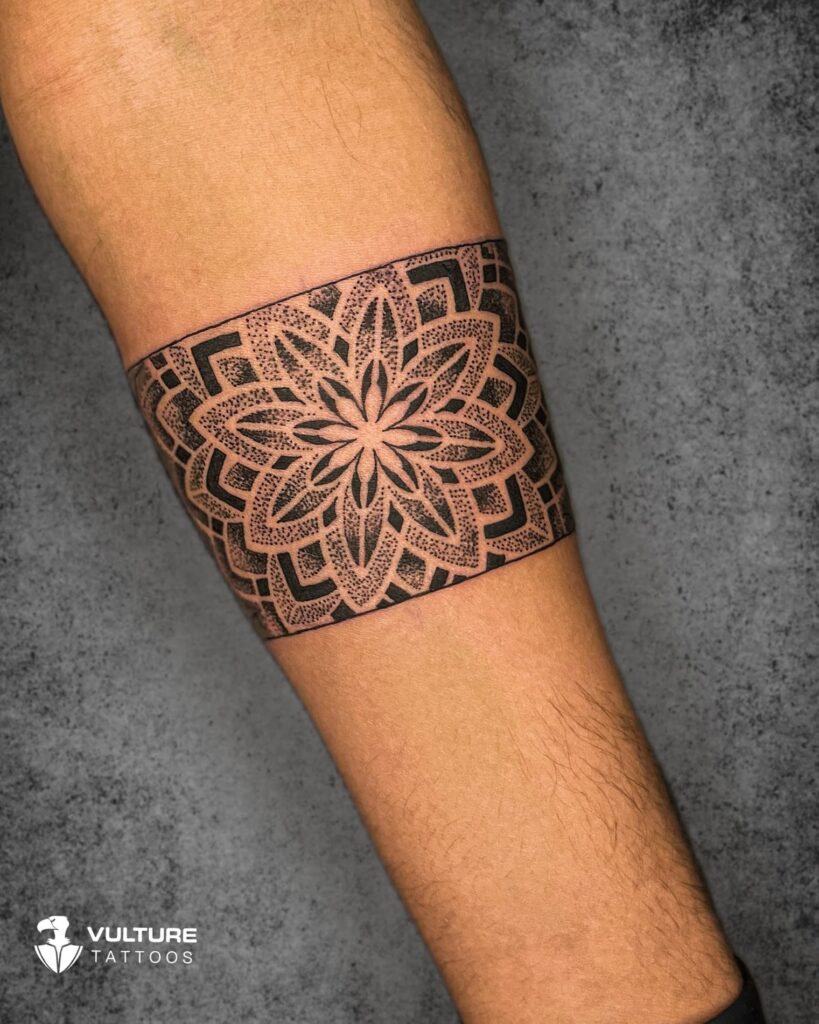
An armband is the only tattoo that has to meet itself. Every other design has a beginning and an end. A band goes all the way around your arm and comes back to where it started, and if that join is even slightly off — a millimetre of mismatch, a pattern that does not line up, a line that steps — it is visible forever, on the exact part of your arm that people walking behind you can see.
That single technical problem is why armbands separate good artists from average ones so quickly, and why so many cheap bands look almost right instead of right. If you are looking at armband tattoo designs, this guide covers the styles that work, where the join actually goes, and the honest things nobody mentions before you sit down. We are Vulture Tattoos, an appointment-only studio in Sector 47, Gurgaon.
Why armbands are so popular in India
Bands sit at a particular sweet spot. They read as strong and deliberate without needing a full sleeve. They suit both a first tattoo and a tenth. They cover naturally under a shirt sleeve, which matters when your workplace has opinions. And they carry meaning very efficiently — a band of Sanskrit, a devotional motif, or a solid black stripe all say something without needing a picture.
They also flatter the arm. A band wraps a cylinder, so it follows the muscle instead of sitting flat on it, and that wrap is what makes even a simple design look considered.
Armband designs that actually work
- Tribal and Polynesian bands. The classic. Bold black shapes, high contrast, and they age better than almost anything. Polynesian and Maori-inspired patterns carry genuine meaning in their original context, so it is worth understanding the motifs rather than picking purely on looks.
- Mandala and ornamental bands. Symmetrical geometry running around the arm, often with dotwork shading. Elegant, and one of the most requested bands among women in Gurgaon. Our mandala tattoo guide covers the geometry side properly.
- Sanskrit and Devanagari mantra bands. A mantra or verse running around the arm. Beautiful, deeply personal, and the one that needs the most care — see the spelling section below.
- Devotional bands. Trishul, om, damru, rudraksha, a small Mahadev face worked into the pattern. Enormously popular here and genuinely meaningful for most people who get them.
- Solid blackwork bands. A single wide black stripe, or two or three thinner ones. Uncompromising, incredibly durable, and impossible to ignore. Also the hardest to cover later.
- Fine-line minimal bands. One or two thin lines, sometimes with a small break or a tiny symbol. Subtle and modern. Our fine line tattoo guide explains how thin work ages.
- Name and script bands. A name, a date, or a line of text following the arm’s circumference. Our script tattoo guide covers fonts and spacing.
- Floral and botanical bands. Vines, leaves and blooms wrapping the arm. Softer, and they hide the join more forgivingly than geometric patterns do.
- Nature and landscape bands. Mountains, waves, forest silhouettes running around the arm as a continuous horizon. Excellent for travel-minded pieces.
The join — the thing nobody tells you
Every band has a seam. The question is only where it goes and how well it is hidden.
A skilled artist places the join deliberately, usually on the inner arm or the underside, where it is least visible and where the design can absorb the transition. Geometric and repeating patterns are the hardest, because a repeat that does not divide evenly into your arm’s circumference will show a compressed or stretched section wherever it closes. That is why the stencil has to be measured on your actual arm rather than drawn to a standard size.
There is a second complication that matters more than people expect. Your arm changes shape. A band stencilled on a fully relaxed arm can distort when the muscle flexes, and vice versa. A good artist stencils and checks the band in more than one position — arm down, arm raised, muscle relaxed and engaged — before starting. Skipping that step is how a band ends up looking perfect in the mirror and wrong in every photograph.
Sanskrit and Devanagari bands — read this first
Mantra bands are among the most requested armband tattoo designs in India, and they are also where the worst mistakes happen.
Devanagari is built on a continuous top line, the shirorekha, with vowel marks sitting above and below the consonants. Wrapped around an arm, that top line has to stay consistent as the surface curves, and the matras need vertical clearance or they close up over the years.
- Never work from an unverified translation. Transliteration tools produce convincing nonsense regularly.
- Have it checked by someone who reads the script — not a translation app, and not a friend who “knows a bit”.
- Size it honestly. A mantra needs more height than people budget for. Cramming a verse into a thin band is how it becomes an unreadable dark line in five years.
- Read the stencil on your skin before we start. Out loud, slowly. It costs nothing and it is your last checkpoint.
We would far rather delay a session than put a wrong character on you permanently.
Where a band sits best
- Upper arm / bicep. The classic placement. Naturally covered by a t-shirt sleeve, good muscle shape to wrap, and comfortable to sit through.
- Forearm. More visible, flatter surface, and easier to see on yourself. Slightly sharper to sit than the bicep.
- Wrist. Delicate and elegant, but the highest-friction spot on this list. Keep wrist bands simple and not too fine.
- Ankle. Popular, understated, and easy to cover. Bony, so expect it to be sharper.
- Thigh. Roomy and comfortable, good for wide or detailed bands.
One honest note about size changes: if you are training hard, gaining or losing significant weight, a band’s proportions will shift with your arm. It rarely ruins a piece, but a very tight geometric repeat is less forgiving than a flowing organic pattern. If that is on the cards, we will factor it into the design.
How armbands age
Bands generally age very well, which is one of the best reasons to choose one — but the reason matters. Bold black shapes with generous spacing keep reading for decades because there is plenty of pigment and plenty of gap. That is why the tribal band from twenty years ago still looks like a tribal band.
What does not age well is the opposite: very thin lines packed very close together. As pigment naturally settles outward over years, those tight gaps close and a delicate repeating pattern turns into a solid dark ring. This is the single most common armband regret.
So: intricate is fine, but intricate needs width and needs breathing room between elements. When we suggest making a band a little taller or opening up the spacing, that is the reason.
Does it hurt?
An armband hurts about the same as any tattoo in the same spot — except that a band, by definition, travels through several different zones of your arm in one session.
The outer bicep and outer forearm are comfortable. The inner arm is where most people notice the difference: the skin there is thinner, more sensitive, and it is exactly where the band has to pass. The inner elbow area is sharper again. That is not a reason to avoid a band, it is a reason to know it is coming so the last stretch does not surprise you. Sessions are usually manageable in one sitting for most band designs.
Ready to talk through your idea? Call or WhatsApp us on +91 96676 14250 or message us on WhatsApp and we will help you plan a band built to last.
Healing and aftercare, with a Gurgaon twist
- Keep the initial wrap on for as long as your artist advises, then wash gently with lukewarm water and a mild fragrance-free soap.
- Pat dry, never rub. Rubbing fresh linework pulls pigment out of thin strokes.
- Apply a thin layer of the recommended balm. Thin is the word.
- Do not pick or scratch. A picked scab on a band leaves a gap in a continuous pattern, which is far more obvious than a gap in a standalone design.
- No swimming, saunas, gym sweat or soaking for the first two to three weeks. This matters especially if you train — a band sits exactly where sleeves rub and sweat collects.
- Keep it moisturised well past the peeling stage.
The Gurgaon-specific part: a band on the forearm or wrist is exposed to sun every single day if you ride, drive with the window down, or walk between buildings. UV softens black over years, and on a band the loss shows up as fuzzy edges rather than fading. Once healed, use SPF 30 minimum — 50 is better — every time it is exposed, and cover it on long outdoor days. Our full tattoo aftercare guide for Gurgaon covers each stage.
The honest downside of a band
Two things worth knowing before you commit.
A band is very hard to cover up later. It goes all the way around, so a cover-up cannot simply be placed beside it or extended past it — it has to absorb the whole ring, which usually means going substantially wider and darker. Solid blackwork bands are the hardest of all. This is not a reason to avoid one; it is a reason to be genuinely sure about the design before the outline goes down.
A band is visible. A forearm or wrist band shows in half-sleeves, at weddings, in ID photos. Most people want exactly that. But if your workplace or family situation makes visibility a live question, the upper arm is the placement that gives you the option to cover it.
Why the artist matters here
Bands are deceptively technical. The design might be simple, but wrapping it evenly around a cone-shaped, moving limb and closing it invisibly is not. A skilled artist measures on your arm, adjusts the pattern repeat so it divides properly, plans where the seam lands, and checks the stencil in multiple arm positions. An inexperienced one prints a straight design and wraps it, and you get a join you notice every day.
Ronny specialises in fine-line, botanical, script and geometric work, which covers ornamental, mandala, Sanskrit and minimal bands. Ajay handles realism, devotional, portrait and cover-up work, which covers devotional bands with Mahadev or trishul elements, and reworking older bands. Our page on the tattoo artists in Gurgaon introduces both.
Every tattoo is done with single-use sterile needles opened in front of you, in an appointment-only studio, which is part of why our clients have left more than 270 five-star Google reviews.
Custom design, made for your arm
- Consultation. You bring the idea and references. We measure your actual arm, talk about width, style and where the join should sit.
- Design. We draw the band to your measurements, adjust the pattern repeat so it closes cleanly, and plan the seam. You see it before any needle touches you.
- Stencil check in motion. Arm up, arm down, relaxed and flexed, before we start.
- A written quote at consultation. Clear, before anything begins. Our tattoo cost guide for Gurgaon explains what shapes it.
- Aftercare and touch-ups. A clear plan, and we are on WhatsApp while it heals.
The local angle: why book in Sector 47
Vulture Tattoos sits at Shop F-04, Spaze Boulevard, Malibu Towne, Sector 47, Gurugram, easy to reach from across Gurgaon, DLF, Sohna Road, Golf Course Road and South Delhi. Appointment-only means the studio is calm while your artist does the fiddly measuring and stencil work a band actually needs, rather than rushing it between walk-ins.
Book your armband: call or WhatsApp +91 96676 14250 to start with a consultation.
See our work and get in touch
The join is the thing to judge, and you can only judge it by looking, so browse our recent pieces on Instagram at @vulture_tattooz, read more about the studio at Vulture Tattoos, or reach out through our contact page. When you are ready, call or WhatsApp us on +91 96676 14250 and we will plan armband tattoo designs that close perfectly and stay sharp.
Frequently Asked Questions
Where does the join in an armband go?
On the inner arm or the underside, where it is least visible and where the pattern can absorb the transition. A good artist measures your actual arm circumference and adjusts the pattern repeat so it divides evenly, rather than wrapping a standard-size design and letting the mismatch land wherever it falls. Flowing organic patterns hide a join more forgivingly than tight geometric repeats.
Do armband tattoos hurt a lot?
The outer bicep and outer forearm are comfortable. The inner arm is where most people feel it — thinner, more sensitive skin — and a band has to pass through there by definition. The inner elbow area is sharper again. Knowing it is coming makes it much easier. Most band designs are completed in a single session.
Will my armband stretch if I gain muscle or weight?
Proportions shift with the arm, yes, though it rarely ruins a piece. Flowing organic patterns adapt well; very tight geometric repeats are less forgiving because any distortion shows against the regularity. If you are actively training or expect a significant change, tell us at the consultation and we will factor it into the design.
How thick should an armband be?
Wide enough for the detail in it. A simple solid stripe can be narrow. An ornamental, mandala or Sanskrit band needs real height, because thin lines packed close together are exactly what closes up as pigment settles over the years. When we suggest going a little taller, it is to keep the pattern readable in fifteen years rather than to make the tattoo bigger.
Can an armband be covered up later?
With difficulty. Because it runs all the way around, a cover-up has to absorb the entire ring rather than sit beside it, which usually means going considerably wider and darker. Solid blackwork bands are the hardest of all. Bring it in and Ajay will tell you honestly what is possible with your specific band.
Can you do a Sanskrit mantra as an armband?
Yes, and it is one of our most requested bands. The one condition is verification: the exact wording must be confirmed by someone who genuinely reads Devanagari before it becomes a stencil — never a translation app. We also size it so the matras above and below the top line have room to survive, which usually means a taller band than people first imagine.
Do armband tattoos age well?
Better than most designs, provided the spacing is right. Bold shapes with generous gaps still read clearly after decades. Very thin lines packed tightly together are the exception — those close into a solid dark ring as pigment settles. Sun protection matters too, especially on forearm and wrist bands, which get daily UV in Gurgaon.
How do I book and how much will it cost?
Booking is by appointment. Call or WhatsApp us on +91 96676 14250 to arrange a consultation, where we measure your arm, discuss the design and width, and give you a clear written quote once the details are settled. Pricing depends on size, detail and time, so we quote in person rather than online.