Shiv Parivar Tattoo Designs: Composing the Whole Family Correctly
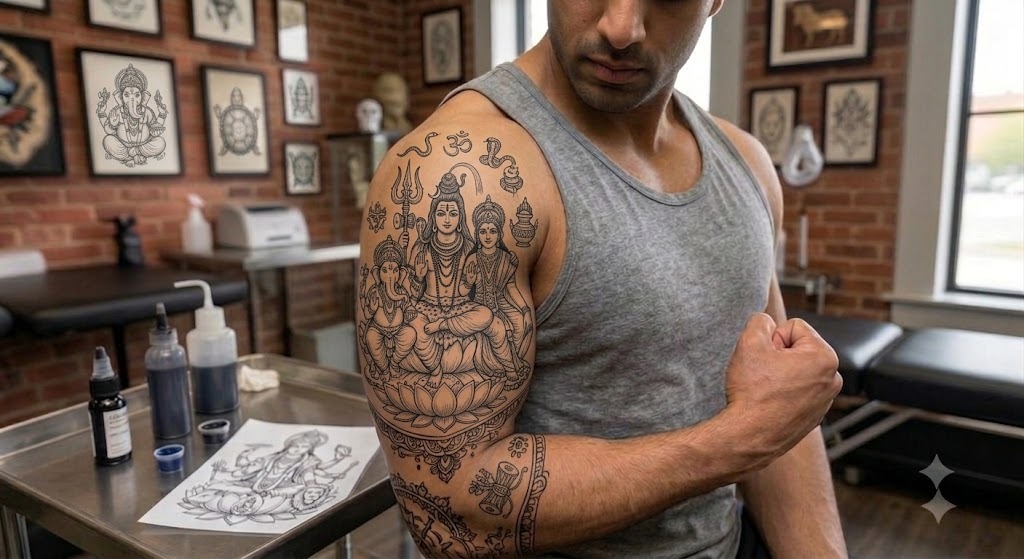
A single Mahadev face is a portrait. Shiv Parivar is four portraits — Shiva, Parvati, Ganesha and Kartikeya — that all have to sit together as one composition without any of them getting lost or crowded out by the others. It is one of the largest devotional pieces we design, and it is also one of the most frequently attempted at too small a scale, which is why this deserves its own honest guide rather than being squeezed into a single-figure page.
If you are looking at shiv parivar tattoo designs, this covers who belongs in the composition, why the arrangement matters as much as the individual figures, and what genuine scale this piece needs. We are Vulture Tattoos, an appointment-only studio in Sector 47, Gurgaon.
Who is in the family, and why it matters
Shiv Parivar means the family of Shiva — the domestic, gentler side of a god more often shown as an ascetic or a warrior. The composition typically includes:
- Shiva. Usually shown calm here, in his role as husband and father rather than the fierce Mahakal form — see our Mahadev tattoo designs guide for that side of him specifically.
- Parvati. His wife, and in this context the emphasis is on her as devoted partner and mother rather than in her Durga or Kali forms.
- Ganesha. Their elder son, the remover of obstacles — see our Ganesha tattoo designs guide for his own extensive symbolism.
- Kartikeya (also Murugan or Skanda). Their younger son, god of war and often shown with a peacock and spear. His inclusion is genuinely underused in tattoo work despite being a core part of the family.
- Nandi. Shiva’s bull, occasionally included at the base of the composition.
The meaning of the whole piece is different from any single figure within it: it is about family itself, about the coexistence of the ascetic and the domestic, the destroyer and the nurturing father, in one household.
Why composition is the entire skill here
This is the single most important thing to understand before booking, because it is the difference between a piece that reads as a family and one that reads as a cluttered collection of faces.
- A clear hierarchy or arrangement. Most successful Shiv Parivar pieces use a deliberate layout — Shiva and Parvati at the centre or top, the sons flanking them, rather than four faces of equal size scattered across the space.
- Each figure needs its own identifying detail. Ganesha’s trunk, Kartikeya’s peacock or spear, Parvati’s specific ornamentation — without these, four generic devotional faces blur together and the family reading is lost.
- Negative space between figures matters as much as the figures themselves. Crowding four portraits together without breathing room is the most common way this composition fails, both visually and in how it ages — see below.
The size question, answered honestly
Four portraits, each needing its own identifying detail and enough space around it to stay legible as ink settles over the decades, cannot fit convincingly on a forearm. A back, chest, or full sleeve is the realistic minimum for a proper Shiv Parivar composition.
If your available space is smaller than that, the honest options are:
- Reduce the family. Shiva and Parvati alone, or Shiva with Ganesha, rather than all four. A well-composed pair is far stronger than four cramped faces.
- Go symbolic rather than portrait-based. A trishul, a small Ganesha silhouette and a peacock feather, arranged together, can represent the same family without needing four faces at all.
- Wait and plan for the scale it deserves. Some pieces are worth designing properly rather than compressing. We will tell you honestly if your idea and your available space do not match.
Black and grey or colour?
Black and grey is what we recommend for most Shiv Parivar work. Four faces already ask a lot of the composition, and black and grey gives the full tonal range needed to distinguish them without adding the extra complexity of palette decisions across four figures — it also holds contrast on every Indian skin tone and lasts longest in Gurgaon’s sun. See our black and grey tattoo guide.
Colour can work beautifully at real scale — Kartikeya’s peacock in particular rewards colour — but it is a bigger undertaking on a piece already asking a lot structurally. Our colour tattoo guide covers the palette question if you go that route.
Where to place it
- Upper back, full back. The best canvas by a distance — flat, large, sun-protected, and it gives every figure room to breathe. See our back tattoo guide.
- Full or half sleeve. A strong alternative if you want the piece visible rather than covered — see our sleeve tattoo guide.
- Chest. Workable for a reduced version — Shiva and Parvati, or Shiva and Ganesha — rather than the full four-figure family.
- Thigh. Roomy enough for a moderate arrangement, comfortable to sit through.
Worth considering. Many people hold that sacred imagery should not be worn below the waist. We raise this at the consultation because placement, not design, is the most common source of regret with devotional work.
Does it hurt?
The same as any tattoo of that size in that place. Outer back muscle, thigh and upper arm are comfortable areas. Directly over the spine and shoulder blade bone, and ribs, are sharper.
This is honestly not a one-session tattoo at proper scale. A full Shiv Parivar back piece is a genuine project across multiple sittings, planned and paced from the start. Our tattoo pain chart covers placement sensation generally.
Want to talk through the composition and scale first? Call or WhatsApp us on +91 96676 14250 or message us on WhatsApp.
Healing and aftercare in Gurgaon
- Keep the wrap on as long as your artist says, then wash gently with lukewarm water and mild fragrance-free soap.
- Pat dry, do not rub. Rubbing a fresh shaded area pulls pigment out.
- Thin layer of balm. Large areas tempt over-application. Thin is still the word.
- Do not pick or scratch. A pale patch on any of the four faces is very visible.
- No swimming, sauna, gym sweat or soaking for two to three weeks after each session.
- Keep it moisturised well past the peeling stage.
- For a back piece, arrange help washing and moisturising — you genuinely cannot reach your own back properly.
Sun flattens contrast over the years, and a piece this size, well protected on the back, generally ages very well in Gurgaon precisely because that placement gets so little direct sun. Use SPF 30 or higher on any exposed sessions of healing. Our full tattoo aftercare guide for Gurgaon covers each stage.
Why the artist matters more here than almost anywhere
This is the most demanding compositional challenge in devotional tattooing that we take on. Four faces, each needing its own recognisable identity and expression, arranged so the eye reads the whole piece as a family rather than a wall of portraits, planned across sessions that all have to stay consistent with each other. It is realism, portrait work and large-scale composition all at once.
Ajay is our realism, devotional, portrait and cover-up specialist, and a piece at this scale is exactly his territory. Ronny specialises in fine-line, botanical, script and geometric work, which covers any ornamental framing or Devanagari mantra worked into the composition. Our page on the tattoo artists in Gurgaon introduces both.
Every tattoo is done with single-use sterile needles opened in front of you, in an appointment-only studio. That is part of why our clients have left more than 270 five-star Google reviews.
How it works with us
- Consultation. Bring your idea and tell us which family members matter most to include. We talk honestly about scale before anything is designed.
- Design. The full composition planned before the first session, with each figure given proper identity and space. You see it before any needle touches you.
- A written quote with a realistic session plan. Given at the consultation. Our tattoo cost guide for Gurgaon explains what shapes it.
- Sessions. Paced across sittings, built and healed one stage at a time.
- Aftercare and touch-ups. A clear plan after every session, and we are on WhatsApp throughout.
Why book in Sector 47
Vulture Tattoos sits at Shop F-04, Spaze Boulevard, Malibu Towne, Sector 47, Gurugram, easy to reach from across Gurgaon, DLF, Sohna Road, Golf Course Road and South Delhi. For a project running across many sessions, having the same artist see it through from start to finish is what keeps four faces consistent as one family rather than four disconnected sittings. Appointment-only means a calm, private studio for a piece that needs real planning time.
Book your Shiv Parivar tattoo: call or WhatsApp +91 96676 14250 to start with a consultation.
See our work
Composition across multiple figures is what to judge here, and it needs to be seen properly. Browse our recent pieces on Instagram at @vulture_tattooz, read more about the studio at Vulture Tattoos, or reach out through our contact page. When you are ready, call or WhatsApp +91 96676 14250 and we will plan shiv parivar tattoo designs built to last.
Frequently Asked Questions
Who is included in a Shiv Parivar tattoo?
Traditionally Shiva, his wife Parvati, and their sons Ganesha and Kartikeya, sometimes with Nandi the bull included at the base. The piece represents the family and domestic side of Shiva, distinct from his fierce Mahakal form or Parvati’s Durga and Kali forms shown elsewhere.
How big does a Shiv Parivar tattoo need to be?
A back, chest or full sleeve is the realistic minimum for the full four-figure composition, because each portrait needs its own space and identifying detail to read clearly and stay legible as ink settles over the decades. Attempting all four on a forearm is the most common way this piece disappoints people.
What if I don’t have room for the full family?
Reduce it deliberately rather than cramming everyone in. Shiva and Parvati alone, or Shiva with Ganesha, reads far better at smaller scale than four crowded faces. A symbolic version — a trishul, small Ganesha silhouette and a peacock feather together — can also represent the family without needing four portraits at all.
Why does Kartikeya get left out of most versions?
He is genuinely underused compared with the rest of the family, often because artists default to just Shiva, Parvati and Ganesha. Including him properly, usually with his peacock or spear, makes for a more complete and distinctive composition — it is worth asking for specifically if the full family matters to you.
Black and grey or colour for Shiv Parivar?
Black and grey for most compositions, because four faces already demand a lot structurally, and black and grey provides the full tonal range needed to distinguish them clearly while holding contrast on every Indian skin tone. Colour can work beautifully at real scale, particularly for Kartikeya’s peacock, but it adds real complexity across four figures.
How many sessions does a Shiv Parivar tattoo take?
This is genuinely a multi-session project at proper scale, not a single sitting. We plan and price the whole composition upfront, then build it across sessions, healing between each, so the piece comes together in stages rather than being rushed.
Where should I not place a Shiv Parivar tattoo?
Many people hold that sacred imagery should not be worn below the waist, which is worth considering for calf, ankle or foot placements — though at this scale, most people are choosing the back, chest or a sleeve regardless. We raise placement at the consultation because it is the most common source of regret with devotional work.
How do I book and how much will it cost?
Booking is by appointment. Call or WhatsApp +91 96676 14250 to arrange a consultation, where we discuss which family members to include, honest scale, and a session plan, and give you a clear written quote once everything is settled. Pricing depends on size, detail and total hours.