Ganesha Tattoo Designs: Ideas, Meaning, Placement and Honest Advice
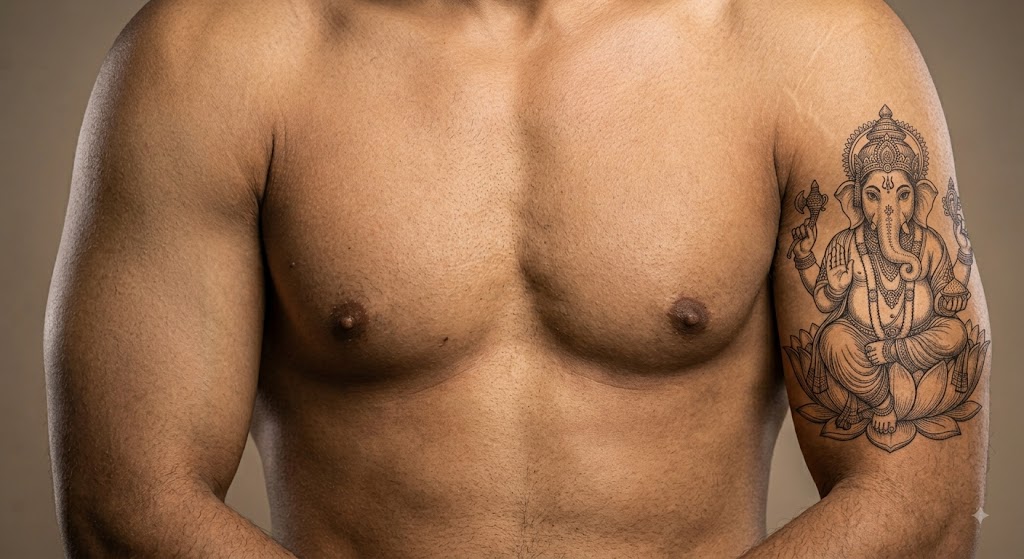
Ganesha is the god you turn to before you start something. A new job, a new business, a move, a marriage. Vighnaharta — the remover of obstacles — is who you ask before the road gets difficult, not after.
That is why so many Ganesha tattoos are booked at a turning point. People come in the month they quit a job, or the week before they get married, or after a year they would rather not repeat.
It is also one of the most flexible devotional designs to tattoo. Unlike a human portrait, Ganesha can be simplified a long way and still be instantly recognisable. That gives you real options. If you are looking at ganesha tattoo designs, this guide covers those options honestly. We are Vulture Tattoos, an appointment-only studio in Sector 47, Gurgaon.
What the details actually mean
Almost every element of Ganesha carries a meaning. Knowing them helps you decide what to include.
- The elephant head. Wisdom and intellect.
- The large ears. Listen more than you speak.
- The small eyes. Concentration and focus.
- The broken tusk. Sacrifice — and the idea of keeping the good and letting go of the rest.
- The large belly. Accepting everything life gives you, good and bad.
- The modak in his hand. The reward that comes after the work.
- The mouse (Mushak). Desire, kept under control rather than eliminated.
- The raised hand (abhaya mudra). Blessing and protection. Do not be afraid.
You do not need all of these in one tattoo. In fact the best small Ganesha pieces pick two or three and leave the rest.
Ganesha, Ganpati, Vighnaharta — the same tattoo?
This piece gets asked for under several names. They are all the same deity, and the name usually hints at which form someone wants.
- Ganesha tattoo / Ganesh tattoo — the general term.
- Ganpati tattoo — the everyday Marathi and North Indian name. Same subject, often the seated form.
- Ganesh ji tattoo — the respectful form of address.
- Vighnaharta tattoo — “remover of obstacles”. Chosen at a turning point rather than for the look.
- Vinayak tattoo — another name for the same figure.
- Siddhi Vinayak tattoo — specifically the right-curving trunk form, considered more powerful.
- Bal Ganesh tattoo — the child form. Softer and popular as a smaller piece.
- Ekdanta tattoo — “one tusk”, referencing the broken tusk story.
If you are searching any of these, you are looking at the same family of designs. What actually changes between them is the pose, the trunk direction and how much detail you include.
Ganesha tattoo designs that work
- Face only. The most requested version. Trunk, ears, crown — clean and recognisable. Works from a forearm down to a smaller upper-arm piece.
- Seated Ganesha. The full figure, calm, often with the modak and mouse. Needs more room but reads beautifully.
- Dancing Ganesha. Mid-movement, full of energy. Popular and dynamic — best on a forearm, thigh or calf where the shape has room.
- Ganesha in a mandala. The figure framed by ornamental geometry. One of the best-ageing versions because the geometry is clean linework. See our mandala tattoo guide.
- Fine-line Ganesha. Minimal, delicate, modern. Beautiful, but read our fine line tattoo guide for how thin work ages before choosing this.
- Ganesha with Om. The symbol and the figure together. Our Om tattoo designs guide covers getting the symbol’s form correct.
- Om Gam Ganapataye Namaha. The mantra in Devanagari, alone or with the figure. Read our script tattoo guide first.
- Ganesha silhouette. A solid black outline. The version that genuinely works small, and it ages better than almost anything.
- Ganesha with lotus. Softer and more decorative, good for a shoulder or collarbone.
- Colour Ganesha. Reds, oranges and gold. Striking, and our colour tattoo guide explains which shades hold on Indian skin.
Why Ganesha is easier to tattoo than most gods
This is genuinely useful to know, and nobody explains it.
A human-faced deity — Shiva, Krishna, Hanuman — is a portrait. Portraits fail on small errors, because your brain knows exactly what a face should look like.
Ganesha is different. The recognisable elements are the shapes: the trunk, the ears, the crown. Those read correctly even when simplified heavily. That is why a small Ganesha silhouette still looks like Ganesha, while a small Shiva face just looks like a blur.
What this means for you:
- Small works. A simple Ganesha at 5–6 cm is a realistic option, unlike most devotional portraits.
- Style is open. Fine-line, blackwork, mandala, dotwork, realism — all of them suit this subject.
- The trunk direction is a real choice. Traditionally, a trunk curving to the left is the common, approachable form. A right-curving trunk (Siddhi Vinayak) is considered more powerful and is said to require stricter observance. Most tattoos use the left curve. Worth deciding rather than leaving to chance.
What still goes wrong
Two things, both fixable at the design stage.
Too much detail in too small a space. A full seated Ganesha with mouse, modak, crown jewels, mandala and mantra, shrunk onto a wrist, will close into a dark shape within a few years. Every enclosed gap fills in as ink settles. Pick fewer elements or go bigger.
Ornament without structure. Very fine ornamental detail with no solid black anywhere has nothing to hold it together long term. A small amount of dark value keeps the piece readable for decades.
Where to place it
- Inner or outer forearm. The best all-round choice. Flat, visible, ages well.
- Upper arm and shoulder. Comfortable, easy to cover, good curve for a seated or dancing figure.
- Upper back and shoulder blade. Flat, protected from sun, ideal for mandala compositions.
- Chest. Meaningful and roomy.
- Thigh. Comfortable to sit, easy to keep out of the sun, plenty of space.
- Collarbone or behind the ear. Only for a simple silhouette or a very reduced design.
One thing to consider. Many Hindus believe sacred images should not be worn below the waist, which makes calf, ankle and foot a real question. Views differ and it is your decision — we raise it at the consultation because placement is the most common regret with devotional work, not design.
Does it hurt?
Same as any tattoo of that size in that place. The outer forearm, upper arm and thigh are the most comfortable. Ribs, sternum, collarbone and areas over bone are sharper.
A simple Ganesha is a short session. A large mandala composition or a shaded realistic figure takes several hours and may be split across sittings. Our tattoo pain chart covers every placement.
Want to talk it through? Call or WhatsApp us on +91 96676 14250 or message us on WhatsApp.
Healing and aftercare in Gurgaon
- Keep the wrap on as long as your artist says, then wash gently with lukewarm water and a mild fragrance-free soap.
- Pat dry, do not rub. Rubbing fresh linework pulls pigment out of thin strokes.
- Use a thin layer of balm. Thin is the word.
- Do not pick or scratch. A gap in ornamental linework is very visible.
- No swimming, sauna, gym sweat or soaking for two to three weeks.
- Keep it moisturised well past the peeling stage.
Forearm placements catch Gurgaon sun every day if you drive or ride. UV softens fine linework faster than anything else. Once healed, use SPF 30 or higher every time it is exposed. Our full tattoo aftercare guide for Gurgaon covers each stage.
Why the artist matters
Ganesha is forgiving on recognisability and unforgiving on line quality. Because most versions are built from clean lines and ornament, every wobble shows. Symmetry matters too — the ears, the crown and any mandala framing all have to mirror properly across a curved arm.
A good artist keeps stroke weight consistent, plans where the solid black sits so the piece holds together long term, and tells you honestly when a design has more detail than your chosen size can carry.
Ronny specialises in fine-line, botanical, script and geometric work, which covers ornamental Ganesha, mandala framing, silhouettes and Devanagari mantras. Ajay handles realism, devotional, portrait and cover-up work, which covers shaded and realistic versions. Our page on the tattoo artists in Gurgaon introduces both.
Every tattoo is done with single-use sterile needles opened in front of you, in an appointment-only studio. That is part of why our clients have left more than 270 five-star Google reviews.
How it works with us
- Consultation. Bring your idea and references. We talk about which elements to include, trunk direction, size and placement.
- Design. Drawn custom, simplified where it needs to be so it survives, and fitted to your placement. You see it before any needle touches you.
- A written quote. Clear, at the consultation. Our tattoo cost guide for Gurgaon explains what shapes it.
- The session. Calm, paced, with breaks whenever you want them.
- Aftercare. A clear plan, and we are on WhatsApp while it heals.
Why book in Sector 47
Vulture Tattoos is at Shop F-04, Spaze Boulevard, Malibu Towne, Sector 47, Gurugram. Easy to reach from across Gurgaon, DLF, Sohna Road, Golf Course Road and South Delhi.
Appointment-only means one client at a time, in a quiet studio. For detailed ornamental work, that matters — this is not the kind of tattoo that should be rushed between walk-ins.
Book your Ganesha tattoo: call or WhatsApp +91 96676 14250.
See our work
Line quality and symmetry are what to judge, and both have to be seen. Browse our recent pieces on Instagram at @vulture_tattooz, read more at Vulture Tattoos, or reach us through our contact page. When you are ready, call or WhatsApp +91 96676 14250 and we will plan ganesha tattoo designs built to last.
Frequently Asked Questions
Can a Ganesha tattoo be small?
Yes — more easily than most devotional designs. Ganesha is recognised by shapes rather than facial features, so a simplified version still reads correctly at 5–6 cm. That is not true of Shiva, Krishna or Hanuman, which are portraits and need far more room. Keep a small Ganesha simple: fewer elements, clean lines, generous gaps.
Which way should the trunk curve?
Most tattoos use the left-curving trunk, which is the common and approachable form. A right-curving trunk is the Siddhi Vinayak form, considered more powerful and traditionally said to require stricter observance. Neither is wrong, but it is worth deciding deliberately rather than leaving it to whichever reference image you found.
What does the broken tusk mean?
Sacrifice, and the idea of keeping what matters while letting go of the rest. It comes from the story of Ganesha breaking his own tusk to keep writing the Mahabharata. It is one of the details worth including even in a simplified design, because it carries so much of the meaning.
Where should I not place a Ganesha tattoo?
Many Hindus believe sacred images should not be worn below the waist, which makes calf, ankle and foot placements a real question for a lot of people. Views differ and it is your decision. We raise it at the consultation because placement, not design, is the most common source of regret with devotional tattoos.
Fine-line or bold for a Ganesha tattoo?
Fine-line looks beautiful fresh, but very thin work with no solid black has nothing holding it together long term. The versions that age best keep some dark value somewhere — a solid area, a heavier outline on the main shape, or a bold silhouette. A slightly bolder Ganesha will still read clearly in twenty years when a delicate one has softened.
Can I add the Om Gam Ganapataye Namaha mantra?
Yes, and it is a common pairing. Have the exact Devanagari confirmed by someone who genuinely reads the script before it becomes a stencil, and allow enough height for the matras above and below the top line. Our script tattoo guide covers this properly.
Is a Ganesha tattoo good for a first tattoo?
It can be an excellent first tattoo, because a simple version is a short session on a comfortable placement like the forearm or upper arm. Keep it simple for the first one and add to it later if you want. Our first tattoo guide for Gurgaon walks through the whole day.
How do I book and how much will it cost?
Booking is by appointment. Call or WhatsApp +91 96676 14250 to arrange a consultation. We discuss the design, elements, size and placement, and give you a clear written quote once the details are settled. Pricing depends on size, detail and time, so we quote in person rather than online.