Pet Portrait Tattoo Designs: Photos, Paw Prints and Memorials
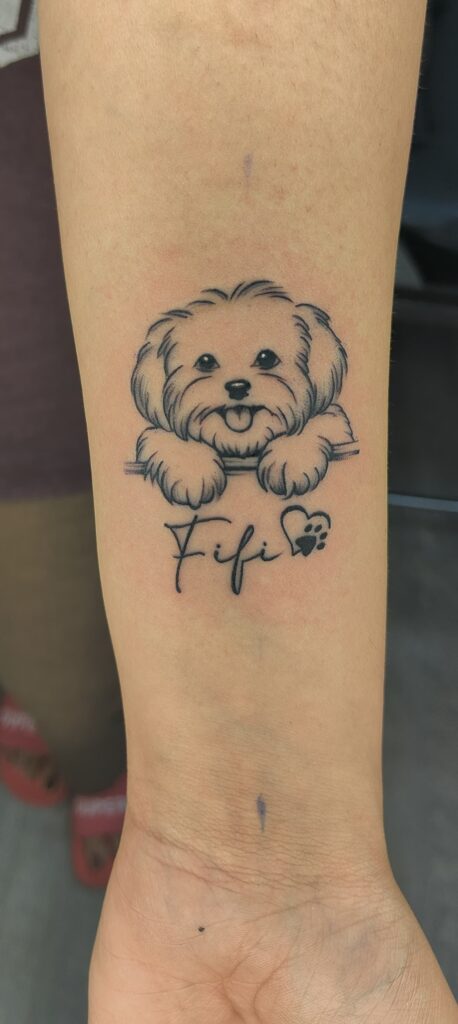
If your dog or cat is still with you, stop reading for two minutes and go take a photo.
Get down on the floor so the camera is at their eye level. Turn on a light or take them near a window. Wait until they look at you. Take twenty shots and keep the sharpest one.
We are asking because of a pattern we see constantly. Someone comes in months or years after losing their pet, wanting a portrait, and the only photos they have are blurry ones taken from standing height, in bad light, with the animal looking away. We can work from those. But the tattoo would have been better with a photo that took two minutes to get while there was still time.
If you are looking at pet portrait tattoo designs, this guide covers what makes a good one, and the options if the photo is not perfect. We are Vulture Tattoos, an appointment-only studio in Sector 47, Gurgaon.
The photo is the whole tattoo
An artist cannot add detail that is not in the reference. This is the single biggest factor in whether your pet portrait looks like your pet or like a generic dog.
What makes a photo work:
- Eye level. Get down to their height. A photo taken from standing distorts the face — the nose looks huge and the head looks small.
- Sharp focus on the eyes. The eyes are what make it recognisably them. If the eyes are soft, the tattoo will be too.
- Good natural light. Near a window, or outside in shade. Light on the face, not behind it.
- No phone flash. Flash flattens the face, kills the fur texture and gives that reflective eye-shine that hides eye colour.
- Looking towards the camera. Or a clean side profile. Not mid-turn.
- Full resolution. Send the original file, not a WhatsApp forward. WhatsApp compresses images heavily and throws away exactly the detail we need.
- A few angles. Bring several photos. It helps to see the shape of the head from more than one side.
If your photo is not perfect, bring it anyway. We will tell you honestly what is achievable, and there are good options below that do not depend on a sharp reference.
Pet tattoo designs that work
- Black and grey portrait. The classic. Full face, realistic shading. The most demanding version and the most rewarding when the reference is good.
- Colour portrait. Worth it when eye colour or a distinctive coat is the thing you remember most.
- Line-art portrait. A clean single-line or minimal outline drawing of their face. Modern, elegant, and it does not need a perfect photo — see our fine line tattoo guide.
- Silhouette. Their profile in solid black. Simple, timeless, ages better than anything else here, and it works when the photo is poor.
- Real paw print. Not a generic paw — their actual one. See below.
- Nose print. A pet’s nose is as unique as a fingerprint. Under-used and beautiful.
- Portrait with name and dates. Read our script tattoo guide before committing to lettering.
- Eyes only. Just their eyes across a forearm or collarbone. Deeply personal and surprisingly powerful.
- Paw print with a heartbeat line. A common memorial arrangement.
- Portrait with florals. Softens a memorial piece and fills the space around the face.
Get their real paw print
This is the tip most people wish they had known earlier.
A generic paw shape off the internet is somebody else’s paw. Your pet’s actual print is theirs. The pad shapes, the spacing, the small irregularities — those are what make it a portrait rather than a symbol.
How to take one, while you still can:
- Use a pet-safe non-toxic ink pad, or plain washable paint, on white paper.
- Press the paw down firmly and lift straight up. Do not drag.
- Take several — some will smudge.
- Photograph the best one flat, in good light, from directly above.
- Wash their paw immediately afterwards.
Your vet can often take a print too, and many will do it as a keepsake at the end of a pet’s life if you ask.
The same applies to a nose print, which is unique to each animal and makes a striking small tattoo.
Why fur is the hardest thing to tattoo
Worth knowing so you can judge an artist’s portfolio properly.
Fur is not one texture. It changes direction, length and density across a face — short and tight around the muzzle, longer and softer at the cheeks, wiry at the brow. Tattooing it convincingly means following those direction changes rather than shading a general grey mass.
What to look for in an artist’s healed work:
- Does the fur have direction, or is it just soft shading?
- Are the eyes wet-looking, with a bright highlight of bare skin?
- Is the nose textured rather than a black blob?
- Do the whiskers read as fine light lines rather than scratches?
- Does it look like a specific animal or a breed in general?
Our realism tattoo guide covers how to judge portrait work before you book, and our black and grey guide explains why contrast decides whether a portrait still reads in twenty years.
Size — be realistic
A pet portrait is a portrait, and portraits fail small.
- Full face portrait: forearm at minimum. Upper arm, thigh or chest for anything detailed.
- Line-art or silhouette: works considerably smaller.
- Paw print or nose print: genuinely works small, and it is a lovely wrist or ankle piece.
- Eyes only: needs moderate room, because the detail is all in a small area.
If you want something small and it must be a face, choose line-art or a silhouette rather than shrinking a realistic portrait. A shrunken realistic portrait loses the eyes first, and the eyes are the whole thing.
Memorial pieces
Most pet portraits are memorials. Two honest things.
There is no rush. Grief moves, and so does what you want to carry. Some people book within days and later find the design belonged to the worst week rather than to the animal. Nobody here will push you to book faster.
Check the dates. If you are including them, confirm the format — 03/05 is two different days depending on where you learned to write dates. It is a small check that prevents a permanent mistake.
And if you have a print, a collar tag rubbing, or anything else physical — bring it. Those details make a memorial piece specific in a way a portrait alone cannot.
Where to place it
- Inner or outer forearm. The best all-round placement. You can see it yourself, which matters for this kind of tattoo.
- Upper arm and shoulder. Comfortable, easy to cover, roomy.
- Thigh. Plenty of space, comfortable to sit, easy to keep out of the sun.
- Chest. Over the heart. Obvious meaning, and there is room to size it properly.
- Calf. Roomy and comfortable.
- Wrist or ankle. Only for a paw print, nose print or small silhouette.
Does it hurt?
The same as any tattoo of that size in that place. Outer forearm, upper arm and thigh are the most comfortable. Ribs, sternum and areas over bone are sharper.
A realistic portrait takes hours because of the shading. A paw print is a short session. Our tattoo pain chart covers every placement.
Want to talk it through? Call or WhatsApp us on +91 96676 14250 or message us on WhatsApp. Send the photo and we will tell you honestly what is possible with it.
Healing and aftercare in Gurgaon
- Keep the wrap on as long as your artist says, then wash gently with lukewarm water and a mild fragrance-free soap.
- Pat dry, do not rub. Rubbing a fresh shaded area pulls pigment out.
- Use a thin layer of balm. Thin is the word.
- Do not pick or scratch. A pale patch in a fur texture is very visible.
- No swimming, sauna, gym sweat or soaking for two to three weeks.
- Keep it moisturised well past the peeling stage.
One practical note: if you have other pets, keep them off the fresh tattoo. Licking, claws and pet hair on a healing tattoo are a genuine infection risk, and it comes up more often than you would think.
Sun flattens shading over the years, and shading is what makes fur read as fur. Use SPF 30 or higher once healed. Our full tattoo aftercare guide for Gurgaon covers each stage.
Why the artist matters
Animal portraits are harder than human ones in one specific way: you know exactly what your pet looks like, better than you know your own face. A human portrait that is slightly off still reads as a person. A pet portrait that is slightly off reads as somebody else’s dog, and you will see it every day.
That means the artist has to capture not just the anatomy but the expression — the particular set of the ears, the tilt of the head, whatever it was that made them them.
Ajay is our realism, devotional, portrait and cover-up specialist, so pet portraits sit with him. Ronny specialises in fine-line, botanical, script and geometric work, which covers line-art portraits, silhouettes, paw prints and lettering. Our page on the tattoo artists in Gurgaon introduces both.
Every tattoo is done with single-use sterile needles opened in front of you, in an appointment-only studio. That is part of why our clients have left more than 270 five-star Google reviews.
How it works with us
- Send the photo first. On WhatsApp, at full resolution. We will tell you honestly whether it is usable before you come in.
- Consultation. We talk about which version suits your photo and your placement, and what size it needs.
- Design. Drawn from your reference and sized so the eyes survive. You see it before any needle touches you.
- A written quote. Clear, at the consultation. Our tattoo cost guide for Gurgaon explains what shapes it.
- Aftercare. A clear plan, and we are on WhatsApp while it heals.
Why book in Sector 47
Vulture Tattoos is at Shop F-04, Spaze Boulevard, Malibu Towne, Sector 47, Gurugram. Easy to reach from across Gurgaon, DLF, Sohna Road, Golf Course Road and South Delhi.
Appointment-only means a quiet, private studio and one client at a time. For a memorial piece, that matters more than it sounds — this is not a tattoo most people want to sit through in a busy shop.
Book your pet portrait: call or WhatsApp +91 96676 14250.
See our work
Fur direction and wet-looking eyes are what to judge, ideally on healed work rather than fresh photos. Browse our recent pieces on Instagram at @vulture_tattooz, read more at Vulture Tattoos, or reach us through our contact page. When you are ready, call or WhatsApp +91 96676 14250 and we will plan pet portrait tattoo designs that actually look like them.
Frequently Asked Questions
What kind of photo do you need for a pet portrait tattoo?
Sharp focus on the eyes, taken at their eye level, in good natural light, with them looking towards the camera. No phone flash. Send the original full-resolution file rather than a WhatsApp forward, because WhatsApp compresses images and throws away the detail we need. Bring a few angles if you have them.
What if my only photos are blurry?
Bring them anyway and we will be honest about what is achievable. A realistic portrait needs detail we cannot invent, but line-art, silhouette and paw-print versions do not depend on a sharp reference and can be just as meaningful. We would rather steer you to a version that works than take the booking and hand you a disappointing portrait.
How do I take my pet’s paw print?
Use a pet-safe non-toxic ink pad or washable paint on white paper. Press the paw firmly and lift straight up without dragging, take several because some will smudge, then photograph the best one flat from directly above in good light. Wash their paw straight after. Your vet can often do this for you too.
How big does a pet portrait need to be?
A realistic full-face portrait needs a forearm at minimum, and an upper arm or thigh for anything detailed. The eyes are the first thing lost when a portrait is shrunk, and the eyes are what make it recognisably your pet. If you want something small, choose line-art, a silhouette or a paw print instead.
Black and grey or colour for a pet tattoo?
Black and grey suits most pet portraits, holds contrast on every skin tone and lasts longest in Gurgaon’s sun. Colour is worth it when eye colour or a distinctive coat is the thing you remember most — a green-eyed cat or a ginger dog. Deep saturated shades read better than pale ones on Indian skin.
Should I wait after losing my pet?
There is no rule, and many people are glad they did it early. What we would gently say is that grief moves, and some people later find the design belonged to the worst week rather than to the animal. Nobody here will push you to book faster, and waiting another month costs nothing.
Can you tattoo a nose print?
Yes, and it is under-used. A pet’s nose print is as unique as a fingerprint, which makes it genuinely specific to them rather than a symbol anyone could wear. It works well at small size on a wrist, forearm or ankle, and it pairs nicely with a name or dates.
How do I book and how much will it cost?
Send your photo on WhatsApp to +91 96676 14250 first — we will tell you honestly whether it is usable before you come in. Then we arrange a consultation to discuss size, placement and version, and give you a clear written quote once the details are settled. Pricing depends on size, detail and time.