Peacock Tattoo Designs: Meaning, Feather Detail and What Ages Well
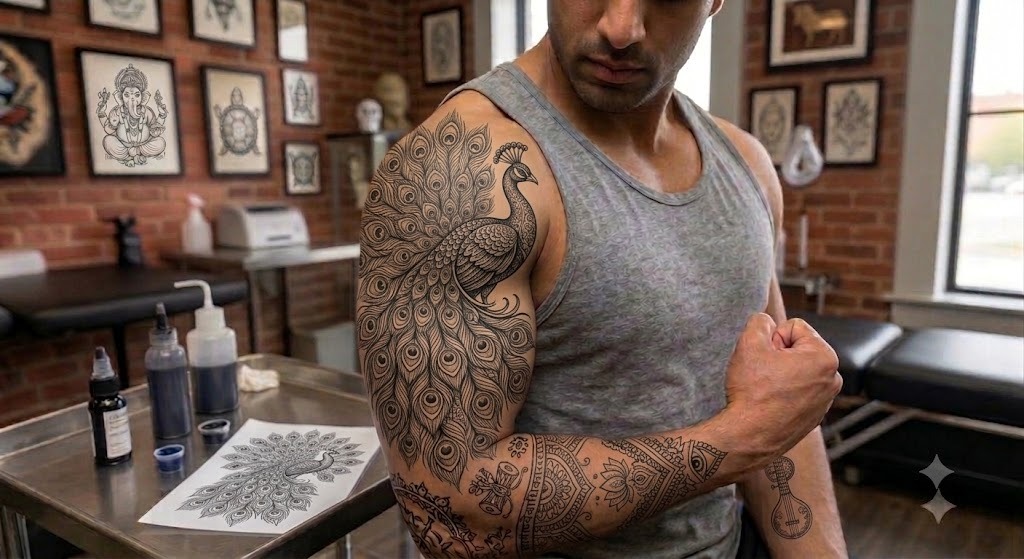
The peacock is India’s national bird, and it carries meaning here that most Western tattoo guides do not even mention. It is associated with Saraswati and, most famously, with Krishna’s crown feather — the mor pankh — which makes it one of the few designs that works equally well as a bold fashion statement or as something quietly devotional, depending entirely on how you build it.
If you are looking at peacock tattoo designs, this guide covers what the bird actually represents, the full-bird-versus-feather decision, and the specific technical challenge that decides whether the design still looks vivid in fifteen years. We are Vulture Tattoos, an appointment-only studio in Sector 47, Gurgaon.
What a peacock represents
- Beauty and self-expression. The most universal reading — the peacock’s display is one of nature’s most spectacular, and the tattoo often carries that same sense of confident, unapologetic beauty.
- Renewal. Peacocks shed and regrow their tail feathers annually, which has made the bird a symbol of cyclical renewal and rebirth across several cultures.
- Krishna’s mor pankh. The feather Krishna wears in his crown, one of his most recognisable attributes — see our Radha Krishna tattoo designs guide. Choosing a single feather rather than the full bird is often specifically about this devotional connection.
- Association with Saraswati. Sometimes shown alongside her, representing ego and worldly pride that knowledge should temper — see our Saraswati tattoo designs guide.
- Pride and confidence. A more secular, direct reading — wearing your own beauty and presence openly.
Full bird or feather alone — a real decision, not just a size question
This is worth thinking through properly, because the two versions carry genuinely different meanings, not just different scales.
The full peacock, feathers spread, is the fashion-forward, confident-beauty reading — a display piece in every sense. It needs real space to do the fan of feathers justice.
A single mor pankh feather leans devotional, connecting more directly to Krishna, and it is one of the few peacock-related designs that genuinely works at small size. Our feather tattoo designs guide covers feathers generally, but the peacock feather specifically carries this extra layer of meaning that a generic feather does not.
Peacock tattoo designs that work
- Full bird, feathers spread. The classic display pose, needing real width to show the fan properly.
- Single mor pankh feather. The distinctive eye-pattern feather alone, often in colour even when the rest of a piece is black and grey.
- Peacock in flight. Less common and more dynamic — the bird mid-motion rather than displaying.
- Peacock with florals. The body and tail worked into a botanical composition — see our flower tattoo designs guide.
- Peacock with Krishna or Saraswati. Paired with the deity directly rather than as a standalone bird.
- Watercolour peacock. Soft washes of colour bleeding from the feathers — see our watercolour tattoo guide.
- Black and grey peacock. The full bird rendered entirely in tone rather than colour — genuinely striking, and see below for why it may be the more durable choice.
- Mandala peacock. The feather’s natural eye-pattern worked into ornamental geometry — see our mandala tattoo guide.
The feather-eye problem — this decides whether it ages well
Every peacock tail feather has a distinctive “eye” pattern — concentric rings of colour around a central point. It is the single most recognisable part of the design, and it is also the part most likely to fail over time if the piece is built too small or too pale.
- The rings need real gaps between them. Just like the concentric structure of an evil eye tattoo, tightly packed colour rings close up as ink spreads over the years. A feather-eye built with generous spacing between each ring stays legible for decades; a tiny, tightly packed one loses its structure within about ten years.
- A full spread of feathers multiplies this risk. Ten or twelve small feather-eyes, each with too little space, is far riskier than two or three larger, well-spaced ones.
- Fewer, larger feathers beat many small ones. If you want the full display, a design with a handful of clearly rendered feathers ages far better than an attempt to show every feather of a real peacock’s tail.
Colour on Indian skin
The peacock is naturally a colour subject — the blues, greens and golds are the whole point of the bird. On medium and deeper Indian skin, deep saturated teal, emerald and blue hold beautifully. Pale turquoise or washed-out green reads faint once healed and loses the vividness that makes this design work. Our colour tattoo guide covers the palette question in depth.
Black and grey is a genuinely strong alternative, particularly for the full bird — the feather’s eye pattern reads through tonal contrast just as well as through colour, and black and grey lasts longest in Gurgaon’s sun with none of the maintenance colour work needs. See our black and grey tattoo guide.
Where to place it
- Upper arm and shoulder. The best all-round placement for a full spread bird — the curve of the arm suits the fan shape naturally.
- Back and shoulder blade. The largest canvas, ideal for a full display with room for every feather to breathe. See our back tattoo guide.
- Thigh and calf. Roomy and comfortable, easy to keep out of the sun.
- Forearm. Good for a single mor pankh feather or a smaller bird composition.
- Collarbone or wrist. Only for a single feather, not the full bird — see our collarbone guide and wrist tattoo guide.
Does it hurt?
The same as any tattoo of that size in that place. Outer arm, shoulder, thigh and calf are the most comfortable. Ribs, sternum and areas over bone are sharper.
A single feather is a manageable session. A full spread peacock with colour packing takes considerably longer, often several hours, and larger back pieces may be split across sittings. Our tattoo pain chart covers every placement.
Want to talk through the composition? Call or WhatsApp us on +91 96676 14250 or message us on WhatsApp.
Healing and aftercare in Gurgaon
- Keep the wrap on as long as your artist says, then wash gently with lukewarm water and mild fragrance-free soap.
- Pat dry, do not rub. Rubbing fresh colour work pulls pigment straight out.
- Thin layer of balm. Thin is the word.
- Do not pick or scratch. A lost patch inside a feather eye needs a touch-up and disrupts the ring pattern noticeably.
- No swimming, sauna, gym sweat or soaking for two to three weeks. Chlorine is hard on fresh colour.
- Keep it moisturised well past the peeling stage.
If your peacock is in colour, sun protection is not optional in Gurgaon. UV is the biggest threat to coloured pigment, and the blues and greens this design depends on are exactly the shades that fade first without protection. Use SPF 30 minimum, 50 is better, once healed. Our full tattoo aftercare guide for Gurgaon covers each stage.
Why the artist matters
The feather-eye pattern is deceptively technical — each ring has to be evenly spaced and cleanly separated from the next, repeated across every feather in the design, while the overall composition still flows naturally around the arm or back. Colour packing has to be solid and even, because thin, patchy colour in a feather eye is the fastest thing to fade into an indistinct blur.
Ajay handles our realism, devotional, portrait and cover-up work, which covers detailed colour realism peacocks and Krishna pairings. Ronny specialises in fine-line, botanical, script and geometric work, which covers single feathers, mandala peacocks and ornamental treatments. Our page on the tattoo artists in Gurgaon introduces both.
Every tattoo is done with single-use sterile needles opened in front of you, in an appointment-only studio. That is part of why our clients have left more than 270 five-star Google reviews.
How it works with us
- Consultation. Bring your idea and references. We talk full bird versus feather, colour versus black and grey, size and placement.
- Design. Drawn to your placement, with feather-eye spacing sized to survive the decades. You see it before any needle touches you.
- A written quote at consultation. Clear, before anything begins. Our tattoo cost guide for Gurgaon explains what shapes it.
- The session. Paced, with breaks, split across sittings for larger colour work.
- Aftercare and touch-ups. A clear plan, and we are on WhatsApp while it heals.
Why book in Sector 47
Vulture Tattoos sits at Shop F-04, Spaze Boulevard, Malibu Towne, Sector 47, Gurugram, easy to reach from across Gurgaon, DLF, Sohna Road, Golf Course Road and South Delhi. Appointment-only means long colour sessions happen in a calm, well-lit studio, which matters for judging feather-eye colour accurately.
Book your peacock tattoo: call or WhatsApp +91 96676 14250 to start with a consultation.
See our work
Feather-eye spacing and colour packing are what to judge, and both need to be seen. Browse our recent pieces on Instagram at @vulture_tattooz, read more about the studio at Vulture Tattoos, or reach out through our contact page. When you are ready, call or WhatsApp +91 96676 14250 and we will plan peacock tattoo designs built to stay vivid.
Frequently Asked Questions
What does a peacock tattoo mean?
Beauty, confidence and renewal — peacocks shed and regrow their tail feathers annually, making the bird a natural symbol of cyclical renewal across several cultures. In India specifically it carries an extra layer through Krishna’s mor pankh crown feather and its association with Saraswati, which makes a single feather design distinctly devotional rather than purely decorative.
Should I get the full bird or just a feather?
They carry genuinely different meanings, not just different sizes. The full bird with feathers spread is a confident, fashion-forward display piece needing real space. A single mor pankh feather leans devotional through its connection to Krishna, and it is one of the few peacock designs that works well at small size.
Why do peacock tattoos sometimes look faded or blurry after a few years?
Almost always because the feather-eye pattern — the concentric rings that make a peacock feather recognisable — was built too small or too tightly packed. Those rings close up as ink naturally spreads over the years, exactly like the rings in an evil eye tattoo. Generous spacing between rings, and fewer, larger feathers rather than many tiny ones, is what prevents this.
Which colours work best on Indian skin for a peacock?
Deep saturated teal, emerald and blue hold beautifully on medium and deeper Indian skin. Pale turquoise or washed-out green has too little contrast and fades faster, losing the vividness the design depends on. Black and grey is a genuinely strong alternative if you want to avoid colour maintenance altogether.
How big does a peacock tattoo need to be?
A single feather works at small to moderate size. A full spread bird needs real width — an upper arm, shoulder or back is the realistic minimum to give the fan of feathers proper room, because cramming a full display onto a small space forces the feather-eye rings too close together to survive.
Is a peacock tattoo religious?
It can be, but does not have to be. A full display bird is often chosen purely for its beauty and confidence symbolism. A single mor pankh feather, particularly paired with Krishna imagery, leans devotional. The same bird carries both readings depending entirely on how the piece is built and what else it is paired with.
Can I combine a peacock with Krishna or Saraswati?
Yes, and both are traditional and meaningful pairings. With Krishna, the feather usually sits at his crown or alongside a flute — see our Radha Krishna tattoo guide. With Saraswati, the peacock is sometimes shown separately, representing worldly pride that knowledge should temper — see our Saraswati tattoo guide.
How do I book and how much will it cost?
Booking is by appointment. Call or WhatsApp +91 96676 14250 to arrange a consultation, where we discuss full bird versus feather, colour, size and placement, and give you a clear written quote once the details are settled. Pricing depends on size, detail and time.