Ek Onkar Tattoo Designs: Khanda, Meaning, Placement and Respect
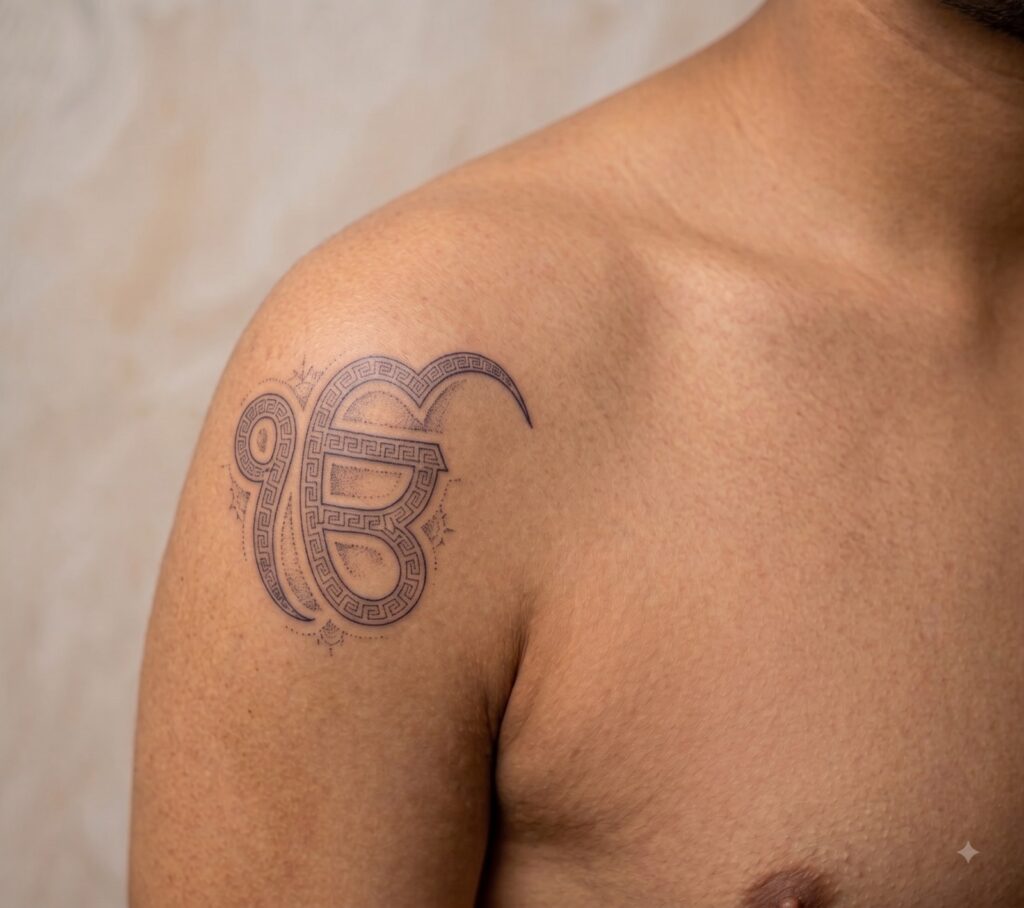
Ik Onkar is the first thing written in the Guru Granth Sahib. Not a chapter heading — the very first character of the Mool Mantar, and the foundation everything after it rests on. It means “there is one God”.
That weight is exactly why this tattoo deserves care, and why it needs a conversation most studios skip. The symbol is written in Gurmukhi, and Gurmukhi has rules. Get a stroke wrong and you have not written Ik Onkar — you have written a shape that resembles it, permanently, on your arm.
If you are looking at ek onkar tattoo designs, this guide covers the meaning, how to keep the form correct, and the respect question that comes up in every family. We are Vulture Tattoos, an appointment-only studio in Sector 47, Gurgaon.
Ek Onkar, Ik Onkar, Khanda — what is what
These names get used interchangeably and they are not the same thing. Worth knowing before you book.
- Ek Onkar tattoo / Ik Onkar tattoo — ੴ. The written symbol meaning “one God”. Both spellings refer to the same thing; Ik Onkar is closer to the Gurmukhi pronunciation.
- Khanda tattoo — the Sikh emblem: a double-edged sword in the centre, a circular chakkar around it, and two curved kirpans on either side. A completely different symbol from Ik Onkar, and a different tattoo.
- Mool Mantar tattoo — the full opening verse in Gurmukhi, of which Ik Onkar is the first part. Much longer, and needs far more room.
- Waheguru tattoo — ਵਾਹਿਗੁਰੂ written in Gurmukhi. Often chosen alongside or instead of the symbol.
- Nishan Sahib — the Sikh flag, sometimes tattooed with the Khanda.
- Kirpan or chakkar alone — individual elements from the Khanda, occasionally worn on their own.
Most people searching “ek onkar tattoo” want the symbol. Most people searching “khanda tattoo” want the emblem. If you want both, they usually work better as one designed composition than as two separate pieces.
What Ik Onkar actually means
Breaking it down helps you decide how to draw it.
- ੴ is made of two parts. The numeral ੧ (ik, meaning one) and the character ਓ (onkar).
- “One” is the whole point. Not one among many — one, undivided, present in everything. The numeral is doing real work; it is not decoration.
- The extended stroke curving off the top is part of the character, not a flourish added for looks. Designers who cannot read Gurmukhi sometimes stylise it into a swirl, which changes the character.
The Khanda carries its own meanings: the central double-edged sword for divine knowledge cutting truth from falsehood, the chakkar’s unbroken circle for God without beginning or end, and the two kirpans for Miri and Piri — worldly and spiritual authority held together.
Getting the Gurmukhi right
This is the section that matters most, and almost no studio page covers it.
- Do not work from a decorative image search result. A large amount of the ੴ artwork online was drawn by designers who do not read Gurmukhi. The proportions drift, the stroke lengths change, the curve gets stylised. It looks fine to an untrained eye and wrong to anyone who reads the script.
- Get it checked before it becomes a stencil. Someone who actually reads Gurmukhi should confirm the form. A parent, a grandparent, anyone from your gurdwara. This takes five minutes and prevents a permanent mistake.
- Keep the proportions. The relationship between the numeral, the character and the extended stroke is what makes it read correctly.
- Do not go tiny. The symbol has enclosed curves, and enclosed gaps close up as ink settles over the years. A very small ੴ turns into a dark shape.
- If you are getting the full Mool Mantar, the verification matters even more, and so does size — see our script tattoo guide for how lettering ages and why length is the enemy.
We would far rather delay a session by a week than tattoo an unverified religious character.
Design directions that work
- Clean Ik Onkar. The symbol alone in solid black. Understated, correct, and it ages better than anything else on this list. The most common choice by far.
- Ik Onkar with Khanda. The symbol above or beside the emblem, designed as one composition.
- Khanda alone. Strong, symmetrical, instantly recognisable. Works well on a forearm, chest or shoulder.
- Ik Onkar in a mandala. The symbol framed by ornamental geometry — see our mandala tattoo guide.
- Waheguru in Gurmukhi. The word alone, or paired with the symbol. Read our script tattoo guide first.
- Ik Onkar with a kirpan or sword. Adds structure and fills a vertical space naturally.
- Blackwork Khanda. Heavy solid black. Extremely durable — see our black and grey guide.
- Ik Onkar with a lion. Referencing Singh. A larger composition, usually a forearm or upper arm.
- Fine-line minimal version. Delicate and modern. Beautiful, but read our fine line tattoo guide on how thin work ages before choosing it.
The respect question, answered straight
This comes up in almost every consultation, so here is a direct answer rather than a dodge.
There is no single Sikh ruling on tattoos. Views differ genuinely within the community. Some hold that the body should be kept as it was given and that any tattoo is inappropriate. Others see a religious tattoo as a legitimate expression of faith. Many families sit somewhere in between — fine with it, provided the placement is respectful.
What almost everyone agrees on is placement. Sacred symbols should not be worn below the waist, and definitely not on the feet or lower legs. This is the single most common source of regret we see with religious tattoos, and it is about where, not what.
Our position: it is your body and your decision, and we will tattoo what you choose. But we will raise the placement question at the consultation rather than let you hear it afterwards at a family gathering. If you are unsure, talk to your family before you book — not after.
Where to place it
- Inner or outer forearm. The most popular and the best all-round choice. Flat, visible, ages well, easy to keep out of the sun.
- Upper arm and shoulder. Comfortable, naturally covered, good for a Khanda.
- Chest, over the heart. Meaningful, symmetrical, with room to size it properly.
- Upper back and between the shoulder blades. Flat, protected from sun, ideal for a larger composition.
- Back of the neck. Discreet and easy to cover.
- Wrist. Very popular, but it is the highest-friction and highest-sun spot on this list. Keep a wrist piece simple and slightly larger than feels necessary — see our wrist tattoo guide.
Does it hurt?
The same as any tattoo of that size in that place. The outer forearm and upper arm are the most comfortable. Wrist, collarbone, chest near the sternum and areas over bone are sharper.
A clean Ik Onkar is usually a short session — often under an hour. A Khanda with detail, or a full Mool Mantar, takes considerably longer. Our tattoo pain chart covers every placement.
Want to talk it through? Call or WhatsApp us on +91 96676 14250 or message us on WhatsApp.
Healing and aftercare in Gurgaon
- Keep the wrap on as long as your artist says, then wash gently with lukewarm water and a mild fragrance-free soap.
- Pat dry, do not rub. Rubbing fresh linework pulls pigment out of thin strokes.
- Use a thin layer of balm. Thin is the word.
- Do not pick or scratch. A gap in a religious character is very visible and fiddly to correct.
- No swimming, sauna, gym sweat or soaking for two to three weeks.
- Keep it moisturised well past the peeling stage.
Forearm and wrist placements catch Gurgaon sun every day if you drive or ride. UV softens black over the years, and on a symbol with defined curves that shows up as the shapes closing rather than as fading. Once healed, use SPF 30 or higher every time it is exposed. Our full tattoo aftercare guide for Gurgaon covers each stage.
Why the artist matters
A symbol that people recognise is unforgiving. On a floral piece, a slightly uneven curve disappears. On ੴ, everyone who reads Gurmukhi knows exactly what it should look like, so any wobble or drift in proportion registers immediately.
The Khanda has a different challenge — symmetry. The two kirpans must mirror each other exactly across a curved arm, and the chakkar must be a true circle. The human eye spots an off-centre circle instantly.
A skilled artist keeps stroke weight consistent, holds the proportions correct, checks symmetry with your arm in more than one position, and knows when a reference image is a decorative approximation rather than the actual character.
Ronny specialises in fine-line, botanical, script and geometric work, which covers Gurmukhi lettering, clean symbol work and ornamental framing. Ajay handles realism, devotional, portrait and cover-up work, which covers larger compositions with lions or shaded elements. Our page on the tattoo artists in Gurgaon introduces both.
Every tattoo is done with single-use sterile needles opened in front of you, in an appointment-only studio. That is part of why our clients have left more than 270 five-star Google reviews.
How it works with us
- Consultation. Bring your idea and any references. We talk about which symbol you actually want, size and placement.
- Form check. We confirm the Gurmukhi is correct before it becomes a stencil, not after.
- Design. Drawn for your placement and sized so the curves survive the decades. You see it before any needle touches you.
- A written quote. Clear, at the consultation. Our tattoo cost guide for Gurgaon explains what shapes it.
- Aftercare. A clear plan, and we are on WhatsApp while it heals.
Why book in Sector 47
Vulture Tattoos is at Shop F-04, Spaze Boulevard, Malibu Towne, Sector 47, Gurugram. Easy to reach from across Gurgaon, DLF, Sohna Road, Golf Course Road and South Delhi.
Appointment-only means the studio is quiet and private, which most people getting a religious tattoo genuinely prefer. It also means the design gets proper time rather than being rushed between walk-ins — which matters when the piece is a sacred character.
Book your Ek Onkar tattoo: call or WhatsApp +91 96676 14250.
See our work
Line consistency and correct form are the whole test here, and both have to be seen. Browse our recent pieces on Instagram at @vulture_tattooz, read more at Vulture Tattoos, or reach us through our contact page. When you are ready, call or WhatsApp +91 96676 14250 and we will plan ek onkar tattoo designs drawn correctly and built to last.
Frequently Asked Questions
What is the difference between Ek Onkar and Khanda?
Ik Onkar (ੴ) is a written character meaning “there is one God” — the first thing written in the Guru Granth Sahib. The Khanda is the Sikh emblem: a double-edged sword, a circular chakkar, and two curved kirpans. They are different symbols and different tattoos. If you want both, they work better as one designed composition than as two separate pieces.
Are tattoos allowed in Sikhism?
There is no single ruling, and views differ genuinely within the community. Some hold the body should be kept as given; others see a religious tattoo as a legitimate expression of faith. What almost everyone agrees on is placement — sacred symbols should not be worn below the waist. If you are unsure, talk to your family before you book rather than after.
How do I make sure the Gurmukhi is written correctly?
Have the form confirmed by someone who genuinely reads Gurmukhi before it becomes a stencil. A great deal of the ੴ artwork circulating online was drawn by designers who cannot read the script — proportions drift and the extended stroke gets stylised into a swirl. It looks fine to an untrained eye and wrong to anyone who reads it.
How small can an Ek Onkar tattoo be?
Bigger than most people first want. The symbol has enclosed curves, and enclosed gaps are the first thing to close as ink settles over the years. A very small ੴ turns into a dark shape within a decade. A confident stroke weight at a sensible size will still read clearly in twenty years.
Where should I not place a Sikh religious tattoo?
Not below the waist, and definitely not on the feet or lower legs. This is the most consistent view across the community and the most common source of regret we hear about — it is about placement rather than the tattoo itself. Forearm, upper arm, chest, upper back and back of the neck all avoid the question.
Can I get the full Mool Mantar tattooed?
Yes, but plan for size. It is a long piece of Gurmukhi text, and lettering needs generous spacing to stay readable as ink spreads over the years. A cramped Mool Mantar becomes an unreadable block far sooner than people expect. Verification matters even more here, character by character.
Should it be black or colour?
Black, almost always. Both Ik Onkar and the Khanda are graphic symbols built from clean shapes, and solid black is the most stable pigment — it holds contrast on every skin tone and lasts longest in Gurgaon’s sun. Colour adds nothing these symbols need.
How do I book and how much will it cost?
Booking is by appointment. Call or WhatsApp +91 96676 14250 to arrange a consultation. We discuss the symbol, size and placement, verify the form, and give you a clear written quote once the details are settled. Pricing depends on size, detail and time, so we quote in person rather than online.