Daith Piercing in Gurgaon: Pain, Healing and the Migraine Question
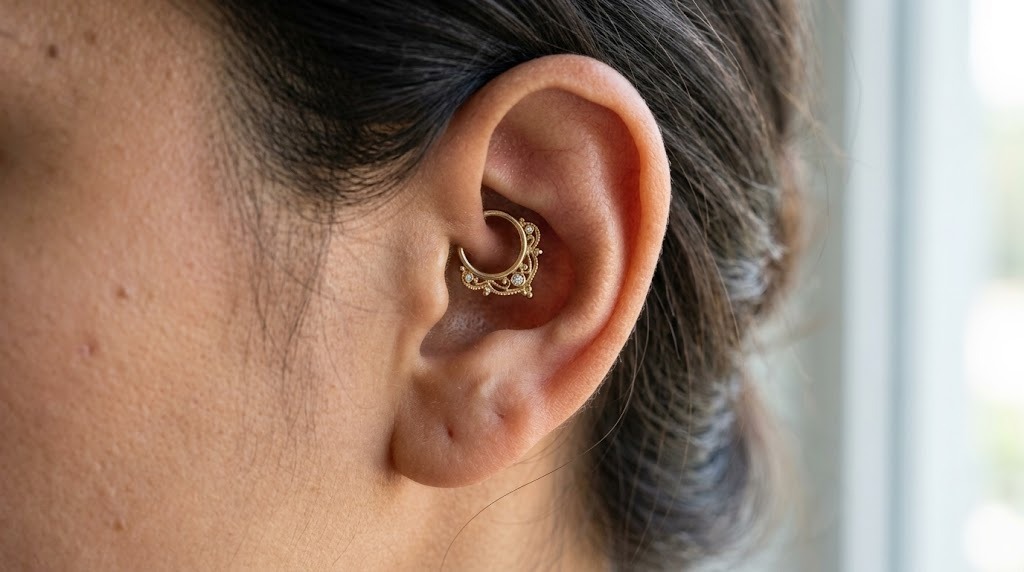
Most people who ask about a daith piercing have read that it helps migraines. So let us deal with that first, honestly, before anything else.
There is no good scientific evidence that a daith piercing treats migraines. The idea comes from a rough comparison to an acupuncture point in the inner ear. Some people genuinely report improvement afterwards. But the studies that exist are small, uncontrolled, and cannot separate a real effect from the placebo effect — which is unusually strong in migraine research.
Reputable medical sources, including migraine charities and neurologists, do not recommend it as a treatment. Plenty of studios in Gurgaon will happily sell you the migraine story. We would rather you heard the honest version and decided for yourself.
If you want a daith piercing in gurgaon because it looks good — and it does — that is a completely sound reason. This guide covers everything else. We are Vulture Tattoos, an appointment-only studio in Sector 47.
What a daith piercing actually is
The daith is the small fold of cartilage right above your ear canal — the innermost ridge, curving over the opening. A daith piercing passes through that fold, so the jewellery sits tucked into the ear rather than out on the rim.
That placement is why people like it. It is visible when someone looks at your ear, and almost invisible from the front or in a photo. It also sits differently from every other ear piercing, so it does not compete with lobes or a helix.
- Daith — the inner fold above the canal. This page.
- Helix — the outer upper rim. See our helix piercing guide.
- Tragus — the small flap in front of the canal. See our tragus piercing guide.
- Rook — the ridge above the daith.
- Conch — the flat inner bowl of the ear.
Not everyone’s anatomy suits it
This is the part that gets skipped, and it is the reason some daith piercings never heal properly.
The daith fold varies a lot between people. Some have a deep, well-defined ridge with plenty of room. Others have a shallow fold with very little tissue to work with. If there is not enough of a fold, a daith piercing will sit under constant tension, and constant tension means irritation, migration and a piercing that never settles.
A good piercer will look at your ear and tell you honestly if the anatomy does not suit it. Being told no is not bad service — it is the piercer saving you six months of a sore ear. If a studio agrees to any piercing without examining the ear first, that is a warning sign.
Does it hurt?
Straight answer: more than a lobe, less than people fear.
It is cartilage, and cartilage is denser than the soft tissue of a lobe, so the sensation is a firm, sharp pressure rather than a quick pinch. It lasts a couple of seconds. Many people describe a distinct pressure and a “crunch” feeling because the piercing is happening close to your ear canal — that sound is the part most people remember, more than the pain.
Because it is tucked inside the ear, the piercer needs a clear angle and steady hands. That takes a moment longer to set up than a lobe. The piercing itself is quick.
Our pain guide covers how placement affects sensation more generally.
Healing — plan for longer than you think
This is where daith piercings go wrong most often, because people treat it like a lobe.
Realistic healing time is 6 to 12 months. Not six weeks. Cartilage has a poor blood supply compared to soft tissue, so it repairs slowly, and the daith sits in a spot that is awkward to clean and easy to knock.
- Months 1–3: tender, possibly swollen, some crusting. Normal.
- Months 3–6: feels fine most days, but still healing internally. This is when people wrongly assume it is done and start changing jewellery.
- Months 6–12: fully settled.
Do not change the jewellery early. Changing a cartilage piercing before it has healed is the single most common cause of irritation bumps and a piercing that has to be abandoned.
Aftercare, and the Gurgaon-specific parts
- Sterile saline spray, twice a day. That is it. Spray, let it sit, pat dry with clean tissue.
- Do not touch or turn it. Twisting jewellery is old advice and it is wrong — it tears healing tissue.
- No alcohol, hydrogen peroxide or Dettol. These kill healing cells along with bacteria.
- Sleep on the other side. This is the hardest part for months. A travel pillow with the hole under your ear genuinely helps.
- Keep hair products, shampoo and conditioner away from it as much as you can. Rinse thoroughly.
- No pools, no sea, no hot tubs until fully healed.
Gurgaon specifics:
- Dust and pollution. Air quality here is genuinely a factor for an open wound near your face. Rinse with saline after a dusty commute.
- Sweat in summer. Salt and heat irritate healing cartilage. Rinse after the gym or a long day out.
- Helmets. If you ride, a helmet strap and padding press directly on the daith. This matters — plan for it, or delay the piercing until you can manage it.
- Face masks and earphones. Both loop around or press on the ear. Over-ear headphones are worse than earbuds for a daith.
Our piercing aftercare guide covers the routine in full.
Jewellery
- Clicker ring — the most popular for a daith. Sits neatly in the fold and is easy to open and close once healed.
- Curved barbell — often used for the initial piercing because it accommodates swelling better.
- Seamless or captive ring — a cleaner look, but harder to change yourself.
Material matters more than style. Implant-grade titanium is the standard for a fresh piercing — it is nickel-free and the least likely to cause a reaction. Avoid cheap mystery-metal jewellery entirely; nickel reactions are one of the main reasons cartilage piercings fail.
Wait until fully healed before switching to gold or anything decorative, and change it at the studio the first time rather than at home.
What can go wrong
Honest list.
- Irritation bumps. The most common issue. Usually caused by knocks, sleeping on it, or changing jewellery too early — not by infection. They resolve when the cause is removed.
- Infection. Less common than people think, but real. Increasing pain, heat, spreading redness, thick discharge or fever means see a doctor, not a piercer.
- Migration or rejection. More likely if the anatomy was marginal to begin with.
- Prolonged healing. Cartilage is slow. Patience is genuinely part of the treatment.
Do not remove the jewellery if you suspect an infection. Taking it out can trap the infection inside as the hole closes. Leave it in and see a doctor.
Why the piercer matters
A daith is a technically demanding piercing. The angle has to follow the natural fold, the piercer is working in a confined space close to the ear canal, and the placement decides whether the jewellery sits comfortably or presses against tissue for a year.
- Needle, never a gun. Piercing guns crush cartilage rather than making a clean hole. They should never be used above the lobe, and no reputable studio uses one for a daith.
- Single-use sterile needle, opened in front of you. Every time, without you having to ask.
- Anatomy checked first. Before any commitment.
- Implant-grade titanium for the initial jewellery.
Every piercing at our studio is done with single-use sterile equipment opened in front of you, in an appointment-only room. That is part of why our clients have left more than 270 five-star Google reviews. Our piercing studio guide for Gurgaon covers the standards you should expect anywhere.
Want to check whether your ear suits a daith? Call or WhatsApp us on +91 96676 14250 or message us on WhatsApp. It takes a minute to look and there is no obligation.
Why book in Sector 47
Vulture Tattoos is at Shop F-04, Spaze Boulevard, Malibu Towne, Sector 47, Gurugram. Easy to reach from across Gurgaon, DLF, Sohna Road, Golf Course Road and South Delhi.
Appointment-only means a clean, private room and one client at a time — and it means you can come back to have the jewellery changed properly when the time comes, rather than doing it yourself at home.
Book your daith piercing: call or WhatsApp +91 96676 14250. See our work on Instagram at @vulture_tattooz, or reach us through our contact page.
Frequently Asked Questions
Does a daith piercing help migraines?
There is no good scientific evidence that it does. The idea comes from a loose comparison with an acupuncture point, and the studies that exist are small and uncontrolled, so they cannot separate a real effect from placebo — which is unusually strong in migraine research. Some people report improvement genuinely. Medical bodies do not recommend it as a treatment. Get it because you like how it looks.
How much does a daith piercing hurt?
More than a lobe, less than most people fear. It is cartilage, so the sensation is a firm sharp pressure rather than a quick pinch, and it lasts a couple of seconds. What people remember most is the pressure and the crunch sound, because the piercing happens close to your ear canal.
How long does a daith piercing take to heal?
Six to twelve months. Not six weeks. Cartilage has a poor blood supply so it repairs slowly, and the daith sits somewhere awkward to clean and easy to knock. It will feel fine long before it is actually healed, which is exactly when people change the jewellery too early and cause an irritation bump.
Can everyone get a daith piercing?
No. The daith fold varies a lot between people, and a shallow fold does not give enough tissue to hold the jewellery without tension. A piercing under constant tension gets irritated, migrates and often has to be abandoned. A good piercer examines your ear first and will tell you honestly if it does not suit you.
When can I change the jewellery?
Not before six months, and preferably not until it is fully healed at around a year. Changing a cartilage piercing early is the single most common cause of irritation bumps. Have the first change done at the studio rather than at home — clicker rings are fiddly and forcing one can damage the healing channel.
What is the bump next to my daith piercing?
Usually an irritation bump rather than an infection. The common causes are knocking it, sleeping on that side, changing jewellery early, or a nickel reaction to cheap jewellery. It resolves once the cause is removed. Signs of actual infection are increasing pain, heat, spreading redness, thick discharge or fever — that means a doctor.
Can I wear earphones with a daith piercing?
Not comfortably while it heals. Over-ear headphones press directly on the area and are the worst option; earbuds sit in the canal and can still rub. If you need headphones daily for work, plan for that before booking, or expect a longer, more irritated heal.
How do I book?
Booking is by appointment. Call or WhatsApp +91 96676 14250. We look at your ear anatomy first and tell you honestly whether a daith suits you, then discuss jewellery and give you a clear price before anything is done.