Best Piercing Shop in Gurgaon: A Safe, Sterile, Needle-Only Guide (2026)
Choosing where to get pierced is not the same as choosing where to buy a coffee. A piercing is a small surgical wound placed through your skin or cartilage, and the studio you walk into decides whether that wound heals cleanly in a few weeks or turns into a months-long problem of swelling, bumps and infection. That is why finding the best piercing shop in Gurgaon is worth a little research rather than picking whichever place is nearest to the mall.
This guide is written by the piercing team at Vulture Tattoos in Sector 47, Gurugram. We will walk you through exactly how a safe, hygienic studio should operate, why the needle-versus-gun question matters more than almost anything else, what jewellery actually belongs in a fresh piercing, and what to expect from every popular piercing in terms of pain and healing. By the end you will be able to judge any studio in Gurgaon on facts, not just on how nice the reception looks.
What actually makes a piercing shop safe
Most people compare studios on price and Instagram photos. Neither tells you whether your piercing will heal. The things that genuinely matter happen at the tray, in the sterilisation room, and in the piercer’s technique. Here is what separates a professional body piercing studio from a place that will give you a rough experience.
- Needle, not gun: A safe studio pierces with a single-use, pre-sterilised hollow needle for every piercing, including ear lobes. Piercing guns cannot be properly sterilised and crush tissue rather than cutting cleanly.
- Single-use, opened in front of you: The needle and tools should come out of a sealed, sterile pouch that is torn open while you watch. If you did not see the seal break, assume nothing.
- Autoclave sterilisation: Any reusable tool must be cleaned in a medical-grade autoclave, which uses pressurised steam to kill everything, including spores. Ask if they have one.
- Implant-grade jewellery: Fresh piercings should only carry implant-grade titanium (ASTM F-136) or solid gold. Cheap alloys leak nickel and cause reactions.
- Clean technique: Fresh gloves, a wiped-down surface, marking with a single-use tool, and correct hand hygiene between steps.
- A piercer who says no: A good piercer will refuse anatomy that will not heal well rather than take your money and let you fail.
If a studio ticks all six of those boxes, you are in safe hands. If it fails even one, keep looking. At Vulture Tattoos we treat all six as non-negotiable, which is a large part of why we have crossed 270 five-star Google reviews from clients across Gurgaon.
Why the piercing gun is the wrong choice
This one point decides more infections and rejected piercings than anything else, so it deserves its own explanation. A piercing gun forces a blunt stud through your ear or nose using spring pressure. It does not cut the tissue, it tears and crushes a hole through it. That extra trauma means more swelling, longer healing and a higher chance of the piercing migrating or growing a bump.
The bigger problem is hygiene. Most guns are made of plastic and cannot go into an autoclave, so they cannot be truly sterilised between customers. A hollow needle is different. It is razor-sharp, used exactly once, and slices a clean channel that your body can heal around. Every reputable studio, including ours, uses needles only. If a place in Gurgaon still pierces with a gun, that alone tells you where they sit on safety.
The jewellery matters as much as the needle
You can get a flawless piercing and still end up with an angry, itchy, bumpy hole if the wrong metal is sitting in it. A fresh piercing is an open wound, and whatever you put in it is in direct contact with living tissue for months. This is where a lot of cheaper studios quietly cut corners.
The only materials that belong in a healing piercing are implant-grade titanium, solid 14k or 18k gold, or in some cases niobium. Implant-grade titanium is the gold standard because it is nickel-safe, extremely light, and the same material used in surgical implants. Avoid anything described vaguely as surgical steel, silver, or gold-plated for a fresh piercing, because these can release nickel and trigger contact reactions that look exactly like an infection.
Two other details separate a good studio from an average one. First, the jewellery should be threadless or internally threaded, meaning no screw threads drag through your wound when it goes in. Second, the piece should be the right length to allow for swelling, then downsized once healing settles. If you want to understand the full jewellery and setup we use, our body piercing in Gurgaon page goes into more detail.
Types of piercings, with honest pain and healing
Every piercing behaves differently. Below is a straight-talking breakdown of the piercings we do most often, with realistic pain levels and healing times. Pain is always personal, so treat these as a guide, not a promise. Healing times assume you actually follow aftercare.
Ear piercings
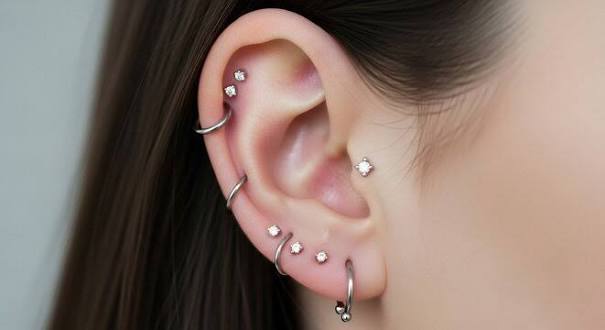
The ear is the most versatile area on the body, which is why ear work makes up most of what we do. You can build an entire curated look over several sessions.
- Ear lobe: The gentlest piercing there is, a quick pinch, healing in around 6 to 8 weeks. Still worth doing with a needle, not a gun.
- Helix (upper cartilage rim): A sharp, brief sting rather than deep pain. Cartilage is slower, so plan on 3 to 6 months, sometimes longer.
- Tragus: The small flap in front of the ear canal. More pressure than pain, healing in roughly 3 to 6 months.
- Conch: The large inner cartilage bowl. A firm, dull pressure, healing in 4 to 9 months.
- Daith: The inner fold of cartilage. Quick but intense for a second, healing in 4 to 9 months.
- Industrial: Two helix points joined by one bar. More involved and slower to settle, often 6 months or more, and it needs correct anatomy to heal straight.
If you are planning any ear work, our ear piercing in Gurgaon page explains placement and curation in more depth. A good piercer will look at your specific ear before recommending anything, because not every ear suits every placement.
Nose piercings
Nose piercings are hugely popular in Gurgaon and across India, both for style and for tradition. The two main options behave very differently.
- Nostril: A brief, watery-eyed sting that passes in a second. Because it goes through cartilage, honest healing is 4 to 6 months even though it feels settled sooner. Resist the urge to change the jewellery too early.
- Septum: Placed through the soft sweet spot between the nostrils, not the hard cartilage. When done correctly it is surprisingly quick and less painful than people expect, healing in 2 to 4 months.
The septum in particular is one where anatomy and placement decide everything. Done a millimetre off, it sits crooked and hurts. You can read more on our nose piercing in Gurgaon page.
Navel and body piercings
The navel, or belly, piercing is a classic body piercing that suits the right anatomy beautifully. It is a quick, pinching sensation, but it is a full body piercing that sits in a mobile area, so healing is a patient 6 to 12 months. Clothing friction and exercise both slow it down, which is why the jewellery choice and aftercare really matter here. We also do a range of other body and surface piercings by consultation, where we will assess your anatomy first and tell you honestly if it will heal well.
Booking is simple and appointment-only, so you get unhurried time on the chair. Call or WhatsApp us at +91 96676 14250 or message on WhatsApp to check availability and get a written quote at the consultation.
Aftercare: the part that decides your result
Here is the honest truth that a lot of studios do not stress enough. Your piercing is only about 20 percent technique and 80 percent aftercare. We can place a perfect piercing, but if you touch it with dirty hands and change the jewellery in week two, it will not heal well. The good news is that aftercare is genuinely simple when you keep it consistent.
- Clean with sterile saline: Spray or soak the piercing with sterile saline twice a day. That is all it needs. Skip antiseptic creams, Dettol, alcohol and hydrogen peroxide, which are too harsh and slow healing.
- Do not touch or twist: Never rotate the jewellery. Only touch the area with freshly washed hands, and only when cleaning.
- Leave the jewellery in: Do not swap jewellery until the piercing is fully healed. Changing early reopens the wound and invites bumps.
- Sleep clean: Use a fresh pillowcase and try not to sleep on a new ear or facial piercing. A travel pillow helps for ear work.
- Avoid pools and dirty water: No swimming pools, hot tubs or the sea until healed, as still and shared water carries bacteria.
- Watch, do not panic: Some redness and clear or pale crust is normal early on. Spreading heat, thick yellow-green discharge, or worsening pain after the first week means you should get it looked at.
We give every client written aftercare instructions and we are always happy to answer questions afterwards. You can also read our full piercing aftercare guide for Gurgaon any time you need a refresher.
A quick checklist to judge any Gurgaon studio
If you are comparing a few places, take this list with you. The right answers are easy for a professional studio to give and awkward for a poor one to dodge.
- Do you pierce with a single-use needle, not a gun? The answer must be needle.
- Will you open the sterile needle in front of me? It should be yes, every time.
- What jewellery goes in a fresh piercing? You want to hear implant-grade titanium or solid gold.
- Do you have an autoclave on site? A real studio does.
- Can I see reviews and healed work? Ask, and check the Google rating yourself.
- Will you assess my anatomy before piercing? A good piercer looks before they mark.
Any studio that gets defensive about these questions is telling you something. A confident, professional team will happily walk you through their setup, because they have nothing to hide.
Why Vulture Tattoos in Sector 47
We built our piercing studio in Sector 47 around one idea: treat every piercing as a small medical procedure and never cut corners on safety. Every piercing at Vulture Tattoos is done with a fresh, single-use sterile needle opened in front of you, using implant-grade jewellery, in a clean and calm appointment-only setting. That approach is why clients keep sending us their friends and family, and why we have earned 270+ five-star Google reviews.
Our studio at Shop F-04, Spaze Boulevard, Malibu Towne, Sector 47, Gurugram is easy to reach whether you are coming from Sohna Road, South City, DLF, or Golf Course Extension Road. Being appointment-only means you are not rushed and the space is prepared just for you. You will get honest advice on placement, a clear look at your jewellery options, and a written quote at the consultation with no surprises. If you want to see typical costs first, our piercing cost in Gurgaon page explains how quotes work.
Ready to book, or just have a question about a piercing you have been thinking about? Call or WhatsApp +91 96676 14250, message us on WhatsApp, or use our contact page. We are glad to help even if you are still deciding.
See our work and get in touch
The best way to get a feel for a piercing studio is to see its work and its standards, so have a look at our portfolio and healed piercings on Instagram at @vulture_tattooz, browse the full studio and service details on our website at vulturetattoos.com, and when you are ready to book simply call or WhatsApp us at +91 96676 14250 to lock in an appointment that suits you.
Frequently Asked Questions
Is needle piercing better than gun piercing?
Yes, clearly. A single-use needle slices a clean channel that heals faster and neater, while a gun crushes tissue and causes more trauma. Guns also cannot be properly sterilised because they are plastic. Every piercing we do uses a fresh, single-use needle.
How much does a piercing cost in Gurgaon?
Cost depends on the piercing and the jewellery you choose, so we do not quote a flat figure online. When you visit, we assess your anatomy, show you the jewellery options, and you get a clear written quote at the consultation before anything is done, with no hidden extras.
Does getting pierced hurt a lot?
Most piercings are a quick, sharp sensation that is over in a second rather than a lasting pain. Ear lobes and septums are very manageable, while cartilage piercings sting a little more. A calm, experienced piercer and a proper needle make a big difference to how comfortable it feels.
How long does a piercing take to heal?
It varies by location. Ear lobes heal in about 6 to 8 weeks, nostrils and most cartilage in 4 to 6 months or more, septums in 2 to 4 months, and navel piercings in 6 to 12 months. Cartilage and body piercings feel settled long before they are truly healed, so be patient with jewellery changes.
What jewellery is safest for a new piercing?
Implant-grade titanium is the safest all-round choice because it is nickel-safe, light and biocompatible. Solid 14k or 18k gold is also excellent. Avoid vague surgical steel, silver, or gold-plated pieces in a fresh piercing, as these can cause nickel reactions that look like infections.
Do you pierce children’s ears?
We take ear piercing seriously for younger clients and handle it case by case with a gentle, needle-based approach and a calm environment. The best thing to do is call or WhatsApp us at +91 96676 14250 so we can talk through age, comfort and aftercare before you visit.
Do I need an appointment?
Yes, we work appointment-only so that the studio is fully prepared and you are never rushed on the chair. Just call or WhatsApp +91 96676 14250 to check availability and book a slot that works for you.
How do I know your studio is hygienic?
Everything is visible. We open a sealed, single-use sterile needle in front of you, use fresh gloves, sterilise reusable tools in a medical-grade autoclave, and only fit implant-grade jewellery. You are welcome to ask about any step, and our 270+ five-star Google reviews reflect that standard.