Bhagavad Gita Tattoo Designs: Choosing a Shloka and Getting It Exact
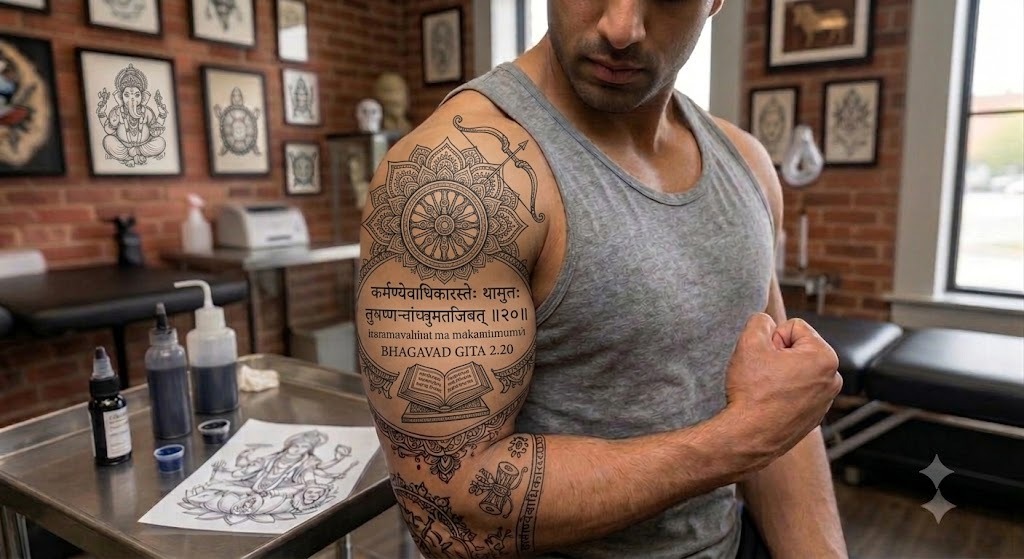
A Bhagavad Gita tattoo is a promise you are making to reread something on your own arm for the rest of your life. That is different from most devotional tattoos, which are symbols you look at. A shloka is text you are meant to actually read, understand and be reminded by — which means the exact wording, and getting it exactly right, matters here more than almost anywhere else in devotional work.
If you are looking at bhagavad gita tattoo designs, this guide covers the verses people choose most, what they mean, and the specific accuracy checks that matter for Sanskrit shlokas rather than single-word Devanagari. We are Vulture Tattoos, an appointment-only studio in Sector 47, Gurgaon.
Popular shlokas, and what they mean
- कर्मण्येवाधिकारस्ते मा फलेषु कदाचन (Chapter 2, Verse 47) — “You have a right to your actions, but never to the fruits of your actions.” The most requested Gita tattoo by a wide margin. About doing the work without attachment to the outcome, chosen constantly by people beginning a new venture, a difficult project or a period of uncertainty.
- यदा यदा हि धर्मस्य ग्लानिर्भवति भारत (Chapter 4, Verse 7) — the verse about Krishna incarnating whenever dharma declines. Often chosen alongside a Krishna or Vishnu piece — see our Radha Krishna tattoo designs guide and Vishnu tattoo designs guide.
- नैनं छिन्दन्ति शस्त्राणि नैनं दहति पावकः (Chapter 2, Verse 23) — on the indestructibility of the soul, that weapons cannot cut it and fire cannot burn it. Frequently chosen as a memorial tattoo.
- परित्राणाय साधूनां विनाशाय च दुष्कृताम् (Chapter 4, Verse 8) — on protecting the righteous and destroying wrongdoing, continuing the incarnation verse above.
- अहम् आत्मा गुडाकेश सर्वभूताशयस्थितः (Chapter 10, Verse 20) — Krishna declaring he is the self seated in the heart of all beings, a verse about the divine present within everyone.
If none of these are the specific verse that matters to you, bring your own — the accuracy process below applies to any shloka you choose.
Why a shloka is not the same challenge as a single word
We have written extensively about Devanagari accuracy for names and short phrases in our script tattoo guide. A full shloka raises the stakes considerably, for reasons specific to Sanskrit verse.
- Sandhi, the way sounds merge between words in Sanskrit, changes how a verse is actually written. A shloka copied word-by-word from a translation without understanding sandhi will often be spelled wrong, even if each individual word looks correct.
- Diacritics and specific characters matter enormously. Sanskrit uses several sounds and marks that do not appear in everyday Hindi, and getting these slightly wrong changes the actual pronunciation and meaning of the verse.
- Line breaks are not arbitrary. Traditional shloka formatting follows the metre of the verse. Breaking a line in the wrong place, purely for how it fits your arm, can look odd to anyone who knows the text.
- A single missed or added matra changes a word. The same rule as any Devanagari, but with a full sentence, there are simply more opportunities for a small error to slip through unnoticed.
How we verify a shloka before it becomes a stencil
- You provide the exact source. The chapter and verse number, ideally from a printed or well-regarded digital edition of the Gita rather than a screenshot forwarded from elsewhere.
- We cross-check against the standard published text. Not a translation app, and not a single online source alone.
- If you have someone who reads Sanskrit — a family member, a priest, a teacher — have them look at the final text before your appointment. This is the single best verification step available, and we genuinely encourage it.
- You read the stencil on your skin before we start. Slowly, character by character, in the mirror. It costs nothing and it is your last checkpoint.
We would rather delay a session by a week than tattoo an unverified shloka. A Gita verse is not the place to move fast.
Design ideas beyond plain text
- The shloka alone, clean linework. The most common and often the most powerful choice — the text carries its own weight without needing decoration.
- Verse with a small Krishna symbol. A peacock feather or a small flute alongside the text, connecting the words to their speaker.
- Verse curved along a placement’s natural line. Following the spine, the collarbone or the forearm’s length rather than sitting in a rigid block — see our spine tattoo guide and collarbone tattoo guide.
- Verse in a circular or ornamental arrangement. Wrapped as a band or arranged in a ring — see our armband tattoo designs guide for how text works within a wrapped design.
- Single line or half-shloka. If the full verse is too long for your intended placement, a well-chosen half line, agreed with someone who understands the metre, is a more honest choice than cramming the whole thing too small.
Length and sizing — the practical constraint
A full shloka is two lines of Sanskrit text, and Devanagari needs more vertical room than Roman script of the same length because the matras above and below the consonants need clearance. This is the single biggest practical decision in this tattoo.
- Give it real length. A shloka wants a forearm, spine or ribcage rather than a small wrist space.
- Do not shrink to fit. If your chosen placement genuinely cannot hold the full verse legibly, choose a shorter line rather than cramping the whole shloka.
- Confident stroke weight, not hairline. Text this significant deserves lines that will still be readable in twenty years.
Does it hurt?
The same as any tattoo of that size in that place — text does not change the sensation. Outer forearm and upper arm are the most comfortable placements for a shloka. Ribs, spine and collarbone are sharper. A single line is a moderate session; a full two-line shloka with generous spacing takes longer. Our tattoo pain chart covers every placement.
Want to talk through your shloka before booking? Call or WhatsApp us on +91 96676 14250 or message us on WhatsApp. Send the exact text and source and we will begin verifying it.
Healing and aftercare in Gurgaon
- Keep the wrap on as long as your artist says, then wash gently with lukewarm water and mild fragrance-free soap.
- Pat dry, do not rub. Rubbing fresh linework pulls pigment out of thin strokes.
- Thin layer of balm. Thin is the word.
- Do not pick or scratch. A gap in a shloka’s script is very visible and awkward to correct cleanly.
- No swimming, sauna, gym sweat or soaking for two to three weeks.
- Keep it moisturised well past the peeling stage.
Forearm and spine placements catch Gurgaon sun and daily friction, and UV softens fine linework faster than anything else. Once healed, use SPF 30 or higher every time it is exposed. Our full tattoo aftercare guide for Gurgaon covers each stage.
Why the artist matters
There is no shading to hide behind on a shloka. Every stroke of every character is visible, and consistency across a full two-line verse — spacing, weight, the continuous shirorekha across each line — is what separates a shloka that reads correctly for decades from one that closes up.
Ronny specialises in fine-line, botanical, script and geometric work, which makes Devanagari lettering and Sanskrit shlokas exactly his territory. Our page on the tattoo artists in Gurgaon introduces the team.
Every tattoo is done with single-use sterile needles opened in front of you, in an appointment-only studio. That is part of why our clients have left more than 270 five-star Google reviews.
How it works with us
- Send us the exact shloka and source before your consultation, on WhatsApp, so verification can begin early.
- Consultation. We confirm the text, discuss placement and length, and talk through design options beyond plain text if you want them.
- Design. Laid out to follow your placement’s natural line, sized so the matras and spacing survive the decades. You see it before any needle touches you.
- A written quote at consultation. Clear, before anything begins. Our tattoo cost guide for Gurgaon explains what shapes it.
- Aftercare. A clear plan, and we are on WhatsApp while it heals.
Why book in Sector 47
Vulture Tattoos sits at Shop F-04, Spaze Boulevard, Malibu Towne, Sector 47, Gurugram, easy to reach from across Gurgaon, DLF, Sohna Road, Golf Course Road and South Delhi. Appointment-only means the studio is quiet and unhurried, exactly what a verse this significant deserves rather than being rushed between walk-ins.
Book your Bhagavad Gita tattoo: call or WhatsApp +91 96676 14250 to start with a consultation.
See our work
Line consistency across a full verse is what to judge, and it needs to be seen. Browse our recent pieces on Instagram at @vulture_tattooz, read more about the studio at Vulture Tattoos, or reach out through our contact page. When you are ready, call or WhatsApp +91 96676 14250 and we will plan bhagavad gita tattoo designs that read correctly for life.
Frequently Asked Questions
What is the most popular Bhagavad Gita tattoo verse?
कर्मण्येवाधिकारस्ते मा फलेषु कदाचन, from Chapter 2, Verse 47 — “you have a right to your actions, but never to the fruits of your actions.” It is by far the most requested, chosen constantly by people starting something new or working through a period of uncertainty, because it is about doing the work without attachment to the outcome.
Why is a shloka harder to get right than a name in Sanskrit?
Sandhi, the way sounds merge between Sanskrit words, changes the actual written form of a verse in ways that copying word-by-word from a translation will not capture. Diacritics matter more, line breaks follow the verse’s metre rather than being arbitrary, and a full sentence simply has more places for a small error to hide than a single word or name does.
How do you verify a shloka before tattooing it?
We cross-check the exact text against a standard published edition of the Gita, not a translation app or a single online source. We strongly encourage having someone who reads Sanskrit — family, a priest, a teacher — look at the final text before your appointment, and you read the stencil on your own skin, character by character, before we start.
Can I get just half a shloka if the full verse is too long?
Yes, and it is often the more honest choice than shrinking the full two lines to fit a small placement. A well-chosen partial line, confirmed with someone who understands the verse’s structure, reads correctly and ages better than a cramped full shloka squeezed into too small a space.
Where is the best placement for a Gita verse?
The inner or outer forearm for most people — flat, visible, room for the text to breathe. The spine and ribcage also suit a longer verse well, following the body’s natural vertical line. A shorter single line can work on the collarbone. Avoid the wrist or small placements for a full two-line shloka.
Do I need to understand Sanskrit to get a shloka tattoo?
No, but you should understand the meaning of the specific verse you choose, in whichever language makes sense to you. Knowing what you are carrying, rather than choosing purely on how the script looks, is what makes the tattoo genuinely yours rather than decoration.
Can I combine a shloka with a Krishna or Vishnu image?
Yes, and it is a natural pairing, particularly for verses spoken by Krishna in the Gita. A small peacock feather, flute, or Vishnu symbol alongside the text connects the words to their speaker without needing a full portrait. See our Radha Krishna and Vishnu tattoo guides for those elements individually.
How do I book and how much will it cost?
Send us your exact shloka and its source on WhatsApp to +91 96676 14250 so we can begin verifying it, then we arrange a consultation to discuss placement, length and design. We give you a clear written quote once the details are settled. Pricing depends on size, detail and time.